Showing posts with label activation unit. Show all posts

Saturday, August 4, 2018

Activated Carbon For Gold and Silver Industries

Initially wood charcoal with a surface area around 200 m2 /gram was used to extract gold and silver from the solution. As the development of the activated carbon having a surface area of  1,000 m2 / gram is used for that, of course, also with the increasing efficiency of the extraction. It encourages the production of activated carbon throughout the world. Coconut shell is the favorite material for active charcoal production today, and palm kernel shell is likely to be the next priority.
Activated carbon has a large surface area because of the large number of pores from its surface. The pores are intentionally made to improve the efficiency of adsorption. The more pores are formed the more activated carbon surface area. Based on the size of these pores are divided into macropore, mesopore and micropore. Macropore is the largest pore size located on the outer side or surface of activated carbon and as the entrance material will be adsorbed then through mesopore medium to last to the micropore. Micropore is the last terminal of material that is adsorbed. Micropore pore size ranges from 10 angstrom, mesopore 100-1000 angstrom and macropore larger 1000 angstrom (1 angstrom = 1e-10 meter). The raw material or activated carbon material, the choice of activation process used and the operating conditions that will determine the surface area of activated carbon consisting of macropore, mesopore and micropore. Hardness and density of materials are also often important considerations given the use of activated carbon itself, for example a number of extractions are carried out by stirring and there are also column operations.
The specific use of activated carbon for the application of certain materials or industries usually also requires certain specifications. Activated carbon used in fluid fluids will be optimal when specially designed under these conditions, as well as those used in gas fluids. The size of the target material and its extraction methods will determine the technical specifications of the activated carbon. Likewise in gold and silver, which extraction with stirring and column operations. So the raw material of coconut shell is generally still the main choice because it has a high level of hardness and density so that abrasion resistance. And so too the palm kernel shells can also be used given the high level of its hardness. So the activated carbon used must meet the criteria of quite hard, active enough and appropriate particle size. In the gold extraction activated carbon gold produced by the activation of physics (steam activation) is used. Rotary kiln is an activation equipment with raw materials such as coconut shell, while fluidized bed appliance and multi hearth kiln are commonly used for activated carbon from coal.
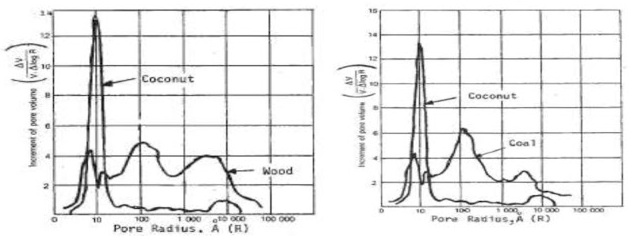
Activated carbon basically can be made from various materials that contain carbon (carbonaceous material) such as coal, coconut shell, palm kernel shell, wood, bamboo, heavy oil and even bone. Each material, type of activation and operating conditions of the process determines the quality or characteristics of activated carbon. Activated carbon from coconut shell has many micropore, while activated carbon from wood is dominated mesopore and macropore (micropore only has small portion) because wooden structure also more open. For activated carbon from coal micropore distribution, mesopore and macropore are almost evenly distributed. Based on the above characteristics, activated carbon coconut shell is widely used to adsorb small molecules of gas and liquid. Its uses such as gas masks, solvent recovery and gold recovery. While activated carbon from wood for the application of large molecules such as adsorbing organic dyes in the industry. While activated carbon from coal for the adsorption of organic molecules with varying sizes and their use is generally for drinking (potable) water treatment and wastewater treatment.

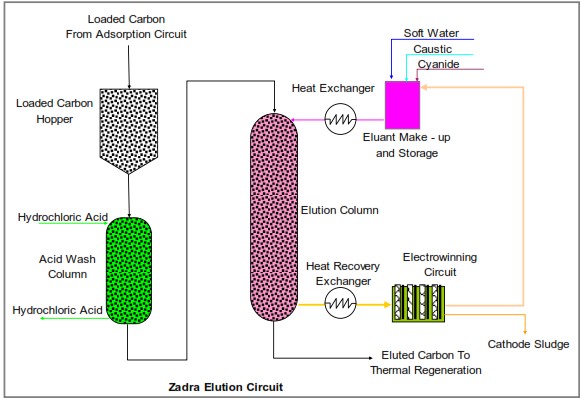
After gold or silver is adsorbed into the pores of activated carbon, the next step is to pick or remove (delution) from activated carbon. There are 2 technologies commonly used for this stage namely AARL elution process and Zadra elution process. The difference between electrowinning is an integral part of the Zadra circuit but a separate part of the AARL circuit. Zadra dominates in North America while AARL dominates in Southern Hemisphere, where the technology was originally developed. Which is the best? Operators factor and device performance more decisive. The 10 largest gold producers today include China, Australia, the United States, Russia, South Africa, Peru, Canada, Ghana, Indonesia and Uzbekistan.

Tuesday, May 22, 2018

Activated Carbon For Any Industries!

Activated carbon or activated charcoal is a material that is widely used in various industries, as auxiliary processing. Food, beverage, energy, mining and pharmaceutical industries use this activated carbon. The need for activated carbon also continues to increase so that production also needs to be expanded. Indonesia has great potential as a world class activated carbon producer considering the abundance of potential raw materials available.

Currently, large activated carbon producers are located outside Indonesia such as Europe and America. Yet neither Europe nor America have abundant source of raw materials or most imports including from Indonesia. The most favorite activated carbon feedstock today is coconut shell and once again Indonesia is the country with the largest coconut plantation in the world, which is about 3.7 million hectares. Palm kernel shells can also be the raw material of further choices. With a palm oil plantation area of approximately 12 million hectares, palm kernel shells produced more than 10 million tons / year.
The raw material of activated carbon is charcoal. The charcoal is then activated to become activated carbon. The process of making charcoal is by carbonization or pyrolysis. Coconut shell as an example of raw material of charcoal, then after carbonization the coconut shell convert into coconut shell charcoal, which then this charcoal become the raw material of activated charcoal. So basically the process of activated charcoal production is through 2 stages of the process namely pyrolysis (carbonization) and activation. The process of producing the charcoal or the carbonization process (pyrolysis) is the same as the biomass carbonization process in general, for more detail can be read here. Currently in large capacity the production of charcoal is carried out continuously with indirect-heating. Rotating kilns and heated auger pyrolyser are commonly used equipment for continuous production of charcoal. Continuous integration of charcoal production and activation process can be read here.
While the activation phase can be done in two ways namely the activation of physics and chemistry. The choice of activation depends on the target surface area, pore distribution and economy. Steam activation is the most widely used physics activation, whereas chemical activation is very diverse. The more surface area of activated carbon the more expensive the price is also proportional to the cost of production. Activation equipment commonly used there are 2 kinds namely, rotating kilns and fluidized bed. Of these 2 types of rotating kiln equipment is more widely used than the fluidized bed. The price of rotating kiln equipment is cheaper because the construction and operation are easier than the fluidized bed system. Fluidized bed systems are typically used for higher quality activated carbon production due to better distribution and pore engineering due to fluidization.
Standard and quality of activated carbon is determined primarily by surface area, pore distribution, size and hardness. The iodine number parameter is commonly used for the quality of activated carbon. The higher the iodine number the better the activated carbon quality. The iodine number is a number indicating how much adsorbent or activated carbon can adsorb iod. The greater the iodine value, the greater the adsorption power of the adsorbent or the activated charcoal. Conversely, the higher water content and ash content contained in the activated carbon will cause many pores to be covered by the impurities so that the surface area will be smaller. Where the surface area is closely related to the activated carbon adsorption capacity.All biomass basically can be used as an activated carbon raw material because it has a carbon content. Specific application of the activated charbon that determines the choice of raw material and its activation options.

Thursday, February 16, 2017

Activated Carbon Production From Coconut Shell and Palm Kernel Shell


Magnification of the surface area due to the increasing number of micro pores that have great adsoroption ability is the main purpose of the production of activated carbon. Characteristics of the pores and even then vary depending on the application or use of activated carbon as an example the pores of the activated carbon used in the liquid, will be different which is used in gas substances. Characteristics of the pores can be designed and made during the production process. Basically the manufacture of activated carbon will involve high temperatures and adjuvant activating that can be a steam, CO2 or chemical, depending on the characteristics of activated carbon, or more specifically in the pores of activated carbon are generally calculated  by its surface area of the activated carbon. Additionally hardness of activated carbon is also other important quality factors of the activated carbon. This article is a continuation of my previous article about the production of charcoal from coconut shell and palm kernel shell continuously. Alhamdulillah can be done writing.


Activated charcoal production requires charcoal as raw material. The charcoal can be produced in both traditional and modern process. Charcoal quality will affect the quality of the final product of activated carboon. Modern charcoal production continuously be able to make the whole process of the activated carbon production becomes efficient when both are integrated into one. In the process of making charcoal which usually need to be cooled beforehand so into charcoal, then it can not be done when the production of charcoal continuously. Results of carbonization directly into the activation unit with only slightly raise its temperature, ie, if the carbonization ranging from 600 C and the activation of about 900 C. When using raw charcoal from the traditional process as a raw material, it takes far more energy to achieve the activation temperature of about 900 C.


Once out of the activation process, the active carbon is cooled by removing a number of considerable heat. Heat is released in large enough quantities can be used for drying coconut shell or palm kernel shell, giving it a special process of carbonization become more efficient as well as a whole with the activation. Activation adjuvant to be inserted in the activation process is well regulated its operating conditions of temperature, pressure and residence time to get the quality and quantity of activated carbon desired. In the activation condition, likened charcoal is material be punched by the activation of materials at high heat. There are many variants of activated carbon can be designed specifically for their intended use, so that the operating conditions and auxiliaries activation there are also variations.
The use of activated carbon, especially in the food industry (food) including beverages and pharmaceuticals, precious metals refinery (favor) and the oil and gas industry. Once the extent and magnitude of this use of activated charcoal so it is a great opportunity also for Indonesia, which has the best raw materials are also the largest quantity in the world of coconut shell and palm kernel shell. Will this also would be ignored? It should not. InsyaAllah

Biomass Boiler Testing and Selection of Suitable Biomass Fuel

In line with the trends toward decarbonization and sustainability across various sectors of life, particularly in the processing industries ...