
Showing posts with label binderless biomass briquette. Show all posts

Thursday, March 8, 2018

Biomass Densification: Cocopeat Become Cocopeat Block

Biomass densification technology is not only used for energy sectors such as the popular today, namely pellets and briquettes, but also other sectors. Densification of cocopeat or cocodust into block or briquette was the main use not for energy, but for the planting media or agriculture. Cocopeat block is basically also briquette, because its size is bigger than pellet. With cocopeat that has the ability to hold high water and also fertilizer, so its use can be a solution to food problems. A good planting medium will produce good plant growth as well as the harvest. The less fertile land can be repaired with the cocopeat.
Cocopeat block with the cube shape, then all compaction or briquetting technology can be used to manufacture the cocopeat block. The production process of cocopeat block is also the same as wood pellet and wood briquette. In general, the size of cocopeat block is quite large, such as 20x20x20 cm, so most use hydraulic type press machine. When using a screw press machine and piston, the size of the press machine becomes big, expensive and difficult operation. This hydraulic type press machine is the most economical compared to the screw press machine and piston press machine, although it works in batch. Construction of hydraulic machines is also simpler compared to the other two types of press machines. For more details about the compaction technology can be read here.
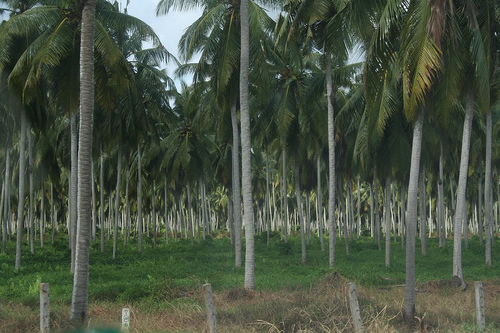

With an area of coconut plantations owned by Indonesia reached 3.7 million hectares, the potential of cocopeat is also very large. Cocopeat is produced from the production of cocofiber or is the waste of cocofiber production. Currently the utilization of coconut husk is also not optimal. After the coconut is peeled or separated from its husk, it is usually only stacked until it is dry, and used as fuel. The utilization of its husk for the production of cocofiber and cocopeat will give added value more economically attractive. Cocofiber itself is also an export commodity with the use of raw materials for rubber fiber, mats, carpets, and industrial products / household handicrafts. Mats and rubber fibers are widely used in the industry of seats, mattresses and hot coatings (insulators).
As a planting medium that can hold water very high up to 73%, then excess water can be fatal to the plant. In practice, planting media does not use 100% cocopeat but with other media such as sand and charcoal (biochar). In the use of cocopeat block is also destroyed or crushed again so that it can be used to be the planting medium. Making cocopeat block will save the transport, facilitate handling and facilitate the packaging so that can be sent long distance or export economically. The use of coconut with charcoal (biochar) will be a high quality planting medium, because it can hold enough water, become the favorite homes of soil microbes to fertilize the soil and save the use of fertilizer significantly.

Thursday, December 14, 2017

Rice Husk Briquette Easy, Quick And Abundant Raw Materials

In fact, Indonesia is currently a net importer of petroleum because the production capacity is not sufficient to the existing needs. In the 1980s our oil production was around 1,700 barrels per day (BPD), while the need for consumption was only about 400 BPD. While the current level of production range of 800s BPH while consumption needs can reach 1400an BPD. This should encourage the use of various renewable energies. Moreover, the problem of energy sovereignty is also an important thing for the existence of a country. If the energy source is easy and cheap is available and easy also in its utilization would be a choice. The rice husk briquette (although the type of solid fuel but also one of the solutions, because our staple food from rice that produces waste rice husk. Rice husks that initially have a density of about 125 kg / m3 can be 1200 kg / m3 or nearly twice as dense than hardwood stems and also much denser than wood pellets ranging from 650 kg / m3 when briquetted. By being briquetted into cost-effective transportation is also easy to use.
Indonesia's paddy production in 2008 was 59.9 million tons of dried unhulled rice (GKG= Gabah Kering Giling), with an average rice husk percentage of 25% / ton of rice, 15 million tons / year. Indonesia is also the largest importer of three largest rice importers in the world according to IndexMundi in 2014 which reached 1.5 million tons. While China ranks first with 3 million tons, and Nigeria 2.4 million tons. Food self-sufficiency that is rice or rice is also no less important thing. If rice self-sufficiency by increasing production of 1.5 million tons of rice husk waste generated also a lot of rice husk briquette production can also be increased.


The process of production of rice husk briquettes is also easy especially compared to sawdust briquette briquettes. This is because the rice husks do not need to dry and the raw materials are homogeneous, so that after being accommodated temporarily in the silo or bin can be directly distributed to the screw extruder to be briquetted. With 17-19% lignin content of rice husks no additional adhesive (binder) is required on rice husk briquetting. The briquettes are subsequently cooled and subsequently packaged to be shipped or marketed to the user. Drying process in addition to increasing production costs also need investment in the form of drying equipment itself which generally use rotary dryer (drum dryer).

The use of rice husk briquette is also the same as sawdust briquette briquette for fuel. Industries can use the briquettes as heat sources such as cooking and steam production with boilers. Compared to sawdust briquettes, rice husk briquettes have lower calorific value of around 3500 kcal / kg and also high ash content of about 20%, so the type of static grate combustor  does not match, because the amount of ash that makes pores grate becomes clogged. While the grill moving grate (chain grate) suitable for briquettes husk rice. Rice husk ash contains a lot of potassium or K is very well returned to the soil as a fertilizer. Silica can also extract ash rice husk briquettes because it is also quite high content.
Another application is to coat the molten steel at the steel plant to increase the carbon content in the steel, but in the form of rice husk charcoal. For that the rice husk briquettes then carbonized for making rice husk briquette charcoal. The carbonization of rice husk briquettes can be done in specially designed furnace with each furnace typically able to accommodate about 2.5 tonnes of rice husk briquettes and a 20% conversion rate to charcoal with a time span of 10-14 days. If at present charcoal is not briquetted and shipped or sent it to steel mills, the transportation becomes problem because inefficient, so the briquetting is the solution. In addition, of course, rice husk briquette charcoal  is also able to roast meat, and fish as well as sawdust charcoal briquette.

InshaAllah we can supply rice husk briquettes machineries including its carbonization furnace (if needed). For those interested please please send an email to eko.sbs@gmail.com

Tuesday, November 8, 2016

Wood Shaving Processing: When Size Being Problems


Wood shaving of barecore mill has a particle size that is big enough but has a small moisture content (MC = 4-6%) or dried. In addition in the form of waste-sawdust shavings also has a low bulk density, at around 150 kg / m3 or about half of sawdust. Densification technology (compaction) suitable for processing the waste. Briquettes and pellets are the two densification technology products are very popular today.

Wood shaving characteristics as mentioned above make some adjustments need to be used directly on the densification technology. The advantage of the dry shaving wood so it does not require longer drying with a dryer (dryer), even as it is too dry so even need water/moisture level is lowered (wetted). While on the other hand because of the small particle size and density, making it hard for densification (compaction) for densification of some densification equipment  that require these materials get into the small diel eg wood pellets or wood briquette type of screw (extruder).

In many cases the wood shaving can be used to manufacture wood pellets or wood briquette (type screw extruder) directly by use waste of barecore that form of wood shaving is used as a mixture (mixed material) with the limited percentage , for example, 10% of wood shaving and 90% sawdust. The densification equipments can run that because the average particle size of the raw material is accepted in the tolerance range of densification technology with small die size.
Hydraulic Press type briquette
Specifically on high pressure briquetting is known three groups of technologies that are currently used, namely:
1. Screw press (Extruder)
2. Piston / ram mechanical press
3. Piston hydraulic press

In piston / ram mechanical technology and piston hydraulic press, wood shaving can be press directly into briquettes and without any additional sawdust or 100% of the wood shaving (single material). This is because the equipment does not encourage the raw materials into the small size of die, but the raw materials are simply filling a particular room and then compacted. While the briquette type of screw (extruder) raw materials pushed and pressed at the same time / simultaneous and entered the mold (die) with small size, so the big size of the particle and low density of raw materials that make the briquette failed to form. In briquetting equipment with type screw (extruder) if it will use 100% wood shaving it needs some modifications from the standard machine so that it can adapt to the characteristics of the wood shaving. Comparison between piston with screw-type briquettes can also be read here.

In the end,the quality or briquette product specifications requested by buyers (market) and manufacturing costs of the use of the densification technologies will be the driving factor of the wood shaving processing business. The mindset of waste management is the early stage is how to cope with such waste, which does not disturb the environment and so while the next stage how such waste can also take advantage or financial profit.

Sunday, January 26, 2014

EFB Briquetting For Bioenergy And Other Purposes

Solid waste such as Empty Fruit Bunch-EFB numbers are very abundant in palm oil mills and to this day are generally not processed moreover utilized optimally.  EFB waste is generally just dumped somewhere and left to decompose naturally through biological processes. Some places have used it as mulch or as an organic fertilizer. But compared to the amount produced, processed EFB are few in number and little added value. The biological processes are also running slow so it takes a big investment to process all EFB waste every day when will use the process. Eco-friendly palm oil mills and "zero waste" certainly impossible achieved.


As energy needs continue to increase every time the diversification of energy becomes important and should be done. These shorter process and results can be used immediately would be an option for the EFB waste processing. Desification technology of biomass into briquette is an attractive option to implement. Briquetting is the shortest route to process the EFB commercially. Process variables such as the size of the briquettes, moisture content, particle size, ash content and plant investment looser than pelleting make it the quickest route of the EFB waste processing. While the briquettes usage  is not a massive pellets but also very large needs. A number of companies producing briquettes, and briquettes are used itself to produce electricity by gasification, pyrolysis and direct combustion technology. Gasification, pyrolysis and direct combustion technology also requires the size and shape of certain raw materials to get optimal performance.


Make the sustainable palm oil business from upstream to downstream is the desire of almost all palm oil businessman. When the palm oil plantation land in need of nutrients that can be supplied from the palm plant itself (EFB for example) but when taken out without anything coming into the soil will also interfere with the palm oil plantation soil fertility in the long term. So it need a good strategy to achieve a sustainable palm oil business. Briquetting is basically the biomass densification that will save transport to its user so that when the briquettes EFB if you want to use as compost can also be parsed again with biological processes to put into the ground so that the balance of soil fertility can be maintained.

Biochar, Soil Health, and the Sustainability of Palm Oil Productivity

Healthy soil is invariably fertile, but fertile soil is not necessarily healthy. Healthy soil teems with life—such as earthworms and other o...