Showing posts with label biomass densification. Show all posts

Wednesday, March 4, 2026

Processing Palm Oil Trunk Waste for OPT Dust Block Production

Basically, there are many options for processing oil palm trunk waste from palm replanting programs. Small to medium to large capacity processing industries can be created depending on how big the market needs and raw material capacity are. Simple technology to advanced technology can also be applied to this industry. One option for processing oil palm oil trunk waste is the production of OPT dust blocks. OPT dust block is a group of biomaterial products used specifically as animal bedding. Livestock such as cows and horses need animal bedding, especially in winter.

Why is animal bedding for cows and horses suitable for the OPT dust block? The material characteristics of oil palm trunks which have the ability to absorb water quickly are an important factor. Production of OPT dust blocks as a compaction technology (biomass densification) is also not difficult, just like making cocopeat blocks. Compared to cocopeat block which is also superior in water absorption but because the price is much more expensive, OPT dust block is more of an option. Apart from that, cocopeat blocks are generally used as a planting medium.

The volume or production capacity of OPT dust blocks will also not be as high as for energy or fuel needs, for example if oil palm oil trunk waste is processed into pellets (OPT pellets) and as fuel for power plants, read more details here. However, as a solution for utilizing oil palm oil trunk waste so that it is not left alone and polluting the land, of course the production of OPT dust blocks can be an effective solution. The market niche in the livestock sector with animal bedding applications can also continue to increase along with the development of the livestock sector. And as a business that can provide financial benefits and also as a solution to environmental problems, of course this is very interesting and needs to be considered. 

Sunday, June 1, 2025

Empty Fruit Bunch of Palm Oil Processing: for Pellets, Briquettes or Biochar ?

Empty fruit bunches (EFB) are solid waste from palm oil mills or CPO production which is the largest in number. This is what makes many machine manufacturers make these EFB processing machines. Most of the machines made are equipments for cutting and pressing the EFB so that the water content decreases and the size becomes smaller. However, both the water content and the size of the EFB as the output of the machine or equipment still do not meet the requirements to be further processed into pellets, briquettes or even biochar. The typical output is more than 4 inches and the water content is more than 45%. EFB must have a low water content of 10% and a size of 5-6 mm to be able to make pellets or briquettes, and less than 1 inch for biochar production.

To obtain suitable raw materials for pellet, briquette and biochar production, the EFB that has been cut and pressed still needs to be reduced in size (size reduction) and its water content reduced to about 1/3 so that it is dry enough. Equipments such as a hammer mill or crusher is needed to reduce the size and a drying tool such as a rotary dryer is needed to reduce the water content. The smaller the size of the material (particle size) and the lower the water content or the drier it is, the more energy is needed. Equipment such as hammer mills and rotary dryers have not become an integral part of EFB processing at this time. However, usually EFB palm oil processing producers also produce press equipments for kernels for the production of kernel oil or PKO in kernel processing plants or KCP (kernel crushing plants) with by-products in the form of palm kernel meal or PKE (palm kernel expeller). 

Considerations for selecting pellet, briquette or biochar production from EFB palm oil depend heavily on the readiness of the business. It is estimated that there are 30 million tons per year of dry EFB palm oil in Indonesia and 10 million tons per year of dry EFB palm oil in Malaysia for raw materials for these products. The use of EFB palm oil waste, in addition to being a solution to waste problems in palm oil mills, will also provide additional benefits for the palm oil mill or company. How much profit is usually also proportional to the investment and production capacity made. With the abundance of potential raw materials and the driving force of sustainability and zero waste, EFB palm oil waste will become an attractive new business. 

Monday, December 30, 2024

The Urgency of a Justice Energy Transition

A Muslim from the United States (US) who is also an environmental activist, Ibrahim Abdul Matin (2012), in his book Green Deen: What Islam Teaches about Protecting the Planet calls renewable energy as energy from heaven. According to him, energy from heaven is energy that comes from above, namely that energy is not extracted (dug up) from within the earth, and can be renewed (renewable). "Extraction causes imbalance (causes climate change), while energy from above is like from heaven."

And so in the carbon perspective when carbon as an energy source comes from (extraction) in the earth, namely fossil energy (petroleum, coal, natural gas) then it contributes to increasing the concentration of greenhouse gases, especially carbon dioxide (CO2) in the atmosphere, or the term carbon positive, while if it comes from plants (biomass) which because it comes from the process of photosynthesis then it does not increase the concentration of greenhouse gases, especially carbon dioxide (CO2) in the atmosphere, or the term carbon neutral. Energy sources that come from the sun, wind and water are also included in the carbon neutral energy sources. Meanwhile, if the carbon source from plants (biomass) from photosynthesis, then it can be stored (carbon sequestration) for hundreds or even thousands of years then it will reduce the concentration of greenhouse gases, especially carbon dioxide (CO2) in the atmosphere, or the term carbon negative.

Even more specifically related to coal mining, the fatwa of Muhammadiyah, one of the largest Islamic mass organizations in Indonesia, stated that the four main problems of coal mining in Indonesia are (a). environmental damage; (b). regulations that are not based on justice and welfare; (c) neglect of the rights of communities around the mine, and (d) mining business as a political tool. If the fatwa is used as a basis for policy and motivation in a just energy transition, environmental damage can be minimized.

Currently, to reduce the concentration of greenhouse gases, especially carbon dioxide (CO2) in the atmosphere, decarbonization efforts are being carried out, namely reducing or replacing the use of fossil fuels with renewable energy sources. The production of biomass fuels such as wood chips, wood pellets, wood briquettes and so on is in the context of decarbonization. Likewise, the production of biochar, then the carbon can be stored for a very long time (carbon sequestration) is starting to be widely carried out today. Even the application of biochar is also used to improve the condition of damaged or less fertile soils so that agricultural or plant productivity will increase. In this context, biochar can even be used to overcome the food shortage crisis, for more details read here.

Renewable energy sources come from plants (bio-energy) which is also in line with QS. Yaasin (36): 80. To produce these energy sources such as tree trunks, fruits, seeds or other parts of the plant, plants carry out photosynthesis. In addition to water and carbon dioxide (CO2), this photosynthesis process requires sunlight. The sun is very important as a source of energy for living things, especially for plants. The sun is a very abundant source of energy, free and will not run out except when the apocalypse arrives. The word sun is mentioned 25 times in the Qur'an and is one of the names of the chapters that Allah immortalized in the Qur'an. This shows that Allah wants to give a sign that there is something that needs to be explored by humans through asy-shams or the sun. Plants through the process of photosynthesis will store energy from the sun in the form of its biomass and this is likened to a battery. This green battery of plants can be used as a very large source of energy, for more details read here.

Regarding the action to mitigate climate change, the role of Islamic scholars can be very important. Even a survey conducted by Purpose and the Foreign Policy Community of Indonesia (FPCI) said that the role of Islamic scholars in this action has the highest influence or level of trust compared to other groups (including environmental activists, government and scientists). And even the results of the National Climate survey also show that legislative members are in last place in terms of public trust. Efforts to prosper or manage the earth according to Allah's command, namely Q.S. Hud: 61 and this is indeed also the duty of humans as Allah's caliphs on earth or on this planet (Q.S. Al-Baqarah: 30) so that the management of the earth must be based on Islamic teachings or values. While the concept of western secularization has resulted in its perspective, namely that humans have dominance over the earth, not as its managers, which is the Islamic view. Muslims must be guardians or managers of the earth, for the sake of their environment and most importantly for the sake of Allah SWT's command.

Although Islam teaches its followers to maintain or manage the earth or caliphate on this planet. And that they will be held accountable by Allah for their actions, but the fact is that the world's inaction continues despite the declaration of Muslim countries in 2015 to play an active role in combating climate change. This certainly has a negative impact on the global climate problem. Concern and real action on this climate should be increased along with efforts to increase faith and piety and mastery of science and technology, especially coupled with a number of natural disasters due to climate change. Gradual energy transition or migration is one solution. Muslim countries should have an advantage in the climate race. They have a framework and belief system that mandates the protection of the earth and its natural resources.

Friday, May 3, 2024

Young Coconut Waste Processing: Briquetted or Pelleted!

When the weather is very hot like recently, drinking coconut water is very refreshing. This is because coconut water, apart from meeting the body's fluid needs, also meets the needs of electrolytes (ionically charged minerals found in cells, tissues and body fluids) which the body really needs. This electrolyte plays a role in supporting the activity of cells and body tissues and maintaining the balance of body fluid levels. When the body loses electrolytes due to physical activity or dehydration, consuming coconut water can help replace lost electrolytes and restore body fluid balance. There are many sellers of young coconut ice, especially in big cities. Apart from being sold in glasses, young coconut water is also sold in the form of whole young coconuts. The combination with young coconut flesh adds to the deliciousness of the drink. But it turns out that the waste from young coconuts is very polluting and has not been processed or used properly. The volume of young coconut waste is quite large, in fact, in the city of Makassar, South Sulawesi,  it is estimated that there is 15 tons/day of young coconut waste.

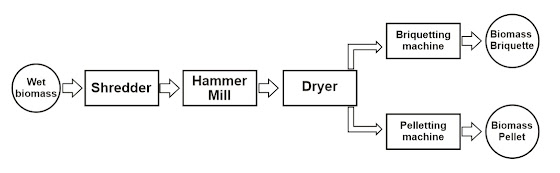
Young coconut waste can be processed into briquettes or pellets. Biomass densification technology is suitable for application as a solution for young coconut waste. The young coconut waste needs to be reduced in size (size reduction), namely with a shredder and hammer mill, then dried with a dryer before being compacted / densified into briquettes with a briquetting machine or into pellets with a pelletiser (pelleting machine). By briquetting or pelletizing the waste, it can be used as fuel or energy source for SMEs or boilers in industry. Many SMEs or processing industries can use this fuel. Apart from being environmentally friendly, it is also easy to use. Simple furnaces can be developed to use these briquettes and pellets.

Indonesia is famous for its seductive land of coconut islands. This is because the extent of coconut plantations in Indonesia reaches around 3.7 million hectares, most of which are smallholder plantations. The extent of these coconut plantations places Indonesia as the owner of the largest coconut plantations in the world. Coconut trees mainly grow along the coast, and indeed Indonesia also has the second longest coastline in the world, after Canada.

Tuesday, April 19, 2022

Rice Husk Briquettes Amid the Soaring Condition of Biomass Fuel Demand

 "Briquettes are a compressed biomass fuel (densified biomass fuel) as an alternative to pellets."

The use of biomass energy is increasing day by day so this is a positive thing that needs to be encouraged. The increase in coal prices (domestic industry is priced at $90) and the resulting pollution are especially the driving force for energy use from the biomass. Among biomass energy, wood pellets are the most popular and most widely used form of biomass fuel. The use of wood pellets is not only used by processing industries but also by power plants. A number of small and medium industries such as tofu factories, cracker factories, and so on. Wood chips, as a simpler form, are less attractive than wood pellets, even though they are cheaper. With a low density, the transportation costs are also high, besides that the moisture content of wood chips is sometimes also less controlled.

The form of briquettes is also less popular than wood pellets. Briquettes can also be said as an alternative to pellets. The technology for making briquettes is the same as wood pellets, namely biomass densification, the difference is that the size of the briquettes is larger than wood pellets. Unlike wood pellets, which only use roller press technology for their production, briquettes have several variants of technology for their production, for more details, read here. But in Indonesia there is only one type of briquette, namely the screw press. Indeed, in many ways briquetting is easier than pelletizing. Biomass materials that are difficult to pelletize are usually easy to briquette. Certain types of boilers may also be more suitable for briquettes, compared to wood pellets, read in more detail here. Therefore, the use of briquettes should also be encouraged.

In addition to wood waste, agricultural wastes are also potential biomass for fuel. Rice husk is an abundant agricultural waste because the staple food of Indonesians is rice. It is estimated that the amount of rice husk is 15 million tons/year. However, with the high content of ash and silica, this rice husk is less desirable to make pellets because it is abrasive, thus shortening the service life of machine components. Likewise for making briquettes, but with a variant of the mechanical press technology, the abrasive problem can be minimized. The production of rice husk briquettes with mechanical press technology can be a solution for the utilization of the rice husk waste. In the midst of the increasing use of biomass fuels, rice husk briquettes can be the next alternative.

Friday, March 25, 2022

Dichotomy of Energy Plantation and Legumes Plantation

There is a dichotomy between friends in livestock and forestry today about these legumes. From animal husbandry, they see leaves as a source of feed protein from plants and from forestry, they see wood as a source of wood that is easy to cultivate with high productivity. In the forestry sector, the wood is usually used as a renewable energy source such as wood chips, wood pellets, wood briquettes or charcoal briquettes. Forestry grows thousands of hectares of these legumes such as gliricidia with a wood orientation while the leaves are considered a by-product or waste from their plantation side. By utilizing the wood and leaves, it means getting out of this dichotomy, creating a new paradigm and being able to overcome food and energy problems or optimize the legume plantation or energy plantation (whole tree utilization) of thousands of hectares.

In addition to functioning as a legume plantation for animal feed, especially ruminants (sheep, goats, cattle, buffalo), as well as biomass fuel as above, the same plantation can also be used as a raw material for synthetic fiber board, for more details, please read here . Meanwhile, as the bioeconomic era is getting closer, the need for bioenergy, especially wood pellets, is increasing, the need for animal feed, especially ruminants which is part of the chain of human food needs is also increasing and indeed the growth of the earth's population is also increasing, and the need for biomaterials such as synthetic boards is also increasing. Therefore, the establishment of energy plantations or legume plantations or biomass plantations is very important, strategic and multi-beneficial. Based on these conditions, it is not impossible that in the near future the plantation will become a national and even global trend.

Sunday, September 12, 2021

Premium Wood Pellet Production From Plywood Factory Waste

Indonesia's plywood or plywood production is estimated to be more than 10 million cubic meters annually, which is produced from hundreds of plywood factories, even Indonesia once dominated the world's wood industry in the period from 1980 to 1995. There are five provinces as the largest plywood producers in Indonesia, namely East Java, East Kalimantan, Central Java, South Kalimantan and West Kalimantan. And six other provinces that are starting to develop, namely Banten, Papua, Central Kalimantan, South Sulawesi, Riau and Jambi. Most of the plywood is for the export market.

The volume of wood waste in the plywood industry is quite large, reaching almost 55% or more than 5 million tons per year of the national plywood production. The potential for this waste is quite large and has great potential to be processed into premium grade wood pellets. Why is wood pellet an option and why does it have to be premium grade? Wood pellets are the choice for the solution to the plywood waste problem because in addition to an easier production process, machine investment is also cheaper. This is because the wood waste from the plywood factory is dry, so it does not require a drying process. The dryer is not only quite expensive but also the operational costs. Premium quality is also possible due to the low ash content, because the wood for the plywood production has been debarking so that the ash content can be reduced to below 1%.

Size reduction / down sizing is the first thing that needs to be done with the plywood waste. After the particle size is appropriate, which is the size of sawdust (~3-5 mm), then the wetting process is carried out until the moisture content reaches about 10%. This is because the wood waste from the plywood factory is usually too dry, with a moisture content of 4-5% so that it does not meet the requirements for pelleting. Raw materials that are too dry make pellet gluing not optimal, so that pellets become brittle and even pellets are not formed at all. The wetting process is carried out with a water sprayer to reach the moisture content level. After the water content reaches about 10%, then the raw materials enter the pelletiser to be pressed or molded into pellets.

The premium grade wood pellet market segment is different from standard or utility grade wood pellets according to the table above. The use of premium grade wood pellets is for heating, especially in winter in countries with four seasons. The main reason for using premium grade wood pellets for this purpose is the very low ash content. With a low ash content, ash cleaning becomes less frequent. In general the production of premium grade wood pellets is more difficult than standard or utility grades, but especially in the plywood industry with the conditions of the raw materials as above, it is much easier and more prepared for the production of premium grade wood pellets. A golden opportunity for those who realize and understand it.

Monday, August 30, 2021

Densified Biomass (Biomass Pellet & Biomass Block) for Animal Bedding

In contrast to wood pellets used for fuel so that their quality or characteristics are reviewed from the combustion side such as calorific value, ash content to ash chemistry, wood pellets used for animal bedding have different quality requirements. In wood pellets for fuel, the performance factor and efficiency of power plants are the benchmarks, while for wood pellets for animal bedding, the health factor of livestock is the benchmark. The use of animal bedding is mainly in subtropical areas or areas with four seasons and the need is increasing in winter. The use of wood pellets for animal bedding is indeed not as popular as wood pellets for fuel so its usage is also not as much as use for fuel. For animal bedding, the quality of wood pellets required is the ability to absorb water, not too hard (low density), not containing harmful ingredients and a soft texture. Not only wood pellets are commonly used as animal bedding, but also biomass blocks.

By compacting (densification) such as pellets and blocks, transportation costs are cheaper, making it easier for storage and use. Historically, the first animal bedding used was straw because it was easy to obtain and widely available. Lack of straw, such as low water absorption, so that more urine flows out than is absorbed, and also after being mixed with urine and livestock manure, the livestock can still eat it so that it often causes stomach pain, which encourage the innovations for animal bedding. In addition, straw also often contains quite a lot of dust and requires a large space for storage. Wood shaving is the next animal bedding material that is better than straw.

Wood shaving in the form of bales is usually traded for this animal bedding. The dust is also removed before the wood shaving is baled, so it does not become a respiratory problem in certain animals such as horses and dairy cows. The water absorption ability of wood shaving is also better than that of straw, which is around 260% to 420% while that of straw is only around 200%. Some manufacturers even enrich the wood shaving with enzymes and bacteria to bind ammonia so it doesn't escape into the air. This product makes the life of animal bedding longer and after that it can be a good compost manure. However, because the density of the bales of wood shaving is quite low, which is less than 200 kg/m3 so it is less economical for transportation and long-distance use. This is so that biomass densification into wood pellets or biomass pellets and biomass blocks is the solution to this problem.


A number of the above biomass compaction products have been used for animal bedding. In a number of countries with four seasons such as horses, dairy cows and chickens using animal bedding, this product indirectly supports food security, especially animal protein sources such as meat and milk. Another important factor is that the animal bedding products do not come from biomass which contains hazardous materials or must come from untreated wood (if it comes from wood biomass), so that raw materials from wood that are painted, polished, caulked or contain other chemicals cannot be used. As for the raw materials above, albasia is a type of soft wood, EFB or empty fruit bunch of palm oil, OPT or oil palm trunks are commonly obtained during replanting of the palm oil plantations and cocopeat is a side product of the cocofiber industry or coconut fiber processing.

Saturday, March 20, 2021

Briquetting of Pineapple Plantation Waste

Pineapple is a fruit that is quite popular throughout the world, this can be seen from the percentage of pineapple fruit production in world fruit production which reaches 8%. Pineapple plants are almost the same as banana trees, that is, after bearing fruit once, the plant dies, and then the production is continued by the saplings for several generations. Or more specifically, pineapple plants produce after 1-2 years of planting and die after fruiting and produce about 70 leaves. The pineapple plants will be dismantled after two or three harvests to be replaced by new plants, which results in increasing pineapple leaf waste. Currently there is almost no utilization of this waste and pineapple leaves also cannot be used for animal feed, so they are only burned or thrown away which also causes environmental pollution. In every hectare of pineapple plantation, the waste produced can reach 3 tons. Large pineapple plantations are usually with an area of  thousands or even tens of thousand of hectares so that the production of this waste is also very much. Handling pineapple leaf waste with an effective and efficient method will certainly provide added value when examined from an economic point of view, so it is necessary to make efforts to handle this waste and briquetting  can be the perfect solution to this problem.

Although both use biomass densification technology, briquetting of pineapple leaves and stems is easier and cheaper than to make pellets. The production of pineapple leaf briquettes can then be used for cooking fuel, industry and even electricity generation. In addition, pineapple leaf briquettes are also used to increase biogas production. There are large pineapple plantation companies that have cattle farming businesses. Cattle farms are chosen mainly because they can use pineapple skin or fruit waste to feed the cows. And because the volume of pineapples produced is also very large, the fruit waste is also large and the cattle farm that is made is also large. The cow manure is usually further processed for biogas production and the digestate of biogas then composted. The compost produced is reused in the pineapple plantation. The briquettes of pineapple leaves and stems added to the substrate or co-digestion will further increase the biogas production significantly. Read here for more details.

With a scenario like the one above, almost all of the biomass waste generated from the pineapple plantation and industry can be utilized optimally. Likewise, the waste from a side business in the form of cattle farming for biogas production. In addition to large pineapple plantation companies, pineapple production centers in Indonesia such as Subang, Pemalang, Prabumulih, Kediri, Blitar, Kubu Raya, Mempawah, Muaro Jambi, Kampar, Central Lampung and Karimun can also develop the above concepts.

Friday, February 26, 2021

Wood Chip, Wood Pellet, and Wood Briquette from Energy Plantations for Local Market Part 2

The PLN (Indonesia State Owned Electricity Company) cofiring program, which is mixing biomass fuel with coal in coal power plants, will clearly encourage the use of biomass as an energy source. Cofiring is the easiest and cheapest way for coal power plants to start entering or gradually using environmentally friendly renewable energy. Emissions are also getting better as the use of biomass fuels increases, such as because the sulfur content is very low, there is little ash instead of hazardous waste, and fly ash is very small. The amount of added biomass, for example, starts from 1% which is then gradually increased and even finally it can be 100% biomass or renewable energy. In 2020 the cofiring program has been initiated with a target of 37 coal power plants and by the end of 2020 it is reported that it has been implemented for 20 coal powerplants. While in total there are 114 coal power plants units owned by PLN that have the potential for cofiring, spread across 52 locations with a total capacity of 18,154 megawatts (MW) with a target of completion in 2024. Consisting of 13 coal power plant locations in Sumatra, 16 coal power plant locations in Java, Kalimantan (10 locations), Bali and Nusa Tenggara (4 coal power plant units), Sulawesi (6 locations) and Maluku and Papua (3 coal power plant locations). Meanwhile, the cofiring ratio ranges from 1-5% biomass with an estimated biomass requirement of 9-12 million tons per year. Technically, with the 1-5% cofiring ratio, the PLTU also does not need to modify its equipment, so that it can be used immediately after the biomass fuel meets the required specifications.

When detailed about the type of technology used by coal power plants in Indonesia today, there are three types of coal power plant, namely, 43 types of PC (Pulverized Coal) with a total capacity of 15,620 MW requiring a mixture of 5% biomass or the equivalent of 10,207.20 tons per day, 38 types of CFB ( Circulating Fluidized Bed) a total capacity of 2,435 MW requires 5% biomass or the equivalent of 2,175.60 tons per day. Meanwhile, 23 types of stoker with a capacity of 220 MW use 100% biomass or the equivalent of 5.088 tons per day. In the short term, the type of biomass used is waste based, while in the long term it is from energy plantations. The Ministry of Environment and Forestry has also allocated a land area of ​​around 12.7 million hectares for the provision of forest land to jointly support the coal power plants biomass supply program. Ex-mining lands covering an area of ​​about 8 million hectares should also be reclaimed using this energy plantation. Even PLN has also signed a memorandum of understanding or a Memorandum of Understanding (MoU) with PTPN III Holding (Persero) and Perum Perhutani. In this case, PLN is the owner of the PLTU, while Perhutani has the resources of industrial forest areas both in Java and outside Java that can be developed as energy plantations. Likewise with PTPN III which has land for the development of energy plantations, read here for more details.

To fulfill the need for biomass as an energy source, energy plantations must be increasingly encouraged. The production of biomass fuels from energy plantations takes longer than processing forestry and agricultural wastes such as felled wood waste, sawdust, wood waste from the wood processing industry, palm oil empty fruit bunches, coconut husks, rice husks, and so on. . The route or option with energy plantations was chosen because in addition to ensuring the quality and quantity of biomass fuel it also optimizes land use, including being integrated with livestock and can be harvested multiple times (coppice) without having to replant for the next harvest. In fact, because energy plantation plants use legumes such as gliricidia and calliandra, which the roots can fix nitrogen from the atmosphere, soil fertility also increases. However, more and more efforts are needed for the energy plantation route because it takes at least 2 years for these crops to be harvested and before that it also needs to prepare the soil and plant the trees.

As previously stated, the choice of production for the type of fuel from energy plantations is influenced by several factors, such as the distance between energy plantations and industrial users, production capacity, industrial needs according to combustion technology and investment cost. If the industrial location or power plant is close to each other, even in the energy plantation area, it is sufficient only to make wood chips from the energy plantation. This is because transportation costs are cheap. Meanwhile, if the location is far enough, the wood should be processed into wood pellets or wood briquette. Wood pellets are indeed much more popular than wood briquettes, although technically wood briquette production is easier and production costs are cheaper. In addition, technically, the density of wood briquette can also be higher than wood pellets. This becomes interesting if a producer is interested in wood briquette production as a product diversification and biomass densification technology.

 
For sustainability, energy plantations will also be better than the use of agricultural and forestry wastes or the timber industry as mentioned above. This is because the plantation is designed and made specifically for the purpose of wood as an energy source. This also makes the volume of wood production more certain than relying on the volume of waste, whose availability depends on the main product. Energy plantations and the following livestock businesses are likely to become an exciting new trend and hopefully the momentum will not be anymore.

Production of Bark Briquettes from Wood Pellet Factory Waste

To reduce the ash content of wood pellets and thereby improve their quality, a process known as "debarking" (removing the tree bar...