Showing posts with label densified biomass fuel. Show all posts

Sunday, February 11, 2018

Wood Pellet Demand Crawling Up?

The fall of wood pellet market some time ago is also greatly influenced by the price of oil. The low oil price touched $ 30/barrel in early 2016 also lowered the selling price and demand for wood pellets. This condition even to shift the position of wood pellet as the cheapest fuel for the heating sector. At that time the energy price per calorie of oil which is a liquid fuel better quality and much in demand cheap, so that solid fuel that lower quality and less desirable also become cheaper. There are even many industries switching to using oil fuels than before using solid fuels such as coal. Wood pellets as one of the solid fuels (although from renewable sources) are also affected by the world oil price, because of the basis of calculating the price per calorie or heat of the fuel.

After almost 3 years of oil prices falling gradually, the current price of oil has risen drastically at the price of $ 70 / barrel. Some analysts say if crude oil prices more than $ 63 / barrel then the demand for wood pellets will rise again with prices that are also more attractive. Oil prices to be one of three causes of the decline in the wood pellet market in the world market in the last 3-4 years. The other two causes are the first, because a number of policies for the use of wood pellets have not been effectively implemented because the power plants have not yet been completed or in the development stage, and some power plants are still in the co-firing trial stage with wood pellets. And the second ,climate change then the winters in Europe in recent years been warmer or less as cold as those earlier times. Logically when the above conditions can turn out otherwise the wood pellet market will improve. And what we are witnessing today is a significant increase in oil prices, as it has exceeded $ 63/barrel.
As the wood pellet industry begins to wiggle and excite, it should also spur wood pellet production in Indonesia. Export market or world wood pellet market more ready and attractive prices need to be filled soon, so if need be dominated. Unused land even barren ones can be greened with energy plantations. Stages of designing energy plantation for wood pellet production can be read here. Furthermore, the domestic market is also need immediately created and developed, because in the short term we will also run out of petroleum, with the current conditions have become nett importers of petroleum. What if we just just sit there like a spectator? Certainly will aggravate our energy condition. We should participate to encourage the energy sovereignty of our country especially with renewable energy such as wood pellets because it provides many benefits.

Friday, October 16, 2015

Wood Briquette Left Behind 25 Years of Wood Pellet

Common areas with wood burning application it will be appropriate to use wood briquette and less suitable when using wood pellets. Various areas in various parts of the world use wood for heating (wood burning stove or boiler) or for cooking. If the ratio of wood as fuel is much so the business of  wood briquette production will be more attractive than wood pellets. Globally wood briquette are less popular than wood pellets, so the wood briquette production is also far below the wood pellets. Wood briquette also has its own characteristics compared to wood pellets.


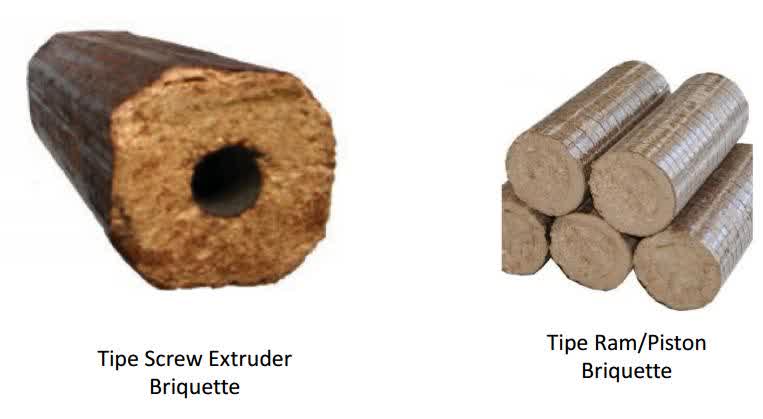
In general, wood briquette production is also much easier than wood pellets. The particle size, raw materials, moisture content and operations slightly more stringent than the requirements for the production of wood pellets. All wood pellets have a cylindrical shape which is only distinguished diameter of the cylinder, and a commonly used the diameter of 6 mm and 8 mm, while the wood briquette in addition to its shape can vary in terms of size also vary, for example, of the diameter of 50 mm (5 cm) to 90 mm (9 cm). Wood pellets almost all using mechanical compression on the wood briquette production while there is some compression options, namely mechanical, hydraulic and extrusion (screw). The different compression technology will also produce different product characteristics, such as differences in mechanical compresssion (ram / piston briquette) and by extrusion (screw briquette). Raw materials that can be made pellets almost certainly be made briquette, but all the raw materials that could be made briquette may not be successful to make pellets. Wood briquette density is also higher than wood pellets, which ranges from 1000-1400 kg/m3 (62.4 to 87.4 pounds/ft3) while on wood pellets range from 700-800 kg/m3 (43.7 to 50 pounds/ft3 ).

Whereas when compared with wood (round wood/log) are usually capable of burning (burning time) about 30 minutes then with a high density on the wood briquette made have burning time of about 6-7 time. Another factor that cause the long burning time is low moisture content than round wood/log.  In many ways wood briquette production process has many similarities with wood pellets or both in the biomass densification technology group. Although both carbon neutral because both biomass fuel, but the process of burning wood briquette produces 60% fewer emissions than using firewood. Then for the cool areas that burn a lot of wood for the fireplace (heating), the wood briquette is the right choice.

Biochar, Soil Health, and the Sustainability of Palm Oil Productivity

Healthy soil is invariably fertile, but fertile soil is not necessarily healthy. Healthy soil teems with life—such as earthworms and other o...