Showing posts with label bioeconomy. Show all posts

Wednesday, March 4, 2026

Blue Economy & Bioeconomy – Seaweed, Coconut and Nyamplung

With the second longest coastline in the world, located on the equator so it has a tropical climate and the largest coconut producer in the world, maintaining and continuing to develop coconuts is very important and strategic for Indonesia, especially since Indonesia has long been famous as the land of waving coconut trees. The productive life of coconut trees is also very long, namely 60 years, so they can be passed down across generations. The nyamplung tree, which is easy to grow and is often found in coastal areas, should also be developed, as well as the potential for seaweed. With the development of the times to carry out decarbonization in various sectors of life, especially the use of renewable energy, coconut, nyamplung and seaweed can be an effective solution.

Coconut oil, like palm kernel oil (PKO), has a high lauric acid content, so it is very suitable for the production of Sustainable Aviation Fuel (SAF). Currently, Indonesia is planning to increase SAF production from palm oil, namely palm kernel oil, to 3% this year (2026). This policy was accelerated to support the aviation sector's decarbonization targets. Palm kernel oil production is around 5 million tons/year with the main uses currently being very diverse, including the food industry (margarine, chocolate, cakes), cosmetics (soap, shampoo, lipstick), oleochemicals (fatty acids, glycerol), to renewable energy (SAF) - still in the early stages, as well as non-food products such as lubricants. while the potential for coconut oil is 2.9 million tons with the main uses being cooking (cooking oil), processed food industry (biscuits, margarine, ice cream), cosmetics (soap, shampoo, moisturizer), health (consumed directly as Virgin Coconut Oil (VCO)) and pharmaceuticals (ointment base), skin/hair care and oleochemicals. Why coconut oil and palm kernel oil are very suitable for SAF production, read more details here.

In addition to the potential raw material for SAF from coconut, the international civil aviation organization (ICAO) has included non-standard coconut in the ICAO positive list - ICAO document - CORSIA Default Life Cycle Emissions Values for CORSIA Eligible Fuels, 6th Edition on October 28 20024. Non-standard coconut includes very small old coconuts, already sprouted, starting to rot or become moldy and those that are broken. Based on data from a number of research studies, the number of non-standard coconuts in Indonesia is estimated to reach 30% of Indonesia's coconut production.

Regarding coconuts, the government should limit or prohibit exports of round coconuts. This will not only hinder the domestic coconut processing industry but also more specifically the development of SAF. Apart from that, efforts to replant coconut plantations must also be carried out. The area of ​​coconut plantations that must be replanted currently reaches hundreds of thousands of hectares, such as in Riau alone with a coconut plantation area of ​​426,579 hectares (11.4% of the plantation area in the province, read more details here). 72 thousand hectares of coconuts need to be replanted, while the replanting speed is very low so coconut productivity continues to decline. Meanwhile, nyamplung trees and seaweed require socialization and real action so that they can meet production targets and expectations.

Meanwhile, nyamplung oil can be used for biodiesel / FAME production. From the government's plan to increase the biodiesel mixture from B-40 to B-50, this means requiring almost 60 million tons/year of vegetable oil, especially palm oil. Meanwhile, currently crude palm oil or CPO production is around 50 million tons/year and increasing 20% ​​or to 60 million tons/year is certainly not easy. Moreover, currently the expansion of palm oil plantations (extensification) is in the sharp public spotlight with widespread public attention. A number of natural disasters, especially the Sumatran floods, which have claimed the lives of thousands of people, with the extensification of palm oil plantations as the suspect, have made it increasingly difficult to increase palm oil production through expanding this land. And indeed land expansion (extensification) must always be in the corridor of sustainability, so that palm oil can be a blessing and not a disaster.

Nyamplung trees with productivity almost the same as palm oil trees are very interesting to develop for biodiesel production or more practically adding 10 million tons / year to reach the B-50 proportion. Along Indonesia's very long coastline, there are locations for coconut and nyamplung plantations. Apart from that, seaweed from its waste is also a potential raw material for renewable energy, both ethanol, biodiesel and SAF.

Meanwhile, from the seaweed sector, apart from the production of agar, carrageenan and alginate which are widely used for food products, biofuel can be produced from seaweed waste. Seaweed industry waste can reach 65-75% of the fresh raw materials processed. This very large amount is often wasted without further use which can increase added value. Because solid seaweed waste contains a high percentage of cellulose and only a small amount of lignin, this waste has the potential to be processed into bioethanol and sustainable aviation fuel (SAF). 

The process route, namely ATJ or alcohol to jet fuel, can be used to produce sustainable aviation fuel (SAF). Meanwhile, seaweed waste is usually disposed of in landfills, which can cause unpleasant odor problems. Specifications for industrial waste from the E. cottonii species are 3.66% water content; ash 36.84%; protein 1.78%; carbohydrates 11.36%; 0% cellulose; hemicellulose 12.86%; lignin 0%. Meanwhile, industrial waste specifications from the species Gracilaria sp. and Gelidium sp.: cellulose 26.92%; hemicellulose 16.11%; lignin 15.38%; ash 16.72%; water content 12.94%; NaCl 3.77%. 

After their productive life is over or ends, the coconut trees and nyamplung trees are cut down. Coconut tree trunks and nyamplung trees are very suitable for building wood used for housing. This will add economic value and is a necessity that will continue to be needed. In fact, efforts to improve the quality of wood can also be done by engineering the wood material, such as with CLT (cross laminated timber) and so on.

And like palm oil, both coconut and nyamplung also produce shells. Just as palm kernel shells can be used for fuel, so coconut shells and nyamplung shells as well. Even palm kernel shells or known as PKS (palm kernel shell) are the main competitors of wood pellets in the global biomass fuel market. However, because the quality of coconut shells is better or more suitable for the production of charcoal briquettes and activated carbon, coconut shells are generally carbonized or made into charcoal. Charcoal is an intermediate product or raw material for charcoal briquettes and activated carbon. Read more details about the production of activated carbon from coconut shells here. Meanwhile, because nyamplung shells are not widely produced, their use is still limited, but if the quantities are large, such as the production of palm kernel shells, then it could be like palm kernel shells, or perhaps also like the use of coconut shells.

Apart from that, both the production and extraction of coconut oil and nyamplung oil will produce cake. Coconut cake and palm oil cake can be used as animal feed, but nyamplung cake requires additional processing so that it is non-toxic and safe for animal feed. The development of a blue economy on the Indonesian sea coast should be an important concern as an environmentally friendly economic solution that suits the conditions and potential of Indonesian society and is in line with the global community's concerns about decarbonization as mitigation for climate change and global warming. Apart from also supporting food and feed security. 

Monday, October 20, 2025

AI for Palm Oil Mills or New Product Development with New Process Design?

AI applications have penetrated various sectors, including palm oil mills or CPO mills. AI applications for palm oil mills are still relatively new, so few, if any, have implemented them. One palm oil mill that has implemented AI is Minsawi Industries in Kuala Kangsar, Malaysia, with a capacity of 45 tons of fresh fruit bunches (FFB) per hour. The use of AI has resulted in annual savings of RM 1.6 million (Rp 6.24 billion) due to reduced oil loss, reduced maintenance costs, and a 33% reduction in labor. However, there are concerns that using AI for palm oil mills could potentially lead to job losses. Even with fewer workers, incomes are higher.

The cost-to-benefit ratio is certainly a crucial consideration for any new technology, including the use of AI. The amount of money spent must yield equivalent or greater benefits. In the case of the AI ​​application in the palm oil mill, the cost of the AI ​​was RM 5 million (~Rp 19.5 billion), meaning that with savings of RM 1.6 million per year, the investment in the AI ​​equipment would be recovered in approximately three years. This is a reasonable return on investment. However, investing that much to improve efficiency in an existing mill, or for example, 15% of the main mill, requires comprehensive consideration.

Several devices, such as sensors, predictive tools, and AI applications, are integrated to improve the efficiency of palm oil (CPO) production. More specifically, the key components of an AI-based palm oil mill include: first, advanced sensors. These sensors are installed throughout the palm oil mill to obtain real-time data on critical parameters such as temperature, pressure, amperage, and machine performance. Second, AI-enabled CCTV cameras. Several cameras are installed at strategic locations to monitor key areas, such as detecting the volume of fresh fruit bunches (FFB) and their quality, and providing this information to control the production process. Third, an AI-driven control system. These systems automatically optimize processes, manage equipment operations, and utilize resources based on real-time data analysis.

Meanwhile, developing new products means increasing the added value of existing materials. This increased added value can be far greater than that gained from increasing factory efficiency through AI applications. Raw materials that were previously underutilized or even discarded, polluting the environment, can generate significant benefits from developing new products. While optimizing factory performance is crucial for achieving high efficiency, innovation in new product development is equally crucial.


In the palm oil industry, new product development can be achieved by creating various derivatives from crude palm oil (CPO) and processing various biomass waste from palm oil operations, both from mills and plantations. Numerous products can be produced from these processes. For example, CPO derivatives produce biofuels such as biodiesel, cooking oil, stearin, olein, and so on. Biomass waste can be processed into bioenergy, biocarbons, biofuels, biomaterials, and biochemicals.


Designing efficient production processes is crucial for producing competitive products. Likewise, low-emission production, minimizing waste, or even zero waste, is also a key focus. Integrating various production processes, particularly for energy savings, including waste heat recovery, is highly feasible, enabling efficiency and lower production costs. The significant benefits of AI applications in palm oil mills or CPO production include the potential for further use in new product development, including designing the most efficient production processes possible.

Ultimately, if the development of these new products can be carried out and AI is integrated, the need for labor will increase in these business units, even if each business unit is operating efficiently. The production of various derivative products, including specialty chemicals, is highly possible with the development of new products that keep pace with the times. Furthermore, on the plantation side, AI and mechanization can also be utilized to reduce 3D (dirty, dangerous, demeaning) jobs, resulting in more efficient work and increased income. Even mechanization in oil palm plantations is still low, making it more urgent than AI applications. 

Sunday, April 27, 2025

Bioeconomy: Carbon Neutral Economy (Wood Pellets & PkS) VS Carbon Sink Economy (Biochar)

Market readiness and availability are important factors for the growth and development of a business in general and biomass-based businesses in particular. And globally according to Hawkin Wright, predicting wood pellet sales will reach the highest among other biomass fuels, which is more than 27 million tons/year in 2025. While FutureMetric also predicts that the market for wood pellets for industry (industrial pellet fuel) can reach 55 million tons in 2030. Thus the need for wood pellets will continue to increase by an average of more than 5.5 million tons per year since 2025, so too for wood pellet production. In addition, PKS (palm kernel shell) are also an alternative biomass fuel besides wood pellets and PKS is the main competitor of wood pellets in the global biomass fuel market. But compared to wood pellets, global PKS trade is relatively small, estimated at only 5 million tons/year. Indonesia is the largest producer of PKS in the world because it is comparable to the area of  palm oil plantations and as a producer of palm oil / CPO or the owner of the largest oil palm plantation in the world.

Meanwhile, biochar, specifically for Europe alone, is estimated to have 51 new biochar factories or a total of 220 units, with biochar production estimated to be 115,000 tons per year. And global biochar production in 2023 is estimated to reach 350 thousand tons or equivalent to 600,000 carbon credits and is expected to continue to increase. And in 2025, the biochar industry is predicted to grow more than 5 times compared to 2023. The existence of carbon credits is one of the biggest motivations for biochar production. With the existence of carbon credits, there is a significant surge in biochar production from before. As an illustration, in 2023, this biochar carbon credit will make the largest contribution, namely 90% of carbon removal in the voluntary carbon market according to data from CDR.fyi.

The main market or user of wood pellets (industrial pellet grade) are power plants that carry out cofiring with renewable fuels, namely biomass-based, especially wood pellets. The greater the cofiring ratio, the greater the need for wood pellets. With a capacity or size of hundreds or even thousands of MW of power plants, the need for wood pellets is also high even with a low cofiring ratio. The trend of coal-fired power plants to carry out cofiring is getting bigger and also the increase in their cofiring ratio, even a number of coal-fired power plants can switch to 100% using wood pellets (fulfiring). In addition, a number of biomass power plants, both 100% with wood pellets or PKS, have also been built and started operating. There is a global target that the portion of coal-fired power plants must decrease to 4% (from the current condition of around 30%) by 2030 and 0% by 2040 if the world wants to limit global warming to 1.5 degrees Celsius (2.7 degrees Fahrenheit) and prevent the occurrence of severe damage from the climate crisis. This is also what makes a number of coal companies in Indonesia develop renewable energy, especially wood pellets from energy plantations.

While biochar, although its market potential is also very large, the problem is that awareness is still low, so education and socialization still need to be improved. Like the market for biomass fuel in the form of wood pellets and PKS / palm kernel shells which are generally large companies (because they are also the largest CO2 emitters), to accelerate the biochar industry, a large capacity market or user is needed. Large farms and plantations as well as energy plantation forests or energy plantations are potential markets / large users of biochar. Likewise, post-mining reclamation lands that will be revegetated are also potential users / large markets for biochar. This is also related to the fact that a significant volume is needed to be able to produce adequate CO2 absorption volume (carbon sequestration / carbon sink). Meanwhile, from the agricultural or plantation side or application to the soil related to the use of biochar, so far, when considering the effects of biochar, the focus has only been on increasing crop yields. However, the added value that biochar can offer in its application in soil, at least in optimal agricultural systems, includes not only increasing crop yields, but also counteracting the loss of humus in the soil, preventing nitrate leaching, and increasing water storage capacity to increase crop resistance to drought and resilience to the climate crisis.

And basically both biomass fuel production such as wood pellets and carbon sink materials such as biochar will have a positive impact on the climate, even both can support each other such as if biochar is used for energy plantations and then wood products from the energy plantation are used for wood pellet production, more details read here. The use of renewable energy will reduce the concentration of CO2 in the atmosphere because it does not increase the concentration of CO2 or is carbon neutral, while biochar will reduce the concentration of CO2 in the atmosphere because it absorbs CO2 in the atmosphere in biomass which is then concentrated by pyrolysis to become biochar, or carbon negative. Even making a carbon sink, but not reducing the source of its emissions is a futile or irrelevant effort, more details read here. So bioeconomy with carbon neutral economy, namely biomass fuels such as wood pellets or PKS or carbon sink economy, namely with biochar, will be closely related to business readiness such as market / user aspects, raw materials for certain production capacities, raw materials and so on. These characteristics need to be considered carefully and comprehensively so as to produce optimal and sustainable profits.

Monday, February 10, 2025

Optimizing Calliandra Energy Plantations for Energy, Food and Feed, Is It Possible?

Calliandra energy plantations as the name implies are indeed prioritized or for the main purpose of producing energy from biomass, either wood pellets or just wood chips. This is because wood is the main product of the energy plantation, while leaves and flower nectar are by-products or are considered waste from the wood pellet or wood chip business. However, if the use of leaves for animal feed and flower nectar for honey production has an economic value that approaches or even exceeds the wood pellet product, then it will be a different story. Calliandra leaves, like indigofera leaves and glicidia / gamal leaves, have a high protein content, while this protein element is the most expensive source of nutrition of all the elements in animal feed products, while calliandra honey is one of the best quality honeys compared to other honey products such as acacia honey, kapok honey, rubber honey and so on.

Synchronization between honey and wood production is very important in the energy plantation to maximize profit. In honey production, the first time the calliandra flowers and the next flower cycle are very important. Don't let it be that just because of ignorance of the flower cycle, many benefits that should have been obtained are lost. In addition, for sustainable and optimal honey production, not only calliandra nectar is needed, but also a number of certain plants as support, both for additional bee feed and for making beehives. When all that is available is calliandra nectar, honey production will be maximized but will not be sustainable because the bee colony will shrink and then disappear. This is the importance of plantation engineering with a number of species or types of certain plants if honey production is also an important product in the calliandra plantation-based business.

Calliandra leaves in abundance will automatically be obtained when the calliandra trees are cut down or harvested. The calliandra leaves need to be separated from the wood and twigs to be used for animal feed. Animal feed products from calliandra leaves can be in the form of fresh leaves or processed leaves in the form of pellets, or hay. This makes it possible to have a leaf pellet factory in addition to the wood pellet factory. With an estimated leaf volume of 1/4 of the wood but the price of leaf pellets is around 3 times the price of wood pellets. So the profit from utilizing leaves into pellets (leaf pellets) is very large, estimated at 1/2 to 3/4 of the wood pellet turnover. This is certainly a serious consideration and cannot be ignored.

A comprehensive understanding of calliandra plantations for energy, food and feed is indeed very important to maximize profits from calliandra plantation-based businesses. This will encourage the calliandra energy plantation to grow further. In addition, the legality aspect and land selection for the location of the calliandra plantation. This is because, especially for wood pellet products in general, it is for export orientation and especially for Japan and Europe, environmental or sustainability certification is very important and even required so that the legality aspect (which is clear and clean) and land selectivity according to its designation including the history of the land are also very important. So optimizing calliandra energy plantations for energy, food and feed is possible if the terms and conditions are met.

Monday, December 30, 2024

Biochar or Biocoal Production?

Biochar and biocoal production are basically one breath. Biochar production with full pyrolysis while biocoal with half/mild pyrolysis (torrefaction). The purpose of torrefaction/mild pyrolysis is to increase its energy content and make it hydrophobic so it is called biocoal. While the purpose of full pyrolysis is to produce stable biocarbon material so that it does not decompose in the soil for hundreds or even thousands of years and improve soil fertility so as to increase plant productivity (agriculture and forestry). 

Current biochar applications are mainly for agriculture and biochar production will produce excess heat, syngas and biooil as energy sources. While biocoal only focuses on energy. The benefits of biochar production are obtained from the sale of biochar, the sale of carbon credits and the utilization of by-products (full) pyrolysis. While the benefits of biocoal are only from the sale of biocoal itself.

The selection or development of a business will be related to business readiness (market, technology, investment, etc.) and other benefits, namely benefits in the social and environmental sectors. 

Bioeconomy in a Tropical Country “Biomass Heaven”

Indonesia is believed to be a tropical country of biomass heaven so this needs to be translated into a more concrete form so that it can be understood, executed so that it is proven and the potential can be utilized optimally. There is so much potential that should be used to support the welfare of its people. The simple diagram below illustrates so many things that can be done in a tropical country "biomass heaven".

The availability of raw materials is a vital and absolute factor so that various biomass processing can be carried out and sustainable. On the other hand, there is a lot of land potentials that can be utilized for this purpose, the amount of which reaches tens of millions of hectares, namely critical land / marginal land, dry land and post-mining land (coal mines, tin mines, nickel mines, copper mines, gold mines and so on). In more detail, it is estimated that for critical / marginal land it reaches 24.3 million hectares (Times Indonesia, 2017) while dry land reaches 122.1 million ha consisting of dry acid land covering 108.8 million ha and dry climate dry land covering 13.3 million ha and post-mining damaged land reaching 8 million hectares. Energy plantations or biomass plantations need to be created in these land areas and can even be used for various food crops. Even now there are plant species that can only be economically viable on these lands.

Both energy and biomass plantations can be planted with various plants that support sustainable bioeconomy in line with decarbonization, including calliandra, gliricidia, bamboo, calophyllum inophyllum, coconut and even oil palm, including food crops such as rice, corn and soybeans. The selection of plant species will be adjusted to the product to be made, land conditions, and technological and business readiness.

Meanwhile, biomass waste that is currently produced annually, especially from the agricultural and forestry sectors, which also amounts to millions of tons, can be optimized so that in addition to reducing or avoiding environmental pollution, it will also provide added economic value, environmental and social benefits. The utilization of biomass, both from agricultural and forestry waste or from energy plantations and biomass plantations, will be a sustainable bioeconomy activity and in line with the global decarbonization trend that is in line with climate solutions.
 

Friday, May 3, 2024

Young Coconut Waste Processing: Briquetted or Pelleted!

When the weather is very hot like recently, drinking coconut water is very refreshing. This is because coconut water, apart from meeting the body's fluid needs, also meets the needs of electrolytes (ionically charged minerals found in cells, tissues and body fluids) which the body really needs. This electrolyte plays a role in supporting the activity of cells and body tissues and maintaining the balance of body fluid levels. When the body loses electrolytes due to physical activity or dehydration, consuming coconut water can help replace lost electrolytes and restore body fluid balance. There are many sellers of young coconut ice, especially in big cities. Apart from being sold in glasses, young coconut water is also sold in the form of whole young coconuts. The combination with young coconut flesh adds to the deliciousness of the drink. But it turns out that the waste from young coconuts is very polluting and has not been processed or used properly. The volume of young coconut waste is quite large, in fact, in the city of Makassar, South Sulawesi,  it is estimated that there is 15 tons/day of young coconut waste.

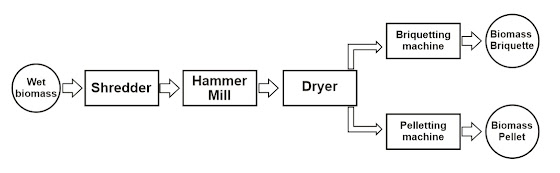
Young coconut waste can be processed into briquettes or pellets. Biomass densification technology is suitable for application as a solution for young coconut waste. The young coconut waste needs to be reduced in size (size reduction), namely with a shredder and hammer mill, then dried with a dryer before being compacted / densified into briquettes with a briquetting machine or into pellets with a pelletiser (pelleting machine). By briquetting or pelletizing the waste, it can be used as fuel or energy source for SMEs or boilers in industry. Many SMEs or processing industries can use this fuel. Apart from being environmentally friendly, it is also easy to use. Simple furnaces can be developed to use these briquettes and pellets.

Indonesia is famous for its seductive land of coconut islands. This is because the extent of coconut plantations in Indonesia reaches around 3.7 million hectares, most of which are smallholder plantations. The extent of these coconut plantations places Indonesia as the owner of the largest coconut plantations in the world. Coconut trees mainly grow along the coast, and indeed Indonesia also has the second longest coastline in the world, after Canada.

Wednesday, May 1, 2024

Buy Wood Pellets or PKS (Palm Kernel Shell)?

The need for biomass fuel as a decarbonization effort because it is a renewable fuel that is carbon neutral is increasing. Two biomass fuels that are popular in the world and compete fiercely are wood pellets and palm kernel shell (PKS). Under normal conditions or without a spike in demand, the price of wood pellets is usually more expensive than PKS. This is understandable because wood pellet production requires more effort than PKS. Wood pellet production requires a number of equipment with an expensive investment, while PKS only requires minimal equipment, namely just a screening/sieving machine.

But what if the prices of wood pellets and PKS are almost the same or even PKS is even more expensive? This can happen due to several factors, namely first, the influence of market demand. High market demand, especially PKS from Indonesia and Malaysia, means supply is reduced or inadequate. PKS production in Indonesia and Malaysia is indeed much greater than wood pellet production from these two countries. Apart from the larger production volume, factors such as availability and continuity (long-term security of supply) can be guaranteed more than wood pellets. This is because it is estimated that there are 1500 palm oil mills in Indonesia and Malaysia that produce PKS which is a by-product or waste of palm oil mills. This allows for long contracts between sellers or suppliers (exporters) and buyers who are usually not end users but trading companies in Japan and Korea.

Loading PKS for export with transhipment (ship to ship)

The second factor is levy and tax. PKS exports in Indonesia are subject to levy and tax whose value is correlated with the price of crude palm oil (CPO). This is because PKS in Indonesia is included in the palm oil derivative product category, whereas in Malaysia it is not subject to these levy and tax, because PKS in Malaysia is included in the palm oil waste category. When levy and tax are high, the price of PKS will automatically become expensive. This levy and tax factor is something that PKS exporters cannot control. Through the APCASI organization (Indonesian Palm Kernel Shell Entrepreneurs Association) they are fighting for levy and tax to be more measurable or cheaper, even if they can be eliminated like in Malaysia.

Basically buyers will buy the best possible goods at the cheapest possible prices, or better quality goods but cheaper prices. The quality of wood pellets is better than PKS, namely in terms of calorific value, ash content, shape uniformity and moisture content. However, due to volume factor and continuity (long-term security of supply) which are often or still widely in doubt, the choice to go to PKS is still being made. To overcome this, wood pellets production must meet production capacity with a reliable source of raw material supply. Production of wood pellets from energy plantations is the solution.

With wood raw materials from energy plantations, the supply of raw materials will be more stable, unlike those that rely on collecting wood waste from sawmills or wood processing industries. With Indonesia's production forest area reaching tens of millions of hectares, of course land is not a problem in wood pellet production. Wood pellet production centers can be created on these production forest lands, for more details, you can read here.
 

Friday, February 23, 2024

2nd Generation Biofuel with Biodiesel Production from Calophyllum Inophyllum and the Like

Biodiesel production from CPO is a 1st generation biofuel where the raw material competes with food products, which of course is not good. Biodiesel production from oils that do not compete with food products will be much better. The image of producers and even their country will also be improved if the program can be carried out on a massive scale. There are a number of trees that produce oil for biodiesel production. The selectivity of plant types related to productivity, climatic conditions and so on is certainly a serious consideration if production is on an industrial scale. Nyamplung oil (calophyllum inophyllum oil) is one of the best solutions because apart from high oil productivity, the productive period is long, and the logs after the productive period are also economical or have high selling value.

The productivity of calophyllum inophyllum oil competes with palm oil, whose productivity is around 6 tons/hectare/year, but caring for calophyllum inophyllum trees is easier and cheaper. Meanwhile, jathropha has lower productivity so it is less attractive and profitable to develop. Calophyllum inophyllum trees that grow well in the lowlands or on the coast will be very suitable for Indonesia as an archipelagic country. Indonesia has a coastline of 99,093 km or the second longest in the world after Canada. And it would be even better if the calophyllum inophyllum plantations on the coast also coincided with coconut planting. Indonesia is famous for its land of coconut islands, which generally grow well in coastal areas. Coconut trees also have many benefits from almost all their parts. If this happens, optimization of renewable energy production, namely biofuel in the form of biodiesel from calophyllum inophyllum oil and food products, especially those based on coconuts.

The transportation sector itself contributes 14% of CO2 emissions globally or 27% in Indonesia. Biodiesel produced by transesterfication reaction (C6-C22 chain) has very similar properties to diesel oil so it can be used 100% in diesel engines without the need for modification or mixing/blending with certain portions. Biodiesel contains 10% oxygen and zero sulfur, which makes engine combustion more complete and efficient. Liquid fuel also has its own advantages over gas fuel, including easy use and storage, and most existing vehicles use liquid fuel, so they can be used straight away. The development of biofuel as a carbon neutral fuel needs to be prioritized as part of decarbonization, especially for 2nd Generation Biofuel because it does not conflict or compete with food.

For 2nd generation biofuel from biomass or lignocelullosic biomass (such as wood waste), biodiesel production is still high cost. There are two process routes for biodiesel production from lignocelullosic biomass, namely gasification for syngas production followed by the Fischer-Tropsch (FT) process and fast pyrolysis for biooil production followed by hydrotreating and catalytic cracking processes. This is what makes biodiesel production in this way not possible even though it is technically possible. The raw materials for lignocellulosic biomass are much cheaper because they are generally categorized as biomass waste. However, the complexity of the production process makes production costs expensive, so it is not yet an option.

Meanwhile, for 3rd generation biofuel, namely from microalgae, even though the potential is huge, the productivity can even be more than 16 times the productivity of palm oil or calophyllum inophyllum oil (6 tons/hectare/year for palm oil and calophyllum inophyllum, while oil from microalgae reaches 100 tons/hectare/year ) but it seems that it still takes time to enter the commercialization stage. Problems related to cultivation, harvesting and oil extraction also still require extensive research. By producing biodiesel from calophyllum inophyllum oil, biodiesel production from CPO can be gradually reduced. The larger the calophyllum inophyllum plantation, the greater the biodiesel product produced, so that palm oil or CPO can be specialized as edible oil or specifically a food product. Likewise, it is hoped that oil from coconut will increase along with the growth and development of biodiesel production from calophyllum inophyllum oil.

Friday, October 27, 2023

Optimizing Wood Pellet Production from Wood Waste

The volume of wood waste from the woodworking industry in Indonesia is estimated to reach 25 million tons every year. Every wood processing will produce waste such as sawdust, wood shavings, wood chips and so on, the volume of which is around 40% of the raw materials used. However, there is still a lot of waste that has not been processed so it pollutes the environment. Meanwhile, the development of the Indonesian timber industry continues to increase due to high export demand, even though actual realization of the timber industry is still low.

It is estimated that the Indonesian wood industry can actually be optimized until its production capacity reaches 91 million cubic meters per year, but in reality in 2022 the forest products industry will only be able to produce 42.19 million cubic meters per year or around 48.7% of its optimum capacity. There are 3 factors that cause the low realization of the wood industry, namely, efficiency of the wood industry, problems related to raw materials and market availability.

The low efficiency of the woodworking industry is due to the use of old machines or traditional methods for production. Meanwhile, problems related to raw materials are caused by the reduction in forest areas due to the large amount of development that causes forest land to change its function. Efforts to maintain a stable and sustainable supply of wood raw materials need to be made, including land rehabilitation programs and coaching for community forest farmers. National mapping of wood potential also needs to be carried out so that industry can obtain information regarding the supply of raw materials needed. Market availability is also an important factor in the development of the timber industry, so the ability to access information and identify market aspects, both domestic and international, is needed.

As the wood industry increases, wood waste also increases. An environmentally conscious industry certainly pays great attention to waste issues so that ideally it can achieve zero waste. These wastes are raw materials for wood pellets. The need for wood pellets continues to increase in line with the global decarbonization trend. Just as the woodworking industry requires consistency to maintain its products, so does wood pellet production. The consistency of the wood pellet raw material mixture is the key to the quality of wood pellets, including making production optimal.

In large woodworking factories, wood pellet production can be carried out simply by using its own waste, so that apart from solving the waste problem according to the zero waste concept, it can also be used as a new business development. Meanwhile, in the small - medium woodworking industry, because there is insufficient wood waste, some wood waste as raw material for wood pellets needs to be sourced from other places. A wood pellet factory can also be made independently, namely with raw materials that come 100% from other people's woodworking factory waste, meaning that the wood pellet factory is not owned by a wood processing industry. So basically a wood pellet factory is a factory or installation for processing wood waste that produces products with high selling value and is in line with the global decarbonization trend.

Monday, October 23, 2023

Export-Oriented Large Capacity Wood Pellet Production

Availability of raw materials and market control are the two absolute main things that must be fulfilled so that the wood pellet production business can be sustainable. Investing in expensive equipment will be useless if the two things mentioned above are not met. In large capacity wood pellet production, the quality of the production equipment used is very important. The production goal of achieving large capacity will be achieved if it is carried out with an efficient and safe production process so that production costs are low. Production equipment that is capable of working non-stop 24 hours, easy operation and maintenance with good performance is vital. Regarding raw materials, apart from continuous availability, there are 2 important things that need to be considered, namely the consistency of raw materials and cheap logistics to the location of the wood pellet factory.

Mapping the potential of raw materials needs to be done well, as well as the wood pellet market. Wood pellet raw materials from one type of wood (single material) are certainly easier than mixed raw materials from several types of wood. This is related to the composition of the mixture, which of course is not a problem if the raw material is from one type of wood (single material) which is homogeneous. To strive for homogeneous raw materials, this can be done by creating energy plantations, while mixed raw materials can be taken from several wood processing sources such as sawmills and so on. Energy plantations that can be multifunctional so that they provide many benefits. This can be done by maintaining a balance between wood productivity for wood pellet production, environmental functions in the form of maintaining erosion and groundwater, and the volume of wood harvested must not exceed the growth rate or be at least the same (carbon balance) and the use of by-products for additional revenue such as utilization leaves for animal feed and honey from beekeeping.


Meanwhile, from a market aspect, a number of requirements also need to be met so that sustainable transactions occur. Apart from technical factors in the form of wood pellet specifications and production volume, non-technical factors such as sources of raw materials related to environmental sustainability are also often required nowadays. Users of wood pellets abroad, especially power plants, are in decarbonization efforts through cofiring programs with coal. Sustainable decarbonization efforts usually require environmental certificates such as FSC regarding the source of the raw materials used. This is to prove that the renewable fuel chain, especially wood pellets, indeed complies with mutually acceptable environmental sustainability standards. There are certain countries that impose long contracts for the purchase or procurement of their wood pellets, but there are also those that choose short-term contracts. The typical buyer or market for wood pellets also needs to be given special attention.

Thursday, August 10, 2023

Post-Mining Reclamation with Energy Plantation Revegetation for Wood Pellet Production

Revegetation is one option for post-mining reclamation. The choice of revegetation options also has certain considerations apart from environmental, social and of course economic or business aspects. The vision for the future in the form of sustainability is an important factor for post-mining reclamation, especially the revegetation.

Revegetation with palm oil plantations is one of the most popular revegetation options. This is because palm oil product (CPO) and their derivatives sell well in the market. However, the land requirements and operational costs for palm oil plantations themselves are not easy and cheap. The choice of revegetation with other plants should also be considered.

Creating an energy plantation from short rotation crops (short rotation coppices) can be considered. This is because land and operational requirements are much easier and cheaper. Even in the long term the use of the land will also improve the quality of the land. Products from energy plantations will also become a world trend and the current global climate solution, namely wood pellets. Meanwhile, by-products in the form of animal feed (feed pellets or hay) and honey from beekeeping are no less interesting by-products.

The extent of post-mining land, which reaches millions of hectares, is of course a very attractive potential for the development of these energy plantations. The need for bioenergy, especially wood pellets, is also getting bigger along with the global decarbonization program. Likewise the need for animal feed which is a link in the chain of human food needs, especially meat or protein. Efforts to increase land use value, prevent natural disasters, absorb employment and economic benefits are the thrust for revegetation reclamation with the energy plantations.


Biochar, Soil Health, and the Sustainability of Palm Oil Productivity

Healthy soil is invariably fertile, but fertile soil is not necessarily healthy. Healthy soil teems with life—such as earthworms and other o...