
Energy is generally the highest cost component in the
production process. Energy savings would
give a significant impact on production costs and product prices. So that the
energy must be obtained at a low cost for production efficiency. Utilization of
wastes available is a surefire way to get the production efficiency, especially
these wastes generated daily is available or even with a large number or
capacity.

EFB (empty fruit bunch) is waste that is generated every day
in the palm oil mill or CPO factory. The EFB volume or capacity pretty much
every day, for example: the CPO mill with a capacity of 30 ton FFB (fresh fruit bunch) / hour will
be generated tankos 8.1 tonnes / hour (5.7 tons of water, 2.4 tons of dry
weight) or 162 tonnes each day (114 tons of water, 48 tons of dry weight). EFB
utilization for energy source in refining or downstream of CPO, is the perfect
solution for waste management and the source of energy.


EFB is wet waste of palm oil and large size from the CPO
mill can not be directly used but must be processed in advance so that a fuel
or energy source ready. Densification or compaction of EFB into pellets or
briquettes is the solution to fuel or energy source that is ready to use it.
Since the Government implemented customs exit (BK = Bea
Keluar in Indonesian) CPO, downstream palm oil industry in Indonesia is
growing. Finance Minister Regulation (PMK) No. 67/2010 on Stipulation of Export
Goods Subject BK and BK Rates mentioned, CPO exports imposed BK from 0-25%
depending on price developments in Rotterdam, Netherlands. But the government
ultimately lowering the amount of BK to 22.5% after the oil palm planters
protest. Magnitude BK was arranged through the PMK No. 128/2011 regarding the
Stipulation of Export Goods subject to export duty on August 15, 2011. Analogy in the fields of petroleum, sell
export crude oil should be restricted or even banned, but the industrial
products which have undergone treatment so as to give a great added value
supported and encouraged as much as possible. Indonesian palm oil product
exports 60-70% is in the form of CPO, while the downstream products is only
30-40%. Refinery or refining of CPO was built and some have already been
produced. In general, oil products are divided into crude palm oil (CPO),
refined products of CPO, palm kernel oil (PKO) and refined products of PKO,
biodiesel and oleo-chemical.

Purification or CPO refinery is now generally only owned by
CPO large factories, while the small and medium-sized CPO factories in general
do not have the CPO purification unit. Indonesian Palm Oil Association (GAPKI)
noted that currently there are 1,911 oil palm industries in Indonesia which
produce 23.5 million tonnes of crude palm oil (CPO) from an area of 8.2 million
hectares of land. Utilization of wastes optimally so that the production
process of CPO into zero waste and energy cost savings (energy efficiency), the
target of all production processes. Briquetting and peletting of EFB as a source
of cheap energy, environmentally friendly (carbon neutral) and sustainable for
CPO refining industries means will drive the downstream palm oil products, and
can be more affordable for the small and medium sized factories.
Simply put the small and medium palm oil mills are going process or producing EFB briquette thereby increasing revenue, making it more profitable than throw away or sold cheaply, while large factories which have CPO purification unit can buy it as fuel for the CPO refining. EFB briquettes price could be cheaper than other energy but still profitable for the EFB briquette producer. In addition to getting energy from burning EFB briquettes, the briquettes buyers will also get an additional benefit from the use of ash.

Simply put the small and medium palm oil mills are going process or producing EFB briquette thereby increasing revenue, making it more profitable than throw away or sold cheaply, while large factories which have CPO purification unit can buy it as fuel for the CPO refining. EFB briquettes price could be cheaper than other energy but still profitable for the EFB briquette producer. In addition to getting energy from burning EFB briquettes, the briquettes buyers will also get an additional benefit from the use of ash.
 |
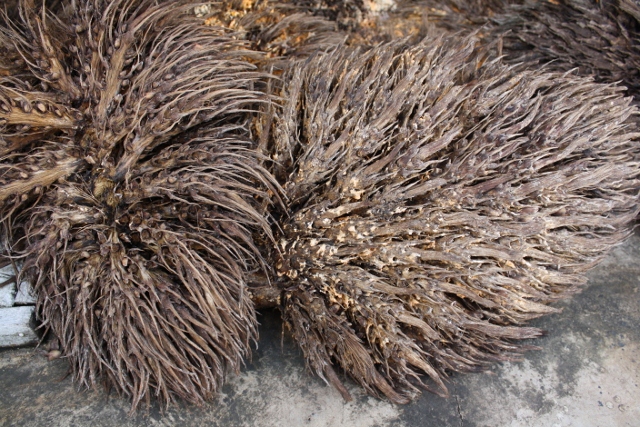
| EFB Ash, photo is taken from here |

 |
| Nutrient in Banana fruit and K have large portion on it |
 |
| Effect of K in banana yield |
After EFB densification or compaction product in the form of
briquettes or pellets then burned it will leave ash as combustion residue or
waste. Ash has many benefits for the life of plants. Ash
from EFB palm oil are also rich in various compounds, especially potassium (K)
which is necessary for the plant with the percentage ranges from 30-40%. Potassium has many functions for plant namely
transporting sugar, to control stomata on the leaves by maintaining
electro-neutrality in a plant cell, a co-factor of more than 40 enzime and
reduce the occurrence of various diseases. The ash of EFB can then be used as
organic fertilizer in the palm oil plantation itself and other plantations,
like banana. The high content of potassium in bananas and leaves, indicating
potassium is the most important nutrients in banana production. Some of
potassium from the soil is taken or removed from the plantation in the form of
a banana crop very much.
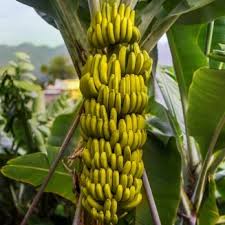 |
| Banana fruit |
Estimated loss of the potassium element from the soil
through the banana fruit alone reached 400 kg (equivalent to 480 kg K2O) per
hectare with a production of 70 tons of fruit. Based on these reason, the
banana still require high amount of potassium supply, although the content of
potassium in the soil is already quite high. A study on the banana tree with
K2O giving as much as 1000 grams / tree has given a bunch of banana weighing
29.4 kg. Some plants are also less suitable and sensitive element of chloride
(Cl), so that the portions need to be reduced or even eliminated. In the banana
plant, for example the high chloride make banana seedling growth is disrupted
and empty fruit. K2O is a compound in EFB ash can be used as ideal organic
fertilizer, replacing KCl fertilizer. Potassium fertilizers on the market today
KCl and K2SO4 (ZK). The price of KCl fertilizer is cheap because of subsidy,
while K2SO4 (ZK) fertilizer is expensive, following the dollar exchange rate
because it is not subsidized so that only generally only used by large estates/plantations.
Whereas if our plants need potassium fertilizer and does not contain chloride,
and ZK fertilizer price in the market is much more expensive, the EFB ash
fertilizer that rich of K2O can be a perfect solution.