Showing posts with label palm oil empty fruit bunch. Show all posts

Tuesday, January 2, 2018

Export Pellets Fuel And Soil Fertility

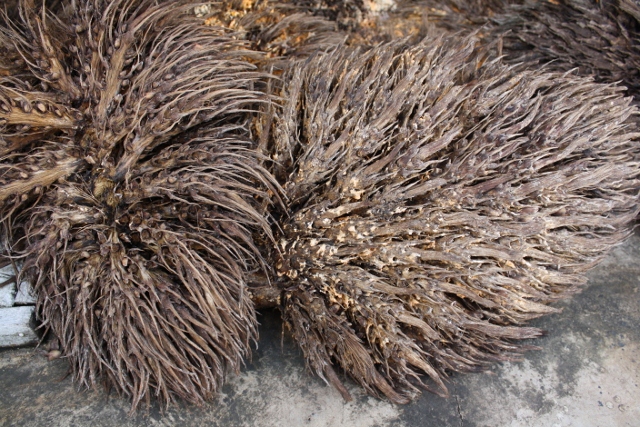
There are some people who worry if bioenergy export especially pellets fuel is done massively so soil fertility will decrease or the soil become damaged. Why are they worried about this? Because the intended pellet fuel is EFB pellets or empty fruit bunches of palm oilpellets . Empty fruit bunch of palm oil as raw material EFB pellet is indeed currently many processed into compost or solid organic fertilizer is used on the palm plantation. If there is no fertilizer or nutrients for the palm oil trees it is true that the fertility of the soil will be damaged. Wastes of palm oil plantations such as midrib and leaves can also be composted but will be even more difficult, because  first, as it requires additional effort to collect them, whereas EFB is produced daily in large quantities in palm oil mills so there is no need to collect them. While midrib and palm leaf is the waste of plantation that spread or scattered in the plantation itself. Second, EFB from palm oil tree have high water content because previously done steamming process in CPO production. The high water content of EFB palm oil or about 60% makes it easy to compost because the material is easily decomposed into compost. While the midrib and leaves are generally dry, making it more difficult to compost.

The problems above can be overcome by grazing livestock, especially sheep. With grazing, the grass between the palm trees becomes the feed for the sheep, manure becomes fertilizer for palm oil trees and meat for human consumption. With such grazing, humans can produce meat and fertilize palm oil plantations very economically. A success story reference of this grazing is Allan Savory a biologist from Zimbabwe, whose Holistic Planned Grazing concept has been applied today to about 16 million hectares worldwide or about twice the area of our oil palm plantations. There are a number of factors of sheep grazing superiority compared to cows, which can be read on this link, this and this.
Then what about the pellets fuel from woody biomass or wood pellet from energy plantations? Trees planted as energy plantation are generally leguminoesae whose roots are able to bind nitrogen (nitrogen fixing trees), so it can be a pioneer plant and can grow almost anywhere including in barren or arid lands. The trees are even able to fertilize the land that was originally arid or the dead earth. But to get the best wood productivity the fertile and well-maintained soil (although the treatment is also very easy) should be met. Prepared and precise sheep grazing is one such treatment at the same time we will produce the most economical meat.

Tuesday, March 21, 2017

Popularizing Wood Briquette For Renewable Fuels and Environmentally Friendly


The title of the utilization of renewable energy and environmentally friendly, has a bustling decorate various print and electronic media at this time. Availability of fossil energy are dwindling and unsustainable become a major driving force to give attention to renewable energy. Over time by increasing energy needs, it is inevitable renewable energy will become a mandatory requirement in time. Lignocellulose biomass such as woody is an abundant source that is easily obtainable as well as easily cultivated to the sustainability of their supply. Facts about the low use of renewable energy such as biomass can be viewed from a number of factors, including environmental awareness is still low, including letting productive lands without results even tend to occur desertification, lack of awareness of self or sovereign in the energy sector as one of the vital needs, the lack of or the lack of mastery of technology for renewable energy production and utilization resulting in the inability to see the potential of biomass is very large in tropical areas like our country.

Wood briquette is a product compaction (densification) biomass. Compared to wood pellets, wood briquette is also less popular and production not as much wood pellets. Technically wood briquette quality is not inferior to wood pellets, because in general the density of wood briquette is higher than wood pellets. In addition to the surface of wood briquette also occurr partial carbonized that makes it easy ignited. The large size of wood briquette makes it not easy to flow or be poured as well as wood pellets, which could be a factor that makes wood briquette less desirable. Basically wood briquette similar to wooden sticks as firewood used for cooking, with a density of approximately 2 times the hardwood so to burn is also not a difficult thing. Some furnaces are accustomed to using firewood will easily adjust to the wood briquette. 

Wood briquette is also less publicity than wood pellets, so wood pellets usually more popular. The use of wood pellets for various industries also have started to bloom as in the tea industry for the process of withering and drying the tea leaves themselves. The content of anthraquinone also be very low when using wood pellets as fuel for the process so that it can be accepted by European market in particular. Characteristics of wood pellets which can bulk this is what makes many selected.
Basically wood briquette also has the same functionality, only slight modifications to the furnace may be needed due to the large size. Resume biobriquette or wood briquette application can be read here. The use of wood briquette and mastery of production technology should be easier to do. Wood briquette has a longer produced in various regions in Indonesia, more than 20 years ago as an intermediate product in the production of sawdust charcoal briquette. Fabrication or manufacture of equipment for wood briquette production also has a 100% have been able to be produced in the country, in contrast to wood pellets that most of its production equipment is still imported.


In addition to the woody biomass waste, plantation waste such as empty fruit bunches of palm oil is also good potential compacted into pellets or briquettes. In the palm oil mill the energy needs both heat and electricity in general have been able to be satisfied by the mesocarp fiber and palm kernel shell. Palm Kernel shell even many left, and they can be sold because it can be directly used for fuel and could bulk as well as wood pellets. Large palm oil industry does not only produce crude palm oil or CPO (crude palm oil) but with a range of derivative products or purification/refinery to increase the added value of the CPO will need a lot of energy for the production process. Picture below about purification scheme (refinery) CPO to produce a wide range of derivative products. 

EFB briquettes as a source of energy that CPO refinery. A palm oil mill operations are efficient and zero waste with optimal utilization of wastes for energy resources could have done well with the above-mentioned mechanism. The ash from burning briquettes that are rich in potassium (K) also can be levied which will be used for organic fertilizer on palm plantations.

Saturday, December 26, 2015

Scrambling Biomass Waste Empty Fruit Bunch of Palm Oil: For Paper or Pellets?

In an effort to optimize the full potential of a number of oil companies are planning to process their wastes that resulting from the CPO production process. One of them is empty fruit bunches (EFB).  Two alternatives are being hotly debated is made pellets for energy and for the paper. Viewed from the business side, if it is profitable so is certainly not a problem for the production of both products. Availability of raw materials into one of the important factors in terms of production and business in general.

Further analysis can be done by looking in more detail in the production process technology, the amount of investment, ROI, environmental aspects, sustainability of core business (palm oil) and benefits of the products produced are a number of factors that will make it easier to eventually choose one. Further know more detail about the characteristics of each business such products will also further increase the stability of both products. In the end, the higher score determines the choice or priority of both, and if it turns out an analysis of both the same score then also no problem if both run concurrently if the resource is also capable.

Although the quality of pellets and paper products from palm oil waste raw material was also not the best grade when compared with paper products or pellet of woody raw material, but then when the business is profitable then it is nice to be produced as well. This dilemma is also experienced as agro-based plant (agro-industry), such as sugar cane factories, where baggase can be processed into paper or pellets.

Monday, September 21, 2015

EFB Pellets Great Potential in Indonesia and Malaysia Has Not Been Taken

Wood pellets are still occupying the highest grade biomass fuel than biomass pellets fuel from other than wood. This is because its combustion properties are better than others. But as the magnitude of the biomass energy needs,  it is necessary to look for some other alternatives. Palm oil empty fruit bunch (EFB) is a potential raw material for pellets. Currently, Indonesia is the biggest palm oil producing country, especially crude palm oil (CPO) in the world with an area of palm oil plantations of more than 7 million hectares and hundreds of palm oil milss to process the palm oil fruits. Palm trees require warm temperatures, sunshine and high rainfall, so that only some parts of the world can do that, those are Asia, Africa and South America. Palm oil production is dominated by Indonesia and Malaysia with an amount between 85-90% of world palm oil production. Empty fruit bunches itself is a waste of CPO production which are numerous and today generally untapped.


Another factor driving this is when the supply of raw materials by planting some sort of energy plantation perceived longer and require more capital, or when the availability of raw materials such as woody biomass derived from wastes of the wood processing industries has been limited, the empty fruit bunches of palm oil can be a strong candidate. While the other factor come from the palm oil mill itself that many industries were overwhelmed to handle empty fruit bunch waste itself. Those things are more encouraging empty fruit bunch (EFB) processing into EFB pellets.


In terms of combustion properties as EFB pellet is lower quality from wood pellets, so it should also be used technologies that are more appropriate (suitable) in accordance with the character of the EFB pellets product. Type of fluidized bed combustion technology is the best choice because it is able to optimally handle EFB pellets at once able to reduce the content of a number of negative traits. Chlorine is the most avoidable component of mainly pellets made from agricultural wastes such as EFB. The fluidized bed combustion technology has also been developed from along ago so that is supposed to achieve optimum combustion conditions of EFB pellets become easy thing to do.

Biochar, Soil Health, and the Sustainability of Palm Oil Productivity

Healthy soil is invariably fertile, but fertile soil is not necessarily healthy. Healthy soil teems with life—such as earthworms and other o...