Showing posts with label low carbon economy. Show all posts

Monday, February 10, 2025

If We Don’t Cut Emissions, Creating Carbon Sinks is Irrelevant

The concentration of CO2 in the atmosphere is already high so it must be reduced to save the earth. Efforts to reduce the concentration of CO2 in the atmosphere apparently cannot simply absorb CO2 from the atmosphere (carbon capture and storage). Maximizing the absorption of atmospheric CO2 but on the other hand CO2 emissions continue to increase, it will be very difficult (read: impossible) to reduce the concentration of CO2 in the atmosphere, let alone to a certain target agreed upon by the global community. So what makes sense is that CO2 emissions are not increased again so that the concentration does not increase further and existing CO2 is reduced to a certain level as targeted.

In practice, the production of wood chips and wood pellets as carbon neutral renewable fuels will complement each other with biochar. Wood chips and wood pellets do not add CO2 emissions and biochar absorbs CO2 as a carbon sink (carbon sequestration) or carbon negative. The application of biochar as part of carbon capture and storage (CCS) is currently developing the fastest compared to other CO2 reduction efforts (CDR / Carbon Dioxide Removal). Biochar leads in CDR credits in the voluntary carbon market (VCM), namely with more than 90% globally in 2023 as stated in the cdr.fyi database. From this data, it is estimated that at least 350 thousand tons of biochar have been produced globally in 2023 with an estimated 600,000 units or more of CDR credits (Carbon Credit).

And as in Europe, namely in 2023 there are a total of 48 new biochar plants, installed and operating, although 7 plants are closed, but a total of 41 biochar plants or an estimated total of 171 biochar plants are operating. And in 2024 there are an estimated 51 new biochar plants in Europe or in 2024 the total number of biochar plants is estimated to grow to more than 220 units. In terms of biochar volume, there is an estimated increase of 75,000 tons in 2023 and in 2024 the increase in production to 115,000 tons. Electricity production with 100% biomass fuel and equipped with carbon capture and storage (CCS) devices will also absorb CO2 or carbon negative, but this method is expensive and slow to develop. While biomass and coal cofiring because the cofiring ratio is small, efforts to reduce CO2 emissions are not too significant but cofiring is indeed the easiest entry point for using renewable energy in , especially in the energy or power generation sector (coal power plants). And in the end, creating a carbon sink, but the emission source is not reduced (cut), then it is the same as a lie or an irrelevant effort.

Saturday, March 29, 2014

Pellet Fuel from Corn Cobs and Stalks


Corn cobs and stalks is waste from the cultivation of corn. Generally both of the waste disposed of and is not utilized. The costly of energy prices, solution to problems of waste and increased value added by utilization of these wastes are the driving forces of the utilization of thay waste. Data for the year 2006 with the production of corn nationally 11.7 million tons,  the agricultural waste generated, i.e. 12.1 million tons. With the potential energy of the dried stems and leaves an estimated 66,35 GJ and corncob by 55,75 GJ certainly potential for a source of energy. Dried corn stems and leaves have a calorie value 4370 kcal/kg whereas the corn cob on 4451 kcal/kg at MC 7,53%.

Pelleting to be a pellets fuel is the best choice for the energy source. Pellets from waste agricultural corn can be used to fuel stoves on the agricultural area or for industrial or electricity generation and the potential for exporting abroad. Review of pellet fuel origin because from the waste corn agriculture these include biomass pellet or agri-pellets, that its specifications are slightly different from wood pellets. Production technology of  pellet from waste corn  is also almost the same as the production of wood pellets.


A number of areas where corn production centers throughout Indonesia is potential for developing these commodities due to the availability of raw materials, agricultural waste, tackle the problem of energy needs continue to rise and economic factors. As an environmentally friendly fuel, easily stored and used, as carbon neutral fuel will reduce the impact of climate change due to greenhouse gases and push low-carbon economy.

Saturday, January 11, 2014

Promote Energy Plantations

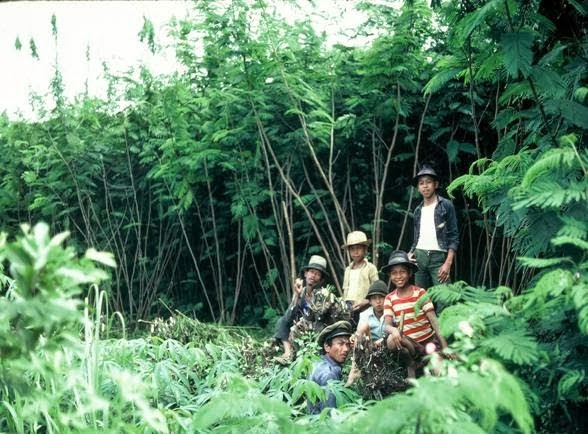
Photo is taken from here
Assuredness of supply of raw materials is absolutely necessary for the survival of industrial woodpellets, briquettes and other biofuels. Raw materials are homogeneous is better because it eases the process, compare with heterogeneous materials, such as raw materials are all derived from the tree trunk will be better than the raw material from a mixture of stems, midrib, leaves, roots, and so on. SRC with a short lifespan and can be harvested repeatedly is an ideal choice as energy crops. The extent of degraded land in Indonesia that reaches hundreds of thousands or even millions of acres of potentially utilized as an energy plantation by planting the SRC.

Gliricidia plantation
Calliandra and gliricidia are two types of SRC crops for energy plantation which has been widely cultivated as a pillar of wood pellet industry. Both the SRC plant was chosen because it requires prerequisites are easy to grow and thrive even live in degraded lands. It is possible to come at the same two advantages namely, sustainable supply of raw materials for industrial wood pellets and reforestation to prevent erosion, flooding and so on. Harvesting can be done after the age of about 1 year and crop later in the following year can be harvested again, up to a dozen times. Sri Lanka is one of the country due to lack of fossil energy then rested its energy from biomass, particularly the gliricidia plants. In addition to the stem can be used as raw material for wood pellet industry, the leaves can be fed to livestock, in addition to calliandra and gliricidia, the nectars can be used to farm honey bees.


Wood pellets are produced from raw material of calliandra and gliricidia has a high calorific value, ie more than 4000 kcal / kg, low ash content and high lignin content so as to facilitate the process of pelleting the wood pellets in the industry. Wood pellets for the main application as a source of renewable energy including carbon neutral fuel categories, this is because the source of wood biomass from photosynthesis using CO2 from the atmosphere and when used as a source of energy is released again into the atmosphere. So balance no additional CO2 in the atmosphere or carbon neutral.


The demand from countries such as South Korea with wood pellets made ​​from woody biomass only will further strengthen the promotion again this energy plantations for sustainable business. This is because the wood biomass has a number of advantages in calorific value, ash content and its ash chemistry than other biomass, especially agro-industry wastes. Compounds such as chlorine, sulfur and nitrogen is an important concern in the standard wood pellets.

Reject (Non-Standard) Coconut Fruit for Bioavtur / SAF Production

The international civil aviation organization (ICAO) has included non-standard coconuts on the ICAO positive list – ICAO document – ​​CORSIA...