Showing posts with label paris agreement. Show all posts

Thursday, May 21, 2026

Biochar Needs for the Iron and Steel Industry

As awareness of climate change and global warming grows, along with the Paris Agreement and Net Zero Emissions (NZE) 2050 targets for decarbonization, the use of biomass to produce biocarbon products is increasing. The iron and steel industry, in particular, faces significant demand, while supply remains limited. This has prompted several large companies to invest in large-scale biocarbon production, particularly biochar/biocoke.

Such large-scale production naturally requires abundant biomass feedstock. Specifically, in Indonesia, biocoke/biochar production from palm kernel shells (PKS) reportedly began last year. PKS was chosen because it is a readily available biomass waste product from palm oil mills. PKS and palm oil mill production in Indonesia is estimated to be around 12.5 million tons/year, but because some of the PKS is used as boiler fuel, the estimated usable PKS or remaining boiler fuel is around 6.25 million tons/year. To increase the supply of PKS from palm oil mills, cogeneration of empty fruit bunches (EFB) can be used. For more details, read here.

In addition to the PKS, biocoke/biochar and even black pellets (torrified pellets) are also produced using wood from energy plantations. Energy plantations with short-rotating crops like calliandra and gliricidia have great potential to produce this wood. Currently, wood pellets (white pellets) are being produced from these wood plantations. For more details on whether wood from energy plantations is better for wood pellets (white pellets) or biocoke/biochar/charcoal, read here.

Biocoke, biochar, and charcoal are used in the iron and steel industry as a substitute for coal-based coke in blast furnaces, while wood pellets (white pellets) and torrified pellets (black pellets) are used in power plants using both cofiring and fulfiring. In addition to their higher calorific value (around 20% higher than wood pellets (white pellets)), torrefied pellets (black pellets) are also hydrophobic, allowing them to be stored outdoors, like coal.

In today's era, the use of biocoke / biochar / charcoal to replace coal coke in blast furnaces is becoming important. Biocoke / biochar / charcoal derived from biomass is a renewable material that is sustainable as a reducing agent or fuel in blast furnaces. The chemical reaction will separate oxygen atoms from iron atoms and this will emit CO2. This will convert iron ore (Fe2O3) into crude (pig) iron.

However, the difference lies in the fact that the carbon source used as a reducing agent or fuel in a blast furnace comes from renewable and sustainable sources, making it a carbon-neutral process. Conversely, using coke from coal, as it comes from a fossil source, makes it a carbon-positive process. Similarly, using natural gas, a fossil fuel, as a carbon source for the reducing agent or fuel in a blast furnace, despite its lower carbon intensity, is considered less carbon intensive. 

Sunday, April 17, 2022

Mining Sector and Post-Mining Reclamation

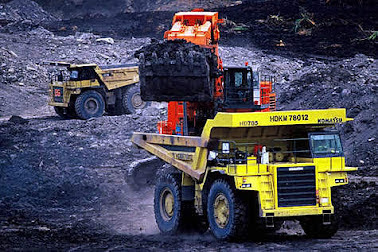
The photo is taken from here
Among the mining sector, coal is the largest mining product in Indonesia and even ranks third at the world level. In 2021 coal production was recorded at 576 million tons and it is projected that there will be only a slight decline in 2024, which is to 570 million tons. This coal is also the largest source of state income after Indonesia's oil can no longer be exported because production runs out for domestic consumption and even less so that it has to become an oil importer. But in the long term the future of coal is bleak as its use is increasingly restricted due to climate concerns. Countries that have ratified the Paris agreement have committed to reducing fossil fuels, especially coal with concrete steps, namely not building new coal power plants, cofiring with renewable energy at coal power plants, converting coal power plants into 100% biomass power plants (fulfiring) and closing a number of coal power plants and replace it with other renewable energy sources.

On the other hand, the post-mining activity also caused a lot of environmental damage, especially the land. Land damage will trigger natural disasters that endanger human life. Do not let the mining activities exploit its natural resources to the fullest but also leave natural damage that is no less severe. Of course this condition is very bad. The obligation of reclamation has also not been carried out properly, many even do not do it or just do it symbolically, imaging and mere formality while the purpose of reclamation itself is not achieved. The threat of a fine of 100 billion rupiah is also imposed for companies that ignore the reclamation to further encourage the reclamation activities.

According to Rizal Kasli, the general chairman of Perhapi (Indonesian Mining Experts Association), currently there are infrastructure and resource constraints (costs) in the implementation of the reclamation, namely for medium and small mining companies, for more details read here. This means that for large companies with large volumes of mining production there should be no obstacles, but stricter law enforcement is needed, according to Rizal Kasli. If large mining companies carry out reclamation properly, of course this is good and becomes an example for small and medium mining companies, but if the opposite happens, it will exacerbate environmental damage. Compensation or profit from the mining business should be in line and proportional to the improvement of the land or post-mining land (reclamation and rehabilitation).

The photo is taken from here
Why do a lot of mining companies generally ignore or neglect reclamation and post-mining land rehabilitation? In addition to the rules that are not strictly enforced, of course the problem is the cost. Mining companies have to spend a lot of money for the reclamation and rehabilitation of post-mining land, the costs depend on the conditions and the area of ​​the land. This of course burdens and reduces the profits of the mining company itself, causing reluctance. So even if reclamation and land rehabilitation are carried out, they are only symbolic, imaging and formality. This can be said to have no impact or achieve the goals of post-mining land reclamation and rehabilitation itself. 

Whereas the purpose of land reclamation and rehabilitation is one of the efforts to prepare fertile land for the future. So what if the reclamation turns out to be a profitable activity? This is certainly very interesting and motivating the mining companies. Bio-economy based reclamation and rehabilitation projects will be able to provide benefits for mining companies that do so. With these benefits, the land reclamation and rehabilitation program will be able to run well and sustainably, so that the entire post-mining area can be touched. We are currently developing a bioeconomic program for the post-mining land reclamation and rehabilitation, for more detailed information please contact us at cakbentra@gmail.com

Biochar, Soil Health, and the Sustainability of Palm Oil Productivity

Healthy soil is invariably fertile, but fertile soil is not necessarily healthy. Healthy soil teems with life—such as earthworms and other o...