Wednesday, July 16, 2025

Palm Oil Mill Operation with Pyrolysis and Biogas Unit Integration for Zero Waste, Maximizing Profits and Sustainability

The goal of a palm oil mill to achieve zero waste, maximum profit, and sustainability can be achieved, among other things, through the integration of pyrolysis and biogas unit. This is because nearly all solid and liquid waste from the palm oil mill can be processed into products needed by the palm oil industry, both in the palm oil mill for CPO (crude palm oil) production and on the palm oil plantation for FFB production. With pyrolysis, solid waste is converted into biochar, producing excess energy in the form of syngas and biooil for boiler fuel. Biochar is first used to increase biogas production before being applied to plantation or agricultural land. 

The biogas product can also be used as fuel for palm oil mill boiler, along with syngas and biooil. This method allows 100% of the palm kernel shell (PKS) to be sold or even exported, thus providing additional profits for the palm oil industry. Currently, 30-50% of the palm kernel shell (PKS) is generally used for boiler fuel, mixed with mesocarp fiber, and the remainder is sold or exported. Biochar production with pyrolysis. The biogas product can also be used as fuel for palm oil mill boiler, along with syngas and biooil. This method allows 100% of the palm kernel shell (PKS) to be sold or even exported, thus providing additional profits for the palm oil industry. Currently, 30-50% of the palm kernel shell (PKS) is generally used for boiler fuel, mixed with mesocarp fiber, and the remainder is sold or exported. Biochar production by pyrolysis can utilize both coconut fiber (MF) and empty fruit bunches (EFB) of palm oil. The integration scheme is as follows:

 
The use of biochar on plantations and agricultural lands will save or reduce the use of chemical fertilizers. This is especially true for oil palm plantations, where the largest operational cost is the use of chemical fertilizers. Reducing chemical fertilizer use will result in savings in fertilizer costs. Furthermore, it will provide other environmental benefits, reducing environmental impacts by minimizing waste from excessive chemical fertilizer use. Biochar slow-releases chemical fertilizers, increasing fertilizer efficiency or Nutrient Use Efficiency (NUE). Furthermore, when combined with biochar and organic fertilizer from biogas residue, the slow-release capacity of chemical fertilizers is further enhanced, resulting in higher NUE. Furthermore, another pyrolysis byproduct, pyroligneous acid (PA), is also highly beneficial for palm oil plantations as a liquid organic fertilizer and biopesticide.

Another source of income is carbon credits, or BCR (biochar carbon removal). Furthermore, carbon credits are currently a strong motivator for producers to produce biochar. To obtain these credits, biochar producers must register with a carbon standards organization and follow their methodology. Some popular carbon standards organizations include Puro Earth, Verra, and CSI. Meanwhile, for biogas production, carbon credits can also be obtained through methane avoidance mechanisms. However, the price of biogas from methane avoidance is usually lower than carbon credits from carbon removal or carbon sequestration with biochar. However, both can be accumulated and yield greater profits.

The operational potential of palm oil mills with integrated pyrolysis and biogas units for zero waste, maximizing profits, and sustainability is enormous and is predicted to become a trend because financial returns align with environmental benefits. Furthermore, environmental and sustainability issues are currently a global concern. With approximately 17 million hectares of palm oil plantations and 5.5 million hectares in Malaysia, the potential for biomass waste, particularly EFB and mesocarp fiber for biochar production, and POME waste for biogas production, is abundant. Globally, palm oil plantations cover nearly 27 million hectares. By 2024, Indonesia will be the world's top CPO producer with 56%, followed by Malaysia with 26%, and Thailand with 5%. There are more than 1,000 palm oil mills in Indonesia and approximately 500 in Malaysia. 

Competing in Goodness in Lowering the Earth's Temperature

Competing to lower the global temperature is a good thing. Competing in good deeds is highly encouraged in Islam. The negative impacts of global warming can be felt on land and at sea, and therefore must be minimized. This is why various parties involved in this effort should collaborate and synergize to achieve this goal. The business aspect of this activity should be a secondary priority, so that a spirit of good deeds, collaboration, and synergy will be fostered. Technically, strategic sectors that are the main causes of global warming are an important priority to address, although other, more pressing matters must also take precedence.

There is an excess concentration of carbon (CO2) in the atmosphere that causes the earth's temperature to rise due to the greenhouse gas effect, but on the other hand there are billions of hectares of land on earth that need carbon in the form of biochar to increase soil fertility as well as to absorb CO2 in the atmosphere with carbon sequestration / carbon sink. If these two things can be synchronized, it will be an effective solution to reduce the earth's temperature. In 2024, CO2 emissions from fossil fuels were recorded at around 36.3 giga tons (36.3 billion metric tons) and the latest CO2 concentration according to the Mauna Loa observatory in Hawaii reached 429.25 ppm (on June 24, 2025). Meanwhile, on the land side, globally an estimated 1.66 billion hectares of land have been degraded due to human activities such as deforestation, overgrazing, mismanaged irrigation, and excessive use of chemicals. 

Biomass fuel, produced by producing wood chips and wood pellets, or biofuel, is a carbon-neutral renewable fuel or source, thus complementing biochar. Wood chips and wood pellets, or biofuel, do not increase CO2 emissions, and biochar absorbs CO2, acting as a carbon sink (carbon sequestration), or carbon-negative. 

Monday, July 14, 2025

Biochar and Biographite for Decarbonization in the Iron and Steel Industry

The decarbonization trend continues across all sectors, particularly strategic industries such as the energy industry, iron and steel industry, and transportation. These industries contribute significantly to CO2 emissions, which increase atmospheric concentrations (carbon positive). The energy industry, particularly power generation, contributes 27.45%, the steel industry 8%, and the transportation sector 24%. With an estimated total CO2 emissions from fossil fuels of 36.3 gigatonnes (36.3 billion metric tons) in 2024, the iron and steel industry's contribution is approximately 2.9 gigatonnes (2.9 billion metric tons).

In the steel industry, carbon neutral production will be achieved when iron and steel production in the industry uses 100% renewable energy. The use of electric arc furnaces (EAFs) can be done as long as the electricity is generated from renewable energy sources. However, the use of EAFs that still use electricity from fossil fuels can be a transition medium before 100% carbon neutral production because of its lower CO2 emissions compared to blast furnaces that use coke from coal. CO2 emissions from blast furnaces are around 2.33 tons for each ton of crude iron / pig iron, while with EAFs, they are only around 0.66 tons for each ton of crude steel. The raw material processed with EAFs is steel scrap, and approximately 80% of steel scrap is currently recycled with EAFs. Globally, steel production with EAFs reaches approximately 22%.

And the fact is that currently, to achieve this goal is still far because the construction of blast furnaces - basic oxygen furnaces (BF -BOF) is still being carried out a lot, which should be EAF (Electric Arc Furnace) or currently only about 30% of the global iron and steel industry uses this EAF. The construction of new blast furnaces is indeed tending to increase, in fact, by mid-2024, around 207 million tons per year of new production has been announced and around 100 million tons per year is under construction.

Nearly all CO2 emissions in the steel production sector come from blast furnaces (BF) for refining iron ore into crude iron or pig iron. The challenge is enormous: there are approximately 1,850 steel mills worldwide, with approximately 1,000 using blast furnaces, with pig iron production reaching approximately 1.5 billion tons per year. The International Energy Association (IEA) has even highlighted this critical issue in achieving the Paris Agreement's net-zero target by 2050. With an average blast furnace lifespan of 20 years, the iron and steel industry's efforts to achieve this target must be well-formulated and programmed. Failure to replace blast furnaces within the specified timeframe will jeopardize the 2050 net-zero emissions target.

This makes the use of charcoal to replace coal-based coke in blast furnaces crucial. Charcoal derived from biomass is a renewable, sustainable material used as a reducing agent or fuel in blast furnaces. The chemical reaction separates oxygen atoms from iron atoms, releasing CO2. This converts iron ore (Fe2O3) into crude (pig) iron. The difference is that because the carbon source as a reducing agent or fuel in blast furnaces comes from renewable and sustainable sources, this process is carbon neutral. Using coke from coal, which comes from fossil fuels, is carbon positive. Similarly, using natural gas as a reducing agent or fuel in blast furnaces, despite its lower carbon intensity, is still carbon positive. 

However, if hydrogen from renewable energy sources (green hydrogen) is used as a reductant in the blast furnace, it will not produce carbon emissions but will produce water vapor (H2O), thus it is also a carbon neutral process. However, this will still take a long time, predicted to take several decades to implement. To produce a carbon negative process, the iron and steel mills that are already operating carbon neutrally must be equipped with CCS (Carbon Capture and Storage) devices, which will certainly be the next step. Furthermore, the use of renewable energy as an EAF energy source is also becoming increasingly important and must be accelerated, which should also be in line with the use of bio-graphite in the EAF.

The use of EAF in iron and steel mills is estimated to reach 550 units worldwide with steel production reaching around 548 million tons or around 30% of the world's steel production which will reach around 1.8 billion tons in 2024. The use of EAF requires graphite electrodes and every ton of steel produced requires an average of 3 kg of graphite. The current source of graphite is almost all derived from fossil sources so it is a source of carbon emissions (carbon positive) and also currently around 80% of the world's graphite supply comes from China. With steel production from EAF of 548 million tons, the annual graphite demand reaches more than 1.6 million tons. Every ton of graphite production from fossil materials emits CO2 emissions of 17-40 tons.

This makes the use of biographite crucial because it is carbon-neutral, producing CO2 emissions. Biographite is produced from biochar, or charcoal, which undergoes a special purification process. The biochar is converted into high-purity graphite suitable for EAF electrodes. Biographite is used for its strength, density, and conductivity, not only because of the CO2 emissions mentioned above, but also because of its technical advantages. Naturally mined graphite cannot meet these technical specifications, while synthetic graphite from fossil fuels is not environmentally friendly and is highly dependent on imports. This is the driving force behind biographite production.
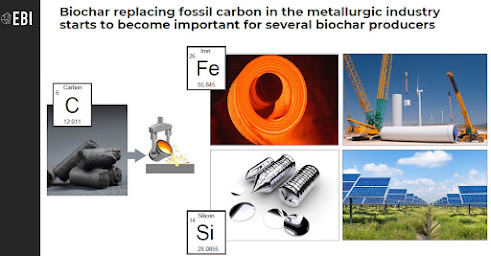
The demand for biochar or charcoal as a reducing agent in BF will be very large, while for biographite as an EAF electrode is not as large as in BF. This makes it crucial to obtain a source of biomass raw materials as a source of biochar or charcoal in sufficient volume, good quality, and sustainable. Similarly, in terms of biochar or charcoal production, which primarily uses pyrolysis/carbonization technology, it must also be able to produce products with adequate quality and quantity, sustainably, and with a production process that is high in productivity, efficient, and environmentally friendly. Biochar or charcoal with specifications of at least 85% fixed carbon and a minimum conversion (gravimetric yield) of 30% is the reference for selecting this pyrolysis technology. 

In addition to biomass waste groups such as forestry waste and plantation waste, energy plantations can also be specifically created for this purpose, for more details read here. These energy plantations must also be created according to the land allocation and area of ​​monoculture energy plantations in accordance with proper planning and procedures, as well as efficient and environmentally friendly pyrolysis / carbonization technology. Biomass sources as raw materials for charcoal / biochar can also be said to be sustainable if the harvested product is less or at most equal to the growth of the plantation's wood. This is to prevent what happened in Brazil, namely in the state of Minas Gerais. Due to the large area of ​​monoculture eucalyptus plantations whose wood products are mostly for charcoal production for iron and steel mills, this has caused various negative impacts on the environment. Brazil is the world's largest charcoal producer and produced 5.2 million tons in 2017, 90% of which was used by the iron and steel industry, with 80% of the charcoal produced from eucalyptus plantation wood.

Approximately 70% of Brazil's iron and steel production occurs in the state of Minas Gerais, and this sector is unique in that 34% of iron production uses charcoal, not mineral coke/coal, and coke is also widely used in steel production. Historically, this was due to a lack of mineral coke in Brazil, but abundant forests for coke production. Minas Gerais currently has nine steel mills and 41 iron plants producing 3.1 million tons of crude iron in 2018, approximately 50% of which was exported. In 2018, Brazil had 5.7 million hectares of eucalyptus plantations, and Minas Gerais continues to have the largest plantation area in the country, covering 24% (1.4 million hectares) of Brazil's eucalyptus. Iron and steel companies also have eucalyptus plantations in an effort to secure a supply of charcoak for their iron and steel mills. Indonesia also has vast land potential, reaching hundreds of millions of hectares for these energy plantations. 
Sunday, June 15, 2025

Wood Pellet Production, Solution to Urban Wood Biomass Waste Problems

Sorting is 50% of the solution to the problem of urban waste. The best sorting is at the location where the waste is generated, such as in households in housing or residential areas. With sorting, further waste processing will be much easier. The better the sorting is done, the easier the waste processing can be done. The reluctance of the community to sort waste makes the waste problem more complicated, prone to social conflict and protracted. Although difficult and complicated, cultivating waste sorting must continue to be done because if not handled it will become a serious environmental problem. The paradigm of waste processing also continues to change according to conditions, namely related to environmental impacts, availability of landfills, types and volumes of waste, as below.

If urban waste or MSW (municipal solid waste) can be sorted and processed properly, the environment will be clean and healthy. For example, such sorting is leaf waste made into compost, organic waste from the kitchen and leftover food for maggot feed or farming, wood waste in the form of twigs, pieces of wood and so on for wood pellet production, and plastic waste to be pyrolyzed into fuel or naphtha. And to be processed adequately, the volume of waste must also be sufficient and continuous. This is because the procurement of units for waste processing is also quite expensive. Waste processing should also be decentralized, so that it does not pile up in one place. The production capacity of the village or sub-district scale seems quite good and suitable for the manufacture of such waste processing units.

Among the urban waste is wood waste in the form of twigs, pieces of wood and so on that can be used for the production of wood pellets or wood pellets. The wood waste can come from pruning and felling trees, wood processing industry waste or wood that clogs waters such as rivers. The use of wood pellets or wood pellets can be for household cooking or SME industries. The use of wood pellets in addition to being a fuel or renewable energy that is environmentally friendly, easy to store and use and a solution to overcome biomass waste and reduce LPG imports which are worth around IDR 63.5 trillion each year.

Along with the innovation that continues to be done, wood pellet cooking stoves are becoming easier to use, efficient, clean and safe. For local governments, the production of wood pellets from wood waste also provides many benefits, namely as a solution to handling the waste, creating jobs and socializing the use of environmentally friendly renewable energy for the community. If this is successfully done, in the future the utilization of wood waste can continue to be developed.

Optimization of Palm Oil Mill Operations to Maximize Profits by Utilizing EFB Waste

As a profit-oriented company, palm oil companies will also do various things necessary to maximize their profits, both in the operations of their palm oil mills and on their plantations. The more efficient the operations of the palm oil mill, as well as on its plantations, the higher the profits obtained. Minimizing the environmental impact of waste produced, even zero waste, and becoming part of responsible and sustainable environmental management practices, including part of climate solutions, are important parts of this industry that cannot be abandoned. That is why palm oil mills must innovate to achieve optimal conditions. To achieve these conditions, it can be done by evaluating current practices and finding better solutions.

CPO (crude palm oil production) requires steam for the sterilization process. This is why palm oil mills definitely need boilers for their production process, for more details read here. Steam from the boiler is also used for power generation with steam turbines to drive generators. The operation of the boiler is generally carried out by burning fiber (mesocarp fiber) and some palm kernel shells / PKS, so that some palm kernel shells /PKS can still be sold or even exported. This common practice in palm oil mills has also been running for decades, but it turns out that there is still a lot of biomass waste from palm oil mills that has not been utilized, especially empty fruit bunches or EFB (empty fruit bunches) which account for around 23% of the fresh fruit bunches (FFB) processed. These EFBs are usually only piled up behind the palm oil mill and tend to pollute the environment.

The EFB can be processed into biochar. Biochar production with thermal processes, either pyrolysis or gasification, will produce energy as cogeneration in palm oil mills. Cogeneration is the right solution for biochar production while supplying energy needs for boiler operations. In this way, 100% of palm kernel shells / PKS can be sold or even exported, meaning that palm oil companies' profits are greater. But to maximize biochar production, pyrolysis is the right choice. This is because gasification technology is to maximize gas products while pyrolysis is to maximize solid products (biochar). By-products from pyrolysis are also beneficial for the palm oil industry.

Empty fruit bunches (EFB) are solid waste from palm oil or CPO production which is the largest in number. This is what makes many machine manufacturers make these EFB processing machines. Most of the machines made are equipments for cutting and pressing the EFB so that the water content decreases and the material size becomes smaller. However, both the water content and the size of the EFB as the output of the machine or equipment still do not meet the requirements to be further processed into biochar. The typical output is more than 4 inches and the water content is more than 45%. EFB must have a low water content of 10% and can be less than 1 inch for biochar production or as fuel in the boiler.


To obtain the EFB with a dryness level or water content of 10%, waste heat recovery from palm oil mills can be utilized for the drying process. Other biomass waste from the palm oil industry can be utilized as fuel or a source of heat energy for drying the EFB. By utilizing these biomass wastes, mill operations can be more efficient so that profits are maximized and environmentally friendly with zero waste. 

Sunday, June 1, 2025

Empty Fruit Bunch of Palm Oil Processing: for Pellets, Briquettes or Biochar ?

Empty fruit bunches (EFB) are solid waste from palm oil mills or CPO production which is the largest in number. This is what makes many machine manufacturers make these EFB processing machines. Most of the machines made are equipments for cutting and pressing the EFB so that the water content decreases and the size becomes smaller. However, both the water content and the size of the EFB as the output of the machine or equipment still do not meet the requirements to be further processed into pellets, briquettes or even biochar. The typical output is more than 4 inches and the water content is more than 45%. EFB must have a low water content of 10% and a size of 5-6 mm to be able to make pellets or briquettes, and less than 1 inch for biochar production.

To obtain suitable raw materials for pellet, briquette and biochar production, the EFB that has been cut and pressed still needs to be reduced in size (size reduction) and its water content reduced to about 1/3 so that it is dry enough. Equipments such as a hammer mill or crusher is needed to reduce the size and a drying tool such as a rotary dryer is needed to reduce the water content. The smaller the size of the material (particle size) and the lower the water content or the drier it is, the more energy is needed. Equipment such as hammer mills and rotary dryers have not become an integral part of EFB processing at this time. However, usually EFB palm oil processing producers also produce press equipments for kernels for the production of kernel oil or PKO in kernel processing plants or KCP (kernel crushing plants) with by-products in the form of palm kernel meal or PKE (palm kernel expeller). 

Considerations for selecting pellet, briquette or biochar production from EFB palm oil depend heavily on the readiness of the business. It is estimated that there are 30 million tons per year of dry EFB palm oil in Indonesia and 10 million tons per year of dry EFB palm oil in Malaysia for raw materials for these products. The use of EFB palm oil waste, in addition to being a solution to waste problems in palm oil mills, will also provide additional benefits for the palm oil mill or company. How much profit is usually also proportional to the investment and production capacity made. With the abundance of potential raw materials and the driving force of sustainability and zero waste, EFB palm oil waste will become an attractive new business. 

Biochar for Biographite, Important Material for Future Strategic Industries

The decarbonization trend continues in all sectors, especially in strategic industries such as the energy industry, iron and steel industry, and transportation equipment industry. The contribution of a number of these industries in producing CO2 emissions that increase concentrations in the atmosphere (carbon positive) is very significant, namely the energy industry, especially power plants, contributing 27.45%, the steel industry contributing 8%, and the transportation sector industry 24%. Various efforts have been made to reduce CO2 emissions from these fossil sources. Biographite is one of the important components for this purpose. The use of graphite currently comes from fossil sources, namely petcoke and coal tar, which are synthetic graphite. This is because graphite mined in nature cannot meet the expected technical specifications in the form of strength, density and conductivity.

Graphite is a material that is used for steel making, lithium ion batteries, nuclear power plants, fuel cells and the defense industry. In the steel industry, every ton of steel produced with EAF uses 2-4 kg of graphite electrodes. On average, each electric car battery contains 70 kg of graphite. According to the Economist, in 2030, the demand for graphite is expected to exceed supply by 1.2 million metric tons, threatening the steel and battery industries. Meanwhile, according to the IEA for Europe, the need for graphite is predicted to increase by around 20-25 times from 2020 to 2040. Including why currently there is no very large battery capacity so that even coal-fired power plants or from fossil sources can be eliminated, it is very possible because of this graphite problem. In addition to graphite, nickel is an important component in lithium-ion batteries used in electric cars with an average of 30 kg, especially in the cathode. Nickel helps increase the energy density and storage capacity of batteries, allowing electric cars to have a longer range.

In the steel industry, carbon neutral production conditions will be achieved when iron and steel production in the industry uses 100% renewable energy. The use of electric furnaces (EAF / Electric Arc Furnace) can be done as long as the electricity is generated from renewable energy sources. And the fact is that currently to achieve this goal is still far because the construction of blast furnaces - basic oxygen furnaces (BF -BOF) is still widely carried out, which should be EAF (Electric Arc Furnace) or currently only around 30% of the global iron and steel industry uses this EAF. Even the International Energy Association (IEA / International Energy Association) highlighted this critical issue to achieve the Paris Agreement's net-zero target by 2050. With an average blast furnace life of 20 years, the iron and steel industry's efforts to achieve the target must be formulated and programmed properly. Even if the blast furnace replacement effort does not follow the target time, it will put the achievement of net zero emissions 2050 in danger. This makes the use of renewable energy as an energy source for EAF increasingly important and must be accelerated, which should also be in line with the use of bio-graphite in the EAF.

The use of biographite will reduce CO2 emissions and reduce dependence on imports. Bio-graphite which is basically derived from biomass offers a sustainable alternative solution to graphite derived from fossil materials. When applied in steel mills with EAF, although biographite emits CO2 emissions when used, this CO2 or carbon comes from biomass. And the biomass from the plant absorbs CO2 from the atmosphere when it grows, making the process carbon neutral. The bio-graphite production process begins by converting biomass into biochar. Furthermore, with special purification, the biochar is converted into high-purity graphite which is suitable for electric arc furnace (EAF) steel electrodes and battery anodes.

Graphite demand / supply showing market deficit beginning 2025E 
 Source: Macquarie Research (March 2023)

With the potential for various applications in a number of strategic industries, bio-graphite is not just a new environmentally friendly material but an important material supporting future industries. The shortage of this material could slow the transition to electric vehicles and renewable energy storage, which has an impact on many industries. And specifically in the steel industry, the shortage of this material will threaten to increase the cost of steelmaking and hinder progress towards climate goals. This is why the development of biochar production for biographite is very important and needs to be accelerated for the growth of various green industries or renewable industries in the future. 

Biochar, Soil Health, and the Sustainability of Palm Oil Productivity

Healthy soil is invariably fertile, but fertile soil is not necessarily healthy. Healthy soil teems with life—such as earthworms and other o...