Showing posts with label wood waste processing. Show all posts

Monday, October 26, 2020

Utilization of Land Clearing Wood Waste For Charcoal And Briquette Production

Land clearing is mostly done, especially for the establishment of new plantations, both plantations for food crops and plantations or forests for wood products. The establishment of palm oil plantations and acacia forests are examples. Prior to planting palm oil or acacia, the location which is usually natural forest was cleared of vegetation or trees beforehand. Natural forests, of course, have various types of trees, both in terms of their types and ages. Some trees have a large diameter while others are smaller. After clearing the old trees, then the land is conditioned for the allocation of the plantation.

Indeed, the establishment of the plantation or forest must be in accordance with the land designation. Of course, land that is protected forest or conservation forest cannot be used for production forest or industrial plantation forest. This of course concerns environmental factors in the form of environmental preservation, such as forests as a source of water, preventing the danger of landslides, as a carbon sink and so on. The economic activities of production forests must also pay attention to environmental aspects so that the business being carried out can also be sustainable. Wood, for example, as a source of biomass for various industrial raw materials, can be said to be a renewable source only if it is managed properly and sustainably.

During the land clearing, a lot of wood just becomes waste. Timber with large diameters can be sold to sawmills. However, small diameter woods such as branches and twigs are mostly not utilized, even though there are many. The solution to this problem can be processed into charcoal and briquettes. Non-salable logs for sale in sawmills can be used for charcoal production. With good technology, high quality charcoal production can be done, namely with a fixed carbon of more than 82%. Production quantity up to 3000 tonnes / year of charcoal are also possible. Meanwhile, waste wood in the form of smaller twigs or pieces of wood can be used for briquette production. The production of briquettes is easier and also cheaper than wood pellets. Another thing that distinguishes briquettes from pellets, especially the market segment, can be read here for more details.

Sunday, June 2, 2019

Wood Waste of Replanting For Sawdust Charcoal Briquette Production

Palm Oil Trunk
Rubber Wood
At a certain age the trees on large plantations are no longer productive so they need to be replanted to maintain the sustainability of the plantation business. Two large plantation groups in Indonesia, which cover millions of hectares, are palm oil plantations and rubber plantations. Wood waste from the trunks of these trees can reach thousands or even millions of tons, and is generally not utilized. Indeed, there are uses of replanting wood waste for furniture, buildings and household appliances industries, but the portion is still very small so it cannot absorb the huge volume of wood. For example rubber wood can also be used for industrial furniture, wood and building wood, as well as palm oil logs. Even rubber wood is also used for making particle boards such as MDF (Medium Density Fibreboard) or HDF (High Density Fibreboard).

Sawdust Charcoal Briquette
Sawdust Briquette Charcoal in Carton Box
The utilization or processing of replanting wood waste for the production of wood charcoal briquette (sawdust charcoal briquette) is the right solution for this problem. Large market potential factors and product specification requirements that are not too difficult make this business attractive. In contrast to wood pellet products which are usually for power plants that require large volumes of supply and very strict specifications, so sawdust charcoal briquette products in addition to the volume of supply also do not have to be large and the specifications are more loose. This is because the use of sawdust charcoal briquette is for barbecue or more specifically mostly for roasting lamb meat in Saudi Arabia, the Middle East and Turkey. In wood pellets for electricity generation specifications are often difficult to fulfill, especially in the chemical aspects of ash such as chlorine, potassium and even sulfur, to be more clearly read here. Whereas in the production of sawdust charcoal briquette for chemical ash, the level of which is only ppm is not a problem at all.
Charcoal Briquette Production Route
Many people think that the production of sawdust briquette charcoal requires additional adhesives such as starch (tapioca), this is understandable because many people still do not know about the production process of the sawdust charcoal briquette. To produce charcoal briquettes in general, using charcoal raw material is then crushed into powder and added adhesive (such as starch) and then briquetted. The briquette product is then dried and packaged to be marketed. The production process of charcoal briquettes in this way is less good and less acceptable to the market. While the production process by means of the wood is crushed about the size of sawdust and then dried and then briquetted. The briquetting does not require adhesive because in wood there is always a lignin compound, which is useful as the adhesive. Furthermore, the briquettes are carbonized to increase fixed carbon and reduce volatile matter. Charcoal briquette products in this way, commonly called sawdust charcoal briquette, have better quality and are in demand by the market. The above scheme is enough to explain 2 routes of the production process of two types of charcoal briquettes.
Wood waste of replanting in time will also run out and be replaced by new plants. How can the sawdust charcoal briquette production business continue? A production unit certainly requires a supply of raw materials. To be able to continue to supply raw materials for production, one alternative is to make energy plantations. The energy plantations can be with fast rotation plants such as calliandra or gliricidae. To optimize woody biomass productivity and business, the energy plantation should be integrated with sheep, cattle and honey bee farms. And for more details can be read here.

Sunday, July 29, 2018

Set Up Wood Charcoal Briquette Production in ASEAN Countries

ASEAN countries have large forests and various forest resources. However, there is a decrease in some countries due to irregular logging in some countries. This is why sustainable forest management is needed to maintain the biomass of forest resources. Indonesia has the largest forest area, but has declined since 1990 primarily due to illegal logging and forest fires. Malaysia has the highest number of biomass and forest growth in area ratio, while Thailand is the lowest. This could also be due to higher rainfall in Malaysia compared to other ASEAN countries, which is 2,875 mm / year, with an world average of 900 mm / year and Indonesia 2700 mm / year. For more details can be seen in table below. Indonesia and Malaysia mainly produce sawn wood and plywood, while Thailand is wood chip and particle board. Vietnam produces many sawn wood, while Cambodia and Laos consume lots of logs as fuel.
Wood charcoal briquette or sawdust charcoal briquette have a very high market especially in Middle East, Saudi Arabia and Turkey. These countries use sawdust briquette charcoal to bake the meat, especially the lamb which is a favorite food there. The production of sawdust briquette charcoal uses logging residues and industrial wood residues. This should be the extent of forest and wood processing industries comparable to the sawdust briquette charcoal industry. The abundant logging wastes are usually the tops of small diameter trees and branches. The logging waste is about 100% average for the production of the logs themselves, so that the amount is huge. Sabah, Malaysia and Kalimantan, Indonesia produces many of these logging wastes at very cheap prices.
As for waste wood processing industry is usually in the form of sawdust, and wood pieces both board and round wood. It is estimated there are 1600 sawmills and 120 plywood factories in Indonesia. The raw materials of the plywood industry are originally from natural forest, but as demand continues to increase the supply of natural forest timber decrease so that it shifts with wood from the planted trees. When using wood from natural forest, the diameter of wood can be more than 70 cm and when using wood the trees planted wood diameter is only about 30 cm. Samarinda, East Kalimantan, Indonesia at first many plywood factories were operating but due to the declining timber supply of many of these factories which shut down production. The yield of plywood from raw materials is 50%, while the remainder becomes waste. Part of the waste is used for block board and packing material, but only about 10%, so 40% is still waste. 
While in Malaysia, the total volume of wood industry waste estimated 7.5 million cubic meters per year. The highest sawmill waste in Sabah, while plywood waste in Sarawak. Sawmill produces sawn wood products ranging from 40-65% and the remaining 35-60% are sawdust. While yield for ply wood ranged 50-60%, while 40-50% as waste. For the molding plant its yield is higher ie 70-74%, means waste 26-30%. Percentage of wood waste from 75% ply wood industry and 25% from saw mill industry. Utilization of wood industry waste is still not optimal, even just stockpiled and then burned because it is considered polluting the environment.

In Laos, there are about 200 wood processing factories (furniture, packing materials, flooring and doors) located mostly around Vientiane, the capital of Laos and only one plywood factory. Charcoal producers are scattered everywhere in the country due to high demand for households. The yield of the wood processing industry is about 60%, so that 40% is waste. Utilization of waste is also not optimal, such as sawdust just dumped just behind the saw mill.
Production of sawdust briquette charcoal (wood briquette charcoal) will be the solution for the utilization of such waste. Sawdust is the best raw material because it does not need size reduction and can be shorter production process. Whereas if the waste is still in the form of pieces of wood then it needs for size reduction first to the size of the particle like sawdust. After that if the wood powder is still wet (moisture content more than 10%) it is necessary for drying with a rotary dryer or drum dryer. Furthermore, after dry powder material is followed by briquetting and carbonisation process into sawdust briquette charcoal as the product. 

Tuesday, July 24, 2018

Production of Pellets and Briquettes from Waste Of Albasia Wood Working Factories

Albasia is a tree that many people planted in various areas within the forest area. It is currently estimated that the albasia plantation area is more than 1 hectare in Indonesia. Wood is the main product of the albasia plantation. The wood is processed into various products of logs, wood boards, plywood, barecore, to pallet. Albasia wood is softwood and produced from the harvest timber of the plantation is at the age of trees approximately 5 years. The centers of albasia plantations in Indonesia are centered on the island of Java and Kalimantan.

Waste from the albasia wood processing are sawdust, pieces of wood, bark and wood shavings. There are still many untapped waste and pollute the environment. The production of wood pellets and wood briquette with these raw materials will overcome environmental problems, move the economic sector from waste treatment or especially bioeconomy which is predicted to be a trend in the not too distant future. The simplest wood processing industry of albasia is sawmill which is the most number of processing compared with the industries downstream. Each sawmill on average produces waste of sawdust 3 m3 / day (600 kg / day) so that for 10 saw mills will produces 6 tons / day of sawdust with an average moisture content of 30%.

The production of briquettes and pellets from wood waste is much in common, because basically the same technology that is biomass compaction (biomass densification). Differences from the production of briquettes and pellets only at the end process namely compactor or the press machine. In the industrial production of pellets will produce the same form that is in the form of cylinder, only the diameter is different and there is no difference pelletisation technology. Ring die pellet press is a pelletiser commonly used for biomass pelletisation in industry especially made from woody biomass raw material. While on briquettes, in addition to different sizes, the shape of the briquettes also vary. Briquettes generally also have a higher density than pellets, even more than a twice. Pellet has a density of about 650 kg / m3 while briquettes can reach 1400 kg / m3.

The easiest way to distinguish briquettes with pellet that is from the physical size. Briquettes have larger size than pellets. Generally, briquetting is also easier than pelleting process. Unlike the pellets that only use the roller press, briquette production using several kinds of technology namely, screw press, hydraulic and piston press. A brief review of the technology can be read here. Screw press technology has many advantages over hydraulic and piston press, such as screw press technology briquettes also have holes in the centre so as to facilitate combustion, and also easy for carbonisation. Screw press technology also produces briquettes continuously, unlike the hydraulic in batch operating.
Another factor that also greatly affect the processing of albasia wood waste processing is, of course, investment or price equipment or production units. Pellet production units are generally more expensive than briquettes, even the briquette production unit is only about half the pellet production unit. This makes briquette entry barrier for production easier or smaller than pellet production. Even briquette screw press technology has been well mastered in Indonesia including up to carbonization process and has been operating for more than 25 years. Fabrication and spare parts of screw press briquette have also been completely mastered, so the processing of albasia wood waste is easier to implement immediately.

Monday, July 3, 2017

Wood Lump Charcoal and Sawdust Charcoal Briquette For Export Markets


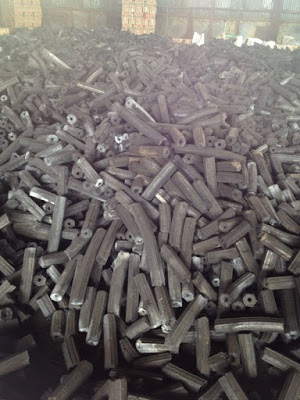
Wood lump charcoal and sawdust charcoal briquette are two types of wood charcoal products. Wood lump charcoal comes from pieces of wood, while sawdust charcoal briquette comes from sawdust. Sawdust charcoal briquette is more in demand by the export market than lump charcoal because of its advantages, which is more solid, ie twice the density of wood so that the flame or burning time is longer and also saves transportation costs, uniform size and shape making it easier in use and packaging. Sawdust charcoal briquette is usually hexagonal and octagonal with a hole in the middle for easy burning. While lump charcoal has irregular shape like the raw material. Middle East countries and especially Saudi Arabia are the countries that use the sawdust charcoal briquette in large numbers that is mainly to grill the sheep as favorite dishes there. And Turkey is a country in Europe that also uses a huge sawdust charcoal briquette to cook their various meat dishes.

In the development of the greater market need for the product sawdust charcoal briquette so that the required supply from producers is also getting bigger. Raw materials from sawdust are also increasingly limited so that raw materials are needed from various kinds of other wood waste. Wood waste from the forestry sector or any wood processing industry that has so far not been utilized can be used for raw materials for the production of sawdust charcoal briquette. The size of large wood waste also needs to be size reduction to be the size of sawdust to be processed into sawdust charcoal briquette.


The need for wood lump charcoal is not as much as sawdust charcoal briquette and generally only wood of a certain type (species) is of interest. Certain types of wood are also generally difficult to obtain. The use of charcoal lump is also almost the same as sawdust charcoal briquette. To maintain its long-term sustainability, the provision of raw woody biomass for both sawdust charcoal briquette and lump charcoal should be sought through the planting of wood producing trees for charcoal lump and sawdust charcoal briquette raw materials.

Biochar, Soil Health, and the Sustainability of Palm Oil Productivity

Healthy soil is invariably fertile, but fertile soil is not necessarily healthy. Healthy soil teems with life—such as earthworms and other o...