Wednesday, June 21, 2023

Is Palm Oil Land Expansion Still Needed?

The area of Indonesian palm oil plantations is currently around 15 million hectares, with CPO or crude palm oil production reaching 46.73 million tonnes in 2022. Indonesian palm oil producers are located in 26 provinces with the province producing the most palm oil namely Riau, followed by Central Kalimantan followed in second place, then North Sumatra. While the province that produces the least palm oil is the Riau Archipelago and above it are North Maluku and Maluku. The CPO product is processed into derivative or downstream products and part of it is exported. In general, the classification of CPO derivative products (downstream products) is grouped into, such as: oleochemicals, oleofood, and bioenergy.

The high demand for vegetable oil, especially crude palm oil or CPO, is driving efforts to expand oil palm plantations or extensification in Indonesia. But is this extensification really needed and the only way to increase CPO production? Meanwhile, permits issued for palm oil plantations have reached more than 25 million hectares as shown in the table below.


Biochar should be encouraged to use it rather than extensification of the land. The use of biochar will improve soil fertility and also make fertilization more efficient so that NUE (Nutrient Use Efficiency) increases, for more details read here. FFB production increase of 30% or more is possible with biochar. CPO production is estimated to increase by 30% to around 60 million tonnes annually. This is also equivalent to saving land reaching 5 million hectares. The problem of land disputes that reach hundreds of cases throughout Indonesia, land conversion, deforestation and so on can be overcome by using this biochar. Of course this should be a serious consideration for the intensification of palm oil plantations compared to the extensification of the land. Apart from that, a climate solution in the form of carbon sequestration / carbon sink can also be carried out simultaneously with the application of the biochar. Every 1 ton of biochar will store or reduce CO2 (carbon dioxide) in the atmosphere by approximately 3 tons. And the price of carbon credits from carbon removal is also increasing.

Thursday, June 15, 2023

Sustainable Business in Post-Mining Land: A New Paradigm

The land area of 8 million hectares (80,000 km2) is a large area, even the area is roughly equivalent to twice the size of the Netherlands or Switzerland or as large as Austria. Various types of plants can be planted or cultivated on the land, both food crops, energy (bioenergy), feed and biomaterials. This is very much in line with the current era of bioeconomics and decarbonization where world attention is focused on reducing carbon (CO2) emissions from fossil fuels to non-carbon in an environmentally friendly and sustainable way. And moreover Indonesia's location is on the equator so it has a tropical climate so it is very suitable for plant cultivation or biomass production for the purposes as above. The 8 million hectares of land is unproductive land or more precisely damaged land, namely post-mining land in Indonesia. Restoring (recovering) the land to a minimum condition like pre-mining is the responsibility of the mining companies. Of course it would be even better if the recovery was better than pre-mining conditions considering that a number of mining businesses generate large profits so environmental improvement efforts such as reclamation and post-mining rehabilitation should be carried out easily.

In addition to residential areas, tourism, water sources and cultivation areas, revegetation is one of the efforts for reclamation and rehabilitation of post-mining land (OP phase reclamation program attachment VI Kepmen ESDM No. 1827 K/MEM/2018). Revegetation for the ultimate goal of an environmentally friendly, sustainable and profitable business activity is certainly the best solution. The general characteristic of ex-mining land is a thin layer of top soil and subsoil so that little soil organic matter and soil microbes are needed for plant growth. It is impossible to simply revegetate land with these extreme conditions, therefore successful revegetation of ex-mining land can only be achieved by combining soil amendments, species selection and application of appropriate silvicultural techniques. This is because these business activities provide environmental, social and financial benefits. Revegetation with productive plantations or forests is an effort to achieve this. How big the benefits are, of course, needs to be studied in more depth on the types of productive plantations or forests that will be created.

The type of mine also influences the post-mining reclamation and rehabilitation work. In almost all coal mines there is no further processing, in contrast to mineral mines which require further processing. In post-mining reclamation coal mines it is simpler just to return the soil to its original condition whereas in mineral mines, apart from returning the soil as in coal mines, the problem of tailings (waste soil left over from the mining ore extraction process) is also another problem, whereas in smelters or smelters (processing/refining) of these minerals also produces slag (post-operation) which can also be another additional problem. The damaged lands in the post-mining reclamation area need to be repaired or rehabilitated so that they can return to their previous condition. The addition of organic fertilizer and biochar, will accelerate the improvement of soil fertility. Acceleration of soil fertility is important to accelerate the growth of plants planted in the area so as to reduce the potential for natural disasters such as floods and landslides. The use of biochar can also provide valuable additional income from carbon credit through a carbon sequestration / carbon sink mechanism. 

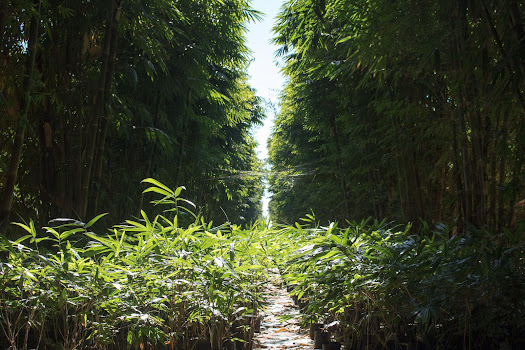
In these land conditions, not all types of plants or trees can be planted on the land. Trees or plants that can live and grow in marginal and even extreme conditions are the choices for these land conditions. Energy plantation of legumes (fast growing species) and bamboo is the best choice for the land. In energy plantations from legumes (fast growing species), apart from having high adaptability to marginal conditions including minimal water availability, the root nodules are also useful for fertilizing the soil. Wood from energy plantations is used for bioenergy into products such as wood pellets, while the leaves are for animal feed and honey from beekeeping which utilizes the flowers of these plants. Bamboo plants also have high adaptability. Products from bamboo plantations can be in the form of food, namely from bamboo shoots and the bamboo itself for various purposes. Industrialization of bamboo so that it becomes high added value products must be carried out. Almost all wood products can be replaced with bamboo and even the quality can be better, such as furniture, bamboo boards, ply bamboo and so on. With the existence of a sustainable industry that takes advantage of the products from the post-mining reclamation land, a number of benefits as mentioned above will be obtained.

The potential of 8 million hectares of land will produce very large biomass products if managed properly and correctly. The era of electric vehicles which is also expected to soon become a world trend will also require electrical energy stored in the battery. The electrical energy used should also come from renewable energy, not from fossil energy sources. The energy source from biomass to electricity is an ideal renewable energy source for the electric vehicle energy source. Production of biochar by pyrolysis and production of biogas from livestock manure as organic matter can be used for electricity production. With a number of driving forces and future trends, it is important to consider the utilization of the 8 million hectare land.
 

Wednesday, May 31, 2023

Pioneering the Export of Hay from Energy Plantation Leaf Waste

The high demand for feed, especially protein elements in Europe, on the other hand, is an opportunity in itself. Leaf waste from energy plantations in abundant quantities can be used as an export commodity to fill this opportunity. These leaves can be processed into hay and then compacted (biomass densification) into large boxes (cubes) and ready for export. Under tropical climate conditions, biomass production, especially for renewable energy, feed and food through energy plantations, is an ideal solution. Wood product will be used as bioenergy, especially into wood pellet product, leaf as an export commodity for animal feed, and honey as a highly nutritious multi-functional food. Millions of hectares of potential land for the creation of energy plantations so as to maximize the benefits of land use, especially with the tropical climate conditions that support.


Learn from the state of Oregon in the United States which is successful as an exporter of hay grass as a source of fiber in animal feed. It is recorded that more than 900,000 tons per year export hay grass from Oregon to the destination countries, namely Japan, Taiwan and Korea. The business has been around for more than 30 years. The mechanization of agriculture and the use of modern agricultural techniques have helped the business grow. A number of grass species that they cultivate include annual ryegrass (Lolium multiflorum), perennial ryegrass (L.perenne), bent grass (Agrostis spp.), fine fescue (Festuca spp), Kentucky blue grass (Poa pratensis), Orchard grass (Dactylis glomerata) and tall fescue (F.arundinacea).

The difference between hay and dry straw (straw) is sometimes still confusing. Hay is made from fresh stalks, leaves and shoots of plants. Many plants can be used as hay, for example in Iowa, USA alfalfa and clover are most commonly used. If it is cut and packaged (compacted) almost all of the nutritional content is not lost and is used as animal feed. Meanwhile, straw is also made from the stalks and leaves of plants, but is cut after the plants are mature with their shoots or the fruit has been harvested for something else. This straw has very little nutritional value and is used primarily as animal bedding. The conditions for plants to make hay are fine textured, harvested at the start of the flowering season and harvested from fertile areas.

Hay production is carried out by cutting the forage (grass or leaves) then withering and drying the forage, then to facilitate storage, transportation and use, the hay needs to be compacted. Animal feed in dry form such as hay will make it able to hold out until the nutrients are maintained. The history of hay production is thought to date back to the late 19th century, when alfalfa was introduced to Iowa and became the most popular crop for hay production. Alfalfa itself comes from Central Asia which was first used for animal feed and then this alfalfa spread to various parts of the world. Legume leaves from energy plantations are also very potential as animal feed and processing them into hay will increase their utilization including their economic value. In the commercial hay industry modern mechanical devices are used primarily for compaction by making blocks or boxes with a high production target, as shown in the video in the following link here.   

Tuesday, May 30, 2023

Green Economy in the Cement Industry Part 4


The cement plants apart from being an industry that utilizes or processes waste such as slag and fly ash so that a circular economy pattern is formed, is also an industry that destroys waste by using it as fuel. RDF (Refuse Derived Fuel) from municipal solid waste (MSW) is an alternative energy source that is widely used by the cement industry, especially in the manufacture of clinker. In addition to helping overcome environmental problems in the form of environmental pollution from city waste, the use of RDF  also helps reduce carbon emissions or is part of the effort to decarbonize. Related to addressing environmental problems, alternative fuels such as used tires which are chopped into tire chips and plastic are also often used. In addition to these alternative fuels, biomass waste such as agricultural waste and livestock waste are also being used. The biomass waste is 100% renewable fuel, so it is more compatible and environmentally friendly. The use of agricultural waste such as rice husk and camel manure is an example of the use of this biomass waste, for more details, read here.

By operating at high temperatures, the cement plant can function as an effective waste destroyer. In this regard, a DRE (Destruction Removal Efficiency) test is required which must meet a very high score or nearly 100% (99.9999%) to be able to carry out the waste destruction activity. The failure to reach this value is due to the insufficiently high temperature, so the consequence is that not all facilities in the cement plant are able to destroy or burn the waste, only burners in kilns that operate above 1200 degrees Celsius can do it, which technically is waste or alternative fuel also has its own feeding point.

Apart from the power failure, cement plant operations can stop due to blocking. The blocking clogs the cyclone on the preheater and calciner. The main cause of blocking occurs is due to the sulfur content, especially from coal and petcoke or alternative fuels that have a high sulfur content such as tires (tyre chips, the sulfur then reacts with the alkali to form compounds that easily stick to the walls of the cyclone or even the kiln. This means that the percentage of sulfur needs to be limited. And the second cause of blocking is chlorine, which also reacts with alkali so it easily sticks to the walls of the equipment, but the difference is blocking because chlorine occurs at a lower temperature, so it sticks to the top of the cyclone. This means that the percentage of chlorine also needs to be limited.

Based on the conditions mentioned above, the use of alternative fuels, especially from renewable materials, is important, moreover, renewable fuels such as biomass have very low sulfur content, as well as chlorine, but certain alternative fuels must be calculated carefully, especially sulfur and chlorine content. , so no blocking occurs. Meanwhile, fossil fuels such as coal and petcoke apart from being cons of decarbonization efforts also turn out to be the main cause of blocking. This means that the use of fossil fuels must be further reduced.

Tuesday, May 23, 2023

Become the Trendsetter of the World's Vegetable Oil Producers

In the vegetable oil market, there are 4 types of vegetable oils that are widely consumed around the world, namely soybean oil, sunflower oil, palm oil and rapeseed oil. Based on USDA data (2018) the total area of the 4 vegetable oil-producing plants in 2017 was around 208 million hectares. Soybean plantations have the largest proportion of area, namely 126 million hectares (61 percent), while the area of palm oil plantations is only 21 million hectares (10 percent). However, with an area of 126 million hectares, soybeans are only able to produce 56 million tons of oil or only 32 percent of the production of the world's 4 main vegetable oils. In contrast, palm oil with an area of 21 million hectares is capable of producing 73 million tons or 42 percent of the production of the world's 4 main vegetable oils.

The high level of palm oil production is obtained from the productivity of palm oil plantations which is much higher than the productivity of other vegetable oil producing plants. According to Oil World (2018), the average productivity of oil palm is 4.27 tons/hectare, while the productivity of other vegetable oil-producing plants is only 0.4 – 0.6 tons/ha. The productivity of palm oil is much higher, around 8-10 times compared to other types, making palm oil have a comparative advantage over other vegetable oils. This comparative advantage can be interpreted as saving deforestation in various regions of the world if palm oil is consumed by the global community or to produce the same amount of oil, the land needed for oil palm is 8-10 times smaller than other crops.


With an average annual productivity of 4.27 tons/hectare of palm oil or 17 tons of FFB/year, this is actually still quite low and productivity can be increased up to around 30 tons of FFB/hectare or 7.5 tons/hectare of oil. Increasing the productivity of palm oil is primarily by increasing soil fertility so that fertilization efficiency increases. Slow release fertilizer (SRF) is an efficient fertilizer that is economical and environmentally friendly. In addition, the use of biochar, apart from being a slow release agent in the fertilizer, will also improve soil quality or fertility by increasing soil porosity, providing organic carbon, raising soil pH, retaining water and nutrients so that they are more available to plants and as a medium for soil microbial colonies. By increasing the productivity of palm oil, followed by saving fertilizer due to increased efficiency, minimizing environmental pollution so that production costs can be reduced, it means that it is equivalent to increasing land efficiency by 76%. This means that the productivity of palm oil per year is 30 tons of FFB/hectare, or 7.5 tons/hectare oil and when compared to other vegetable oils it is 15 times more land-efficient or per tonne of palm oil requires 0.13 hectares while other vegetable oils require 2 hectares of land.

The climate solution in the form of carbon sequestration / carbon sink can also be done simultaneously with the biochar application. Every 1 ton of biochar will store or reduce CO2 (carbon dioxide) in the atmosphere by approximately 3 tons. Carbon credit from the application of biochar is a significant additional income apart from fertilizer efficiency and increased crop productivity, including palm oil yields. Moreover, the value of carbon credit tends to increase and the carbon (CO2) removal mechanism with biochar will become a trend in the future. The amount of income from carbon credit is proportional to the number of biochar applications in the oil palm plantation which will also be proportional to the area of the palm oil plantation.

The area of palm oil plantations ranging from thousands to tens of thousands of hectares owned by a company is common in Indonesia. This indicates the business potential that can be done. With the current area of palm oil plantations in Indonesia reaching around 15 million hectares, as much as 40% (6 million hectares) are smallholder plantations so that the company's plantation area is 60% (9 million hectares) which is divided into owned by Large Private Plantations (PBS), which is 8 .42 million ha (55.8%) and State Large Plantations (PBN) covering an area of 579.6 thousand ha (3.84%), for more details read here. Palm oil trees themselves can only produce well in the tropics because the temperature factor affects production through the rate of biochemical and generative reactions in the plant's body. To some extent, higher temperatures lead to increased fruit production. The temperature of 20°C is referred to as the minimum limit for generative growth and an annual average temperature of 22-23°C is required for continued fruit production. That is why not all locations on earth can be cultivated for palm oil even though the productivity of the oil is the largest compared to other plants, so that it becomes a comparative advantage in itself.

Meanwhile, from biochar production technology, it is also possible to reduce the use of solid fuels such as palm kernel shells (pks) which are commonly used in boilers at palm oil mills. Palm kernel shell which is a biomass fuel and used as boiler fuel in palm oil mills besides fiber (mesocarp fiber), can then be sold directly for both the domestic market (local) and the international market (export). The palm kernel shells can also be further processed into charcoal or activated carbon. The use of energy from biochar production technology (pyrolysis) will also increase the efficiency of boilers at palm oil mills, in addition to additional income from selling palm kernel shells or further processing. Becoming a trendsetter in the world's vegetable oil producers is very possible based on the reasons mentioned above. With Indonesia's current condition in particular, or other palm oil producing countries, with a little improvement, it is very possible to do this. Moreover, the palm oil industry produces a lot of biomass waste which is very potential as raw material for making biochar.

Wednesday, May 10, 2023

Biochar and N2O Emission in Agriculture

Urea Plant
The world's production of urea fertilizer in 2020 will reach around 181 million tons and this type of urea fertilizer is the most widely used. In practice, the use of urea fertilizer is mostly inefficient, so it is wasted and pollutes the environment. It is estimated that the level of loss of urea and pollution to the environment, in use reaches around 40% or 72.4 million tonnes globally. Efforts to improve fertilization efficiency can be done by modifying it to become a slow release fertilizer (SRF), one of which is highly recommended, namely biochar, as a slow release agent, read more details here. In addition, the use of urea causes N2O emissions. N2O (nitrogen monoxide) is a greenhouse gas and air pollutant, N2O is a dangerous gas because it has a stronger effect about 300 times per unit weight than CO2 in a span of 100 years. In air, N2O reacts with oxygen atoms to form NO, and NO then breaks down ozone.

Urea is one of the conventional fertilizers commonly used in agriculture. Urea has a main content in the form of nitrogen which is absorbed by plants in the form of ammonium (NH4+) and nitrate (NO3−). Loss of nitrogen in the fertilizer occurs due to evaporation as ammonia (NH3), immobilization in the pores of the soil or washed by water, both rainwater and irrigation water. In addition to economic losses, environmental pollution due to excess nitrogen also causes a number of negative effects. Nitrogen from urea can also be lost due to complete denitrification of nitrates to produce nitrogen gas (N2) or through incomplete nitrate denitrification to produce nitrogen monoxide (NO) and nitrous oxide (N2O) gases, which evaporate from the soil. Nitrate, nitrogen monoxide (NO) and nitrous oxide (N2O) gases contribute to environmental problems. Nitrates are harmful substances that cause water pollution. Excess concentration of nitrate in drinking water is harmful to health, especially in infants and pregnant women.

Meanwhile, nitrous oxide (N2O) has now become the largest ozone depleting substance emitted in the 21st century. The main source of global nitrous oxide (N2O) emissions is nitrogen-based fertilizers, especially urea fertilizer. The presence of N2O in the lowest region of the atmosphere (troposphere) can cause a greenhouse effect or global warming because N2O traps infrared radiation emitted from the earth's surface and then warms the atmosphere. In addition, N2O can migrate up into the stratosphere where it reacts with oxygen atoms to produce some nitric oxide (NO). Then, the depletion of the ozone layer occurs because NO reacts with stratospheric ozone (O3) to form NO2 and O2. Furthermore, NO2 reacts with O to form NO again. The depletion of the ozone layer increases the amount of UV rays from the sun that reach the earth's surface.

Biochar application has been suggested as a strategy to reduce nitrous oxide (N2O) emissions from agricultural soils while increasing soil carbon (C) stocks, especially in tropical areas. Climate change, especially temperature increase, will affect soil environmental conditions and thereby directly affect soil N2O volume. Related to climate issues, there are two aspects of the role of biochar, namely as a carbon sequestration / carbon sink and reducing nitrous oxide (N2O) emissions, while related to agriculture, namely increasing soil fertility and increasing the productivity of agricultural products. The multi-benefit application of biochar is predicted to become a trend in the bioeconomy era, when the aspects of sustainability, food adequacy and as a climate solution become a complete package in one action.

The effort to minimize the use of urea fertilizer is by modifying it to become a slow release fertilizer with biochar as the slow release agent. The use of excess doses of urea apart from damaging the environment is also a waste. The use of urea can still be used to a certain extent, namely that all of the urea can be absorbed by plants with minimal loss or environmental pollution. When all the nutrients/fertilizer nutrients can be completely absorbed by the plants, it means that there is no residue in the soil, so that damage or environmental pollution can be minimized even avoided. The residue, especially in the long term, will cause severe soil damage. Slow release with close to the rate of absorption of nutrients by plants is a condition that is pursued or NUE (nutrient use efficiency) as much as possible. The technique of modifying urea fertilizer into SRF is the key.
 

Monday, April 24, 2023

Developing Wood Pellet Production Centers in Indonesia

Vast land with a tropical climate with year-round sunshine and high rainfall is a gift from Allah SWT that makes Indonesia a world center of biomass. Biomass-based products such as energy and animal feed are very relevant in the bioeconomy era which is predicted to become a world trend in the near future. Potential optimization must be carried out especially since it is very much in line and relevant to world trends (decarbonization & sustainability) in general and Indonesia's specific national conditions in particular. On the other hand, we can see a number of countries whose majority of their economies depend on fossil energy, especially oil and gas, such as Saudi Arabia and Qatar or the Gulf countries in general, have to change their course to fight to reduce dependence on these natural resources. Efforts for realization/implementation and acceleration should be carried out immediately, even though it is actually a little late compared to other countries in Southeast Asia, especially Vietnam, for more details please read here, but given the potential and future direction of the world economy, of course, besides being urgent, it is also important to do this.  

As a reference for the development of the wood pellet industry in Indonesia, we can take the example of a country in North America, namely Canada, especially in the province of British Columbia. The province has the highest concentration or the most wood pellet factories, which are estimated to reach around 70% of the country's production. From the research conducted, it was found that 85% of the wood pellet raw material used was sawmill waste and the remaining 15% was forest waste. And the forest waste can be further broken down into 11% low quality logs and 4% bush plants. So all the raw materials used in the province use wood wastes produced from sawmills and remnants from the forest. The production of wood pellets basically has to use raw materials from wood wastes or wood which are worth the wood waste.

By utilizing these wastes, in addition to overcoming environmental pollution, even  sawmill operations become zero waste, it also provides additional income or economic benefits which are quite large in value. Forest wastes in Indonesia such as from acacia plantations have the potential to be used for the production of wood pellets. For example, with an acacia plantation, if every hectare produces 20 tons of acacia wood waste, then with an area of 20,000 hectares, 400,000 tons of acacia wood waste will already be produced. The area of 20,000 hectares of acacia plantations is not too big, this is because there are a number of HTI (industrial plantation forest) concession holders covering hundreds of thousands of hectares, so the volume of wood waste produced is also very large. Acacia forests or plantations in Indonesia are estimated to reach 2 million hectares and almost all of these acacia forests are used to supply pulp and paper mills. Every pulp and paper mill always has acacia forests with an area of thousands of hectares to fill the pulp and paper mill. Acacia wood with a minimum diameter of 8 cm is used as the raw material, while those with a diameter smaller than that are only used as waste. After the tree is felled, a new planting is carried out (replanting).

Wood products come from different parts of the tree, each tree has a unique potential, depending on a number of factors including the diameter and straightness of the trunk. In acacia trees trunk diameter is the main parameter.
Likewise in the sawmill industry, apart from waste in the form of sawdust, wood waste such as wood chips can also be used as raw material for the production of wood pellets. Each stage of the sawmill industrial process will produce wood waste, with varying shapes, sizes, quantities and uses. It is estimated that around 40% of wood waste produced from sawmills is around 40%. Factors such as worker skills, operator experience, equipment conditions and the shape of the wood affect the wood waste produced. Based on the above waste percentages, a sawmill that processes 1000 m3/month of logs will produce a total of around 400 m3/month of wood waste. More detail as in the table below:


Energy plantations are another option and are even an ideal option for wood pellet production. This is because the volume is large and its availability can be guaranteed, rather than collecting the wood wastes. With this energy plantation, raw materials in the form of wood will be obtained which costs as much as wood waste. Thousands to tens of thousands of hectares of energy plantations can be made for this purpose. In addition to wood, which is the main product of the energy plantation, by-products with significant value are leaves for animal feed and honey from beekeeping. Optimizing the utilization of all these trees will provide maximum added value from the use of the land. The regions of Kalimantan, Sumatra, Sulawesi, Maluku and Papua can become centers of wood pellet production such as the province of British Columbia in Canada.

Production of Bark Briquettes from Wood Pellet Factory Waste

To reduce the ash content of wood pellets and thereby improve their quality, a process known as "debarking" (removing the tree bar...