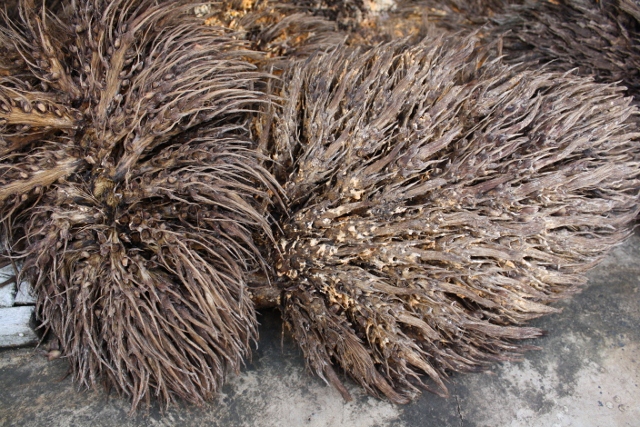
Hygiene is the base of health, that is the proverb or phrase that we often hear. It turns out that hygiene is not only related to health problems, biomass fuel also apparently considered the importance of 'cleanliness' is. Cleanliness in the sense of freedom from a number of impurities or contaminants. Just as in the field of health, impurities will also cause problems in the processing and utilization. The cleaner the biomass fuel the easier it is in the processing and utilization becomes more optimal as well. Biomass fuels typically used by industry include: wood chip,
wood pellet, palm shell or
PKS (Palm Kernel Shell), and
wood briquette. Wood pellets and wood briquette mostly use wood powder like sawdust as its raw material, and if the raw material size is too large then it needs to be reduced to the size of the wood powder. The densification process of wood powder into wood pellet and wood briquette will be easier and the lifespan of the compaction equipments becomes longer when using clean wood powder. For example, a nail or screws in wood powder to the pelletiser will cause severe damage to the roller by grinding the roller grooves within the pelletiser, so that the magnetic separator needs to be installed before the wood powder is fed to the pelletiser. Wood chips and clean palm shells (PKS) are also standard for a number of biomass power plants.
 |
| Vibrating Screen For PKS Cleaning; Photo taken from here |
 |
| Foreign objects in the form of metal from PKS cleaning; Photo taken from here |
 |
| Manual screen for PKS clearing |
The biomass fuel cleaning process becomes an integral part of the fuel production process. A screen is a equipment commonly used for cleaning, and some add a magnet to separate the impurities or foreign objects from metal. Manual screen to mechanical one used for cleaning even to get the maximum level of cleanliness, then the sieve (screen) is made multi-deck. For large capacity mechanical sieves are commonly used, both vibrating and rotary screen. In the process of producing
wood pellets and
wood briquettes, a commonly used sieve is a rotary screen that functions in addition to separate the impurities as well also to obtain the appropriate particle size. While vibrating screen is commonly used for cleaning palm shells (PKS). Feeding to the screen usually uses a conyeyor. For raw material with large particle size such as palm shell (PKS) and wood chip belt conveyor is commonly used, while for raw material of wood powder such as sawdust, screw conveyor is recommended, for minimizing the dust problem.
 |
| Rotary Screen at Sawdust Briquette Factory |
 |
| Sawdust Briquette to be carbonized |
What foreign impurities or objects should be removed from the biomass fuel? Stones, gravel, sand, soil, glass, plastics, fabrics, paper and any number of metals are some impurities that should generally be removed as much as possible. Basically the processing and utilization of biomass fuel will have different levels of tolerance. Biomass power plants operating at high temperatures will require a higher level of cleanliness or a small degree of tolerance for the impurities. Likewise for the production of wood pellets and wood briquette in large capacity, then the quality of raw materials becomes important. This is because at high mechanical pressures during pelleting or briquetting the impurities have the potential to cause severe abrasion so that the equipment will quickly wear out. More specifically for palm kernel shells (PKS), which popular recently as biomass power plant fuel, the presence of fibers and empty fruit bunches is also considered an impurity. This is because the existence of these objects will reduce the heating value and some chemical elements in the ashes are not friendly or cause problems in boiler pipes especially those operating at high temperatures.
 |
| Deposit and ash crust on boiler pipes |
 |
| Formation of deposit in boiler pipe |
Factors that affect biomass
burning mainly are the calorific value, moisture content, ash content
and ash chemistry. The higher the ash content, the calorific value will
be smaller. High silica (Si), potassium (K) and chlorine (Cl) contents
will cause many problems in high temperature combustion. So the biomass
fuel must be chosen according to its use or the type of utilization
technology. For example, fibers and empty fruit bunches containing high
chlorine (Cl) elements, will corrode boiler pipes so that leakages occur
even though they have been operating for less than 10,000 hours. The
high content of potassium (K) and silica (Si) will make a deposit or
crust on the boiler pipes so it will also disrupt the heat exchange. In
addition to impurities or foreign objects containing chemical substances
that would be a problem in boilers, impurities or foreign objects that
are physically large such as stones, concrete flakes, cement clumps,
pieces of iron and so on in addition to disturb combustion also have the
potential to interfere handling of the biomass fuel.