Showing posts with label biomass fuel industry. Show all posts

Friday, January 8, 2016

History Repeated Back In The Field of Biomass


Biomass and wood in particular have been known and used very long for an energy source. The wood is burned to produce heat that can be utilized for human life. The utilization of biomass including wood also became a main source of energy when fossil fuels has not been found or exploited. When fossil fuels become a major fuel source as it is today, then the fuel from biomass is reduced. Conditions such as this makes oil-producing countries have a strategic role in the international arena. Energy is in many ways identical to the petroleum fuel, because its role is vital for human life today.

When there is a state of war, including World War II, namely in 1940 and the Yom Kippur war in the 1970s, many countries experienced an energy crisis that forced them to develop a range of alternative energy. Biomass as a renewable energy back received great attention. Biomass as an energy source to produce energy is relatively stable compared to wind and solar are affected by weather conditions. Conversion of biomass into various forms of energy are also carried out on-era World War II, this is due to adapt to the various needs of the moment. Vehicles, and various industrial original equipment using fossil fuels is replaced with a source of energy from biomass. This makes the findings of biomass utilization technologies that can run a number of existing equipment including fulfilling life. Biomass is the only renewable source of carbon-based so that it can be synthesized into a wide variety of hydrocarbons such as petroleum. In conditions of war, biomass have been converted to solid fuels, liquid fuels, gaseous fuels and other chemicals.
Technologies such as gasification, pyrolysis, combustion, and densification are some of the main technologies used for the conversion of biomass energy. By gasification will be the main product obtained in the form of gas that can be directly used as fuel or synthesized into oil or other chemicals.  With (slow) pyrolysis will be obtained charcoal as a primary product, then gas and liquid products as the byproducts. As well as gas produced from gasification, pyrolysis gas from the results of these also can be used as fuel directly or synthesized into other chemicals. The Liquid product of pyrolysis, bio-oil that can be used as fuel or source of chemicals. While other liquid product namely wood vinegar can be used for a variety of uses in the agricultural sector.
Steam Railway, at the Ambarawa Railway Museum, Central Java, Indonesia
Combustion is the most popular technology used for steam engine, especially in the mid-19th century. James Watt made improvements to the steam engine so that makes it rotates continuously used as a driver in a variety of industrial and transportation or mark the era of the industrial revolution in Europe at that time. Steam train (steam locomotive) is the application of the steam engine in transportation. The first time the steam engine to the train running on rails was made by Richard Trevithick in 1804. While to produce electricity, the steam engine that produces mechanical energy is connected to a dynamo (generator). Charles Parsons was the first to connect the steam engine with dynamo and done in 1884. This makes the electric becoming easily available and widely available.


Densification technology also received serious attention during World War II in 1940s and the during the oil crisis of 1973 as a result of OAPEC embargo as a impact of the Yom Kippur War. Densification technology makes biomass initially have size irregular, low density, large volume, high water content into a uniform shape, high density, low water (moisture) content and volume decreases or there are a number of improvements physical properties so that it becomes more economical to transport , easier handling in use and storage. Briquettes and pellets are the two forms of biomass densification products are most popular and became the forerunner of today's densification technology.

Today, when the environmental crisis-induced excessive human hand in exploiting natural resources including massive fossil fuel use become the driving force for the use of renewable energy then so biomass energy again received fresh momentum and become a focus for some circles. Recorded since the UNFCCC in 1992 until the signing of the Kyoto Protocol in 1997 by 83 countries and at the time of enactment of approval in February 2005, it has been ratified by 141 countries is in order to address the environmental crisis, especially due to the high concentration of greenhouse gases (CO2) in the atmosphere are believed to cause climate change and global warming. Kyoto Protocol in force until 2012 and then extended to the Kyoto Protocol Extension (2012-2020).

Policies that are more regional and technical hereafter devised based Kyoto protol include RED (EU's Renewable Energy Directive), commonly known as the 20-20-20 targets or mandates that are intended to reduce 20% of greenhouse gas emissions from 1995 as the level basically; 20% decrease in energy consumption; and to 20% for renewable energy. Wood energy needs of approximately 30 million tonnes / year by 2020. Furthermore, South Korea has issued a Renewable Portfolio Standard (RPS) which requires a minimum of coal to the power plant using renewable energy 2% in 2012, with an increase of 0.5% / year until 2020. In 2020 they will need a minimum of 10% renewable energy with the expected composition of 60% of renewable energy derived from woody biomass (wood energy), while the remaining 40% from other sources. Japan issued regulations Feed in Tariff and so on which makes the wave era of world energy use of biomass increasingly felt.

Drax England, The Current Largest Biomass Power Plant 
Biomass energy is grouped carbon neutral it will be able to reduce the concentration of CO2 in the atmosphere today that has exceeded the threshold. Biomass then become an important material and use on a large scale. Technologies of processing biomass in World War II and the oil embargo back in use, of course with some improvements adapted to current technological advances such as improved efficiency, safety, automation up to computerization but fundamentals or principles of process technology used virtually unchanged. These technologies today raised again. More so the environmental crisis coupled energy crisis will be the driving force of its own to the larger switch to renewable energy, including biomass. And is not it back indicates to the era before the 19th century when most of the energy used by humans are a group of renewable energy?

Monday, September 28, 2015

Racing for Lowering The Temperature Of The Earth (Part 2)

Biomass as 'carbon neutral fuel' certainly does not stand alone as a great scenario to lower the temperature of the earth due to global warming by greenhouse gas emissions. Advantages of biomass as a renewable energy source because  stable in use, in the sense that is not affected by climatic and weather conditions into a product that is reliable in various scale applications. Efforts to optimize the potential of biomass as an energy source can be viewed from the supply side to use.

On the supply side, the assuredness of supply of biomass as a raw material is an absolute must if you want to use as a primary energy source, for the amount of effort from collecting a variety of waste biomass that was originally only disposed to look for species with a short rotation coppice (SRC), high productivity and a positive effect on nature with is made energy plantations. One of these plants is Calliandra to the tropics, while in sub-tropical regions such as Europe using poplar and willow species. We should be grateful to Allah SWT because of the location in tropical Indonesia make caliandra crop productivity could be 4 times faster than the temperate sub-tropical or concrete four years poplar and willow in Europe as 1 year calliandra in Indonesia. 


While looking at the utilization, biomass energy should be used widely, easy, inexpensive and efficient. Biomass can be used in place or used elsewhere far enough. On the use of on-site or a short distance, biomass usually uniform in size or plus drying.  Whereas for use in locations far enough biomass need to be added process again with compaction (densification) in the form of pellets or briquettes. The biomass is then processed  in thermal route (the most popular) by combustion, pyrolysis or gasification to extract energy content.


The position of Europe has surpassed North America in a race to lower the temperature of the earth or the effort to reduce global warming. After previous EU implementing RED (EU's Renewable Energy Directive) commonly known as the 20-20-20 targets or mandates that are intended to reduce 20% of greenhouse gas emissions from 1995 as base level; 20% decrease in energy consumption; and to 20% for renewable energy. It also makes Europe is the largest consumer or market  of wood pellets with an estimated 80% of world production, followed by the United States and third, South Korea.

Currently the EU is being approached in 2020 for the realization of the 20-20-20 targets but on the other hand they began to prepare the draft for the new policy climate and energy issues from years 2020-2030. EU has proposed a new target in 2030 including a 40% decrease in greenhouse gas emissions, a 30% decrease in energy consumption and 27% for the use of renewable energy. Currently they are also looking for a strategy to achieve the 2030 targets. History also shows how biomass policies is the main driver for the development of pellets market in Europe. It is also widely used as a model of a particular region or country to implement renewable energy policies, especially biomass sector.

Friday, September 25, 2015

Enter the Global Wood Pellet Market


In fact the massive growth of wood pellets derived from the encouragement of a number of policies in Europe, more specifically the electricity business in the UK. In 2020 the world consumption of wood pellets is estimated at 22 million tonnes. Two power plants in the UK are 100% use wood pellets that Drax and Eggborough, requiring 10 million tons annually. Other major needs are wood pellets from Western European countries, especially Italy. While in Asia, Japan and Korea are the two countries most widely consumed wood pellets. Whereas in 2024 the production of wood pellets is predicted to reach 50 million tons globally.


Canada is one of the main producers of wood pellets which supply the needs of some countries above. The extent of the forest so abundant source of raw materials that make Canada one of the main producers of wood pellets. Russia is the other major country which began producing wood pellets. The extent of forests and abundance of raw material resources make Russia comparable to Canada in the production of wood pellets but mainly infrastructure problems is still a major barrier to the development of wood pellet industry in Russia. How about Indonesia? Indonesia also has a great opportunity to join in wood pellets business. Although the forest area which can be used as a source of raw materials is not as large as area of Canada and Russia, but the tropical climate in Indonesia that makes the sun shines all year round is a kind of blessing. Thank God, this is one of the pleasures of Allah that we should be. Energy forests or plantations with short rotation crops (SRC) as calliandra can be cultivated with productivity four-fold compared subtropical regions such as Canada or Russia for similar plants such as Willow or Poplar. In addition, users of wood pellets in Asia such as Korea and Japan also will be looking for wood pellets from Asia prior to Canada or Russia.


Natural or environmental sustainability issues are important things that must be considered, so that the business continuity and environmental sustainability are two things simultaneously maintained. The power plant is a major market wood pellets with large and long-term needs for environmental sustainability that needs to be a serious concern. Almost all the buyers of wood pellets for power generation will also require sustainable forest management practices and certification (FSC or SVLK) about the origin of the raw materials that could be accounted means that does not destroy the forest. Specifically for conditions in Indonesia, with an energy plantation or forest with integrated calliandra plantation with goat or cow farming activities will cycle sustainability and nature conservation will be maintained.


Steam power plant with coal fuel is one of the biggest contributors to CO2 in the atmosphere, so if it can be replaced up to 100% or full with wood pellets as a carbon-neutral fuels will reduce CO2 emissions significantly. Rodenhuize 240 MW power plant in Ghent, Belgium is one example. At first Rodenhuize is coal power plant then after that in 2011 using 100% wood pellets. Earlier in 2005 the power plant was modified so that it can work with co-firing of coal and wood pellets and in 2011 the plant switched to 100% of coal (coal) with wood pellets. The shift from coal to wood pellets has made Rodenhuize power generation reduce 1.6 million tons of CO2 emissions. Rodenhuize pattern seemed to be a reference and will be followed by coal power plants more especially in countries that have implemented environmental policies in the energy sector to compete lowering the temperature of the earth.

Friday, May 23, 2014

Take a Look Closer at Wood Pellet


When we examine more closely to the wood pellet surface that we will look smooth, slippery and shiny. Even as smooth surface, slick and shiny that there are people who say that wood pellets are specially coated. Obviously this statement is groundless because especially not supported with a strong argument. Production of several  tons, tens to hundreds to thousands of tons per day of  wood pellets will produce the number of units very much. How about coating process? And how many substances are used so that the coating and still economically? Altogether these people can not give an answer.


Smooth surface, slippery and shiny is really due to the lignin in the wood tends to be resin that have plastic property. If mold is stretched and the temperature increased, the heat and absence of air condition in the shell will cause pyrolysis is characterized by outer skin darkened by carbonized.  This appears more clearly in the process of screw briquetteproduction, which also features on heater in the die so that the outer skin of the  briquette carbonized


The main components of biomass are cellulose compounds, hemiselulose and lignin. Each of these compounds has a different thermal decomposition temperature. Carbonization occurs when compounds of lignin in the biomass decomposes at a temperature of about 400 C. The table looks like this below.


Monday, January 13, 2014

Briquettes and Pellets for Gasification

Uniformity of particle size is important for the operation of the gasifier. Unlike the updraft gasifier types (counter-current) are not too sensitive to the particle size of the raw material, the type downdraft gasifier (co-current) have a particle size uniformity requirement of raw material that  more stringent. Pelleting and briquetting is an attempt to obtain uniformity of particle sizes of raw materials, improvement of the quality of raw materials, and transportation savings. Materials such as sawdust, forest waste and empty fruit bunches of oil potential for compressed into pellets or briquettes.

Downdraft gasifier (co-current) will produce a cleaner gas from tar so that subsequent gas cleaning will be easier to do, to then be used as heating fuel, gasoline engines, diesel engines (dual fuel), or a gas engine to generate electricity. Updraft gasifier produces gas from too much dirty tar so that the gas cleaning more difficult and therefore its application mainly to the heat source. Downdraft gasifier applications so that wider and more widely used in a number of industries.

The production of briquettes or pellets should be done as close as possible to the raw material (raw material oriented) for technical and economic reasons, and then the product of wood pellets and briquettes can be transported to the gasifier unit location within a specified radius. Special briquettes, just type screw (extruder) are suitable for the gasification process. Gasifier product in the form of heat energy, mechanical energy, and electrical energy can directly be used by the user so that the orientation of the gasifier unit is approaching the user or market (market oriented).

Saturday, January 11, 2014

Promote Energy Plantations

Photo is taken from here
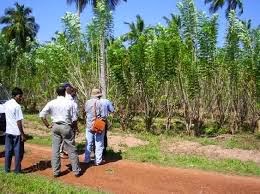
Assuredness of supply of raw materials is absolutely necessary for the survival of industrial woodpellets, briquettes and other biofuels. Raw materials are homogeneous is better because it eases the process, compare with heterogeneous materials, such as raw materials are all derived from the tree trunk will be better than the raw material from a mixture of stems, midrib, leaves, roots, and so on. SRC with a short lifespan and can be harvested repeatedly is an ideal choice as energy crops. The extent of degraded land in Indonesia that reaches hundreds of thousands or even millions of acres of potentially utilized as an energy plantation by planting the SRC.

Gliricidia plantation
Calliandra and gliricidia are two types of SRC crops for energy plantation which has been widely cultivated as a pillar of wood pellet industry. Both the SRC plant was chosen because it requires prerequisites are easy to grow and thrive even live in degraded lands. It is possible to come at the same two advantages namely, sustainable supply of raw materials for industrial wood pellets and reforestation to prevent erosion, flooding and so on. Harvesting can be done after the age of about 1 year and crop later in the following year can be harvested again, up to a dozen times. Sri Lanka is one of the country due to lack of fossil energy then rested its energy from biomass, particularly the gliricidia plants. In addition to the stem can be used as raw material for wood pellet industry, the leaves can be fed to livestock, in addition to calliandra and gliricidia, the nectars can be used to farm honey bees.


Wood pellets are produced from raw material of calliandra and gliricidia has a high calorific value, ie more than 4000 kcal / kg, low ash content and high lignin content so as to facilitate the process of pelleting the wood pellets in the industry. Wood pellets for the main application as a source of renewable energy including carbon neutral fuel categories, this is because the source of wood biomass from photosynthesis using CO2 from the atmosphere and when used as a source of energy is released again into the atmosphere. So balance no additional CO2 in the atmosphere or carbon neutral.


The demand from countries such as South Korea with wood pellets made ​​from woody biomass only will further strengthen the promotion again this energy plantations for sustainable business. This is because the wood biomass has a number of advantages in calorific value, ash content and its ash chemistry than other biomass, especially agro-industry wastes. Compounds such as chlorine, sulfur and nitrogen is an important concern in the standard wood pellets.

Wednesday, October 23, 2013

Optimization of Biomass Gasification With GCU

There are 3 kinds of thermal processes known so far, namely combustion, gasification and pyrolysis. Differences of the three could be reviewed by the presence of air / oxygen, temperature and the resulting product. Pyrolysis is a thermal process that oxygen / air is very limited or even 0 percent or vacuum. While the gasification air / oxygen is controlled to a certain amount in order to maximize the product gas. While the amount of combustion air / oxygen is made so that all the excess fuel can burn completely.


Gasifier that works between pyrolysis and combustion primarily requires good control over the amount of air intake / oxygen. Feedstock condition, and the type of gasifier will affect the resulting gas products. Controlling with computer will give accuracy process that is generated so that optimal condition can be identified and maintained. This equipment works on the basis of information from the sensors to get the best air-fuel ratio. Gasifier Control Unit (GCU) below which is used to control the air-fuel ratio in the gasifier.


Gasifier that works continuously with the amount of automation is expected to meet the energy needs in the long term. A gasifier system is easy to operate and reliable performance is the purpose of installation of a number of such instrumentation. An integrated and synchronized system will improve the overall performance of the gasifier. Following presentation of the commercialization of biomass gasification for heat and electricity generation.

Sunday, October 20, 2013

Biomass Gasification For Engine Fuel At Sawmill Industry

Biomass gasification is a technology that has been long known in the world and yet has not been widely applied in Indonesia. The use of biomass as a renewable fuel or a carbon neutral fuel and including second generation biofuels made ​​this technology has a new perspective in the era of concerns over the global warming. The potential for biomass is very abundant in Indonesia and the potential to apply this technology. On the other hand the energy needs continue to rise in various fields. There are several gasification technologies that can be used include downdraft, updraft, fluidised bed and entrained flow. To get a more pure gas quality or fewer impurities tar the downdraft gasification technology is the most suitable. Raw materials such as wood wastes with a certain size and water content can be used as feedstock in the gasifier. Gas quality comparison between the various gasification technologies are seen as in the table below:


Tolerance level of each machine is also different. So the gas purity to impurity levels should strive to achieve a high grade or still below the tolerance level.


Gasifier to generate mechanical power or electricity is classified as a power gasifier. Due to the use of gas as a fuel for engines that grade of gas should be better than that directly burned. Process diagrams for gasifier power according to the scheme below:


Judging from the composition of the gas produced each gasifier is also different. In general, the heating value of gas produced is small enough that varied between 4.0 and 6.0 MJ/Nm3 or about 10 to 15% of the calorific value of natural gas. Raw materials and different types of gasifier will affect the composition of the gas produced. Under these conditions need to be modified so that the engine uses fuel gas from the gasifier as enlarging the orifice, ignition timing and so on. The table below:

Sawmill industry in Indonesia will produce biomass waste very much. This potential can be exploited for the use of the gasifier. The gasifier will produce a gas that can be directly used as fuel to generate electricity even machines. With these innovations will reduce fossil fuel consumption significantly. Automated greater economic benefits are also obtained by applying this technology, after deduction for expenses such as investment tools, operational, depreciation and outputs obtained.


To get quality gas is cleaner from impurities, some places use charcoal as a gasifier feedstock. Charcoal can be obtained from the traditional charcoal producers or charcoal manufacturer with modern technology.  Charcoal as residue from gasification of wood waste can also be used as feed in charcoal gasification. Charcoal gasification also has a lot to do. This technology will be more competitive as a result of expensive fossil fuel because the reserves dwindling and environmental issues related to global warming.

Reject (Non-Standard) Coconut Fruit for Bioavtur / SAF Production

The international civil aviation organization (ICAO) has included non-standard coconuts on the ICAO positive list – ICAO document – ​​CORSIA...