Showing posts with label wood pellet production. Show all posts

Sunday, June 15, 2025

Wood Pellet Production, Solution to Urban Wood Biomass Waste Problems

Sorting is 50% of the solution to the problem of urban waste. The best sorting is at the location where the waste is generated, such as in households in housing or residential areas. With sorting, further waste processing will be much easier. The better the sorting is done, the easier the waste processing can be done. The reluctance of the community to sort waste makes the waste problem more complicated, prone to social conflict and protracted. Although difficult and complicated, cultivating waste sorting must continue to be done because if not handled it will become a serious environmental problem. The paradigm of waste processing also continues to change according to conditions, namely related to environmental impacts, availability of landfills, types and volumes of waste, as below.

If urban waste or MSW (municipal solid waste) can be sorted and processed properly, the environment will be clean and healthy. For example, such sorting is leaf waste made into compost, organic waste from the kitchen and leftover food for maggot feed or farming, wood waste in the form of twigs, pieces of wood and so on for wood pellet production, and plastic waste to be pyrolyzed into fuel or naphtha. And to be processed adequately, the volume of waste must also be sufficient and continuous. This is because the procurement of units for waste processing is also quite expensive. Waste processing should also be decentralized, so that it does not pile up in one place. The production capacity of the village or sub-district scale seems quite good and suitable for the manufacture of such waste processing units.

Among the urban waste is wood waste in the form of twigs, pieces of wood and so on that can be used for the production of wood pellets or wood pellets. The wood waste can come from pruning and felling trees, wood processing industry waste or wood that clogs waters such as rivers. The use of wood pellets or wood pellets can be for household cooking or SME industries. The use of wood pellets in addition to being a fuel or renewable energy that is environmentally friendly, easy to store and use and a solution to overcome biomass waste and reduce LPG imports which are worth around IDR 63.5 trillion each year.

Along with the innovation that continues to be done, wood pellet cooking stoves are becoming easier to use, efficient, clean and safe. For local governments, the production of wood pellets from wood waste also provides many benefits, namely as a solution to handling the waste, creating jobs and socializing the use of environmentally friendly renewable energy for the community. If this is successfully done, in the future the utilization of wood waste can continue to be developed.

Monday, March 10, 2025

Taiwan, Asia's New Wood Pellet Market

After Japan and Korea have been the main markets for wood pellets in Asia for years, Taiwan is predicted to emerge as a new destination for the wood pellet market in Asia. This is because Taiwan's energy policy targets 20% renewable energy use by 2025. Namely by focusing on the energy transition from coal and other fossil fuels to renewable energy sources including biomass, solar and wind to increase renewable energy from 10% to 20% by 2025. The Greenhouse Gas Reduction and Management Act requires annual carbon emissions to be reduced by 20% by 2030 and 50% by 2050, below 2005 levels or a reduction of 53 million tons of CO2 equivalent by 2030 and 133 million tons by 2050. This is also part of Taiwan's nuclear-free vision and supports the national goal of achieving net-zero carbon emissions by 2050. Renewable energy development is the most important implementation to achieve this goal and wood pellets are a top priority. Taiwan will import wood pellets in large quantities to achieve its new green energy production targets.

The need for wood pellets in Taiwan reaches millions of tons or more detailed estimates are 1.7 million tons per year specifically for Taiwan Power Company, which will be implemented immediately when the policy is implemented. And there are also a number of independent power plants (IPP) that use coal boilers to generate electricity, especially the plastic industry, petroleum refineries and papermaking. Currently, renewable energy accounts for less than 10% of the total energy output in Taiwan. Meanwhile, the government aims to have 778 megawatts (MW) of biomass-based power plants by 2025, allowing production of 4.1 billion kWh.

The world's major wood pellets producing countries are looking to Taiwan, such as the United States, Vietnam and Canada. Vietnam has even become the second largest wood pellet producer in the world, overtaking Canada. And nationally, Vietnam's wood product exports are more than 70% for furniture and interior applications, 7% for wood-based panels, 17% wood chips and 5% for wood pellets. And to produce these products, Vietnam also imports large amounts of wood from more than 114 countries and 700 species / subspecies, amounting to $ 3.1 billion in the form of logs, sawnwood and plywood and imports almost 2 million cubic meters of tropical hardwood.

Basically, the major wood pellet producing countries are competing to convince Taiwan as a user or buyer of wood pellets about the supply capability, including quantity and quality, logistics reliability and sustainability of its supply. Although the Japanese and Korean markets continue to grow, penetration into a new market will add an opportunity to these producers. Even in Japan, many new power plants are being built so that the need for wood pellets is also increasing. In addition, the increase in the cofiring ratio in power plants in Japan will also increase the demand for wood pellets.

And globally according to Hawkin Wright, wood pellet sales are the highest among other biomass fuels, which is more than 27 million tons/year in 2025. While FutureMetric that the market for wood pellets for industry (industrial pellet fuel) can reach 55 million tons in 2030. Thus the need for wood pellets will continue to increase with an average of more than 5.5 million tons per year so that the production of wood pellets. Indonesia still has great potential to become a world wood pellet producer because of the potential raw materials that can be sought, both from wood and forestry industry waste and from energy plantations. With a location that is not too far from Taiwan (compared to wood pellet producing countries such as the United States and Canada) so that logistics or transportation costs are cheaper, the opportunity to compete is also quite large. In addition, PKS (palm kernel shell) are also an alternative biomass fuel besides wood pellets and as a producer of palm oil / CPO or the owner of the largest palm oil plantation in the world, Indonesia is number one for that. 

Problems of Wood Harvesting from Calliandra Energy Plantation and High Potassium Content in Wood Pellet Ash: Two Things That Need Attention

The factor of production efficiency and standard and stable product quality is the mindset of the industry, including for the wood pellet industry from the calliandra energy plantation. Manual wood harvesting operations make production efficiency low. The high daily need for wood pellet raw materials from energy plantations requires mechanization equipments for harvesting the calliandra plantation. Meanwhile, calliandra wood pellet products with high ash content containing potassium also require certain treatments so that the wood pellet products meet the standards for power plants in general. The stability of production quality and quantity is closely related to the quality of the production equipment used. These two things must be an important concern for wood pellet producers from calliandra energy plantations with large capacity and export orientation.

The wood pellet industry from the calliandra energy plantation is new, so there are not many references. The history or the origin of this industry comes from the project of the Ministry of Forestry of the Republic of Indonesia at that time which created an incubator-scale industry as a pilot for the production of wood pellets from the calliandra energy plantation located around Geger Hill, Bangkalan, Madura, East Java about 12 years ago. At that time, there were actually several wood pellet industries operating, but all of these wood pellet factories or industries used raw materials from wood industry waste, such as sawmill industry waste, barecore industry waste, plywood industry waste and so on.

Calliandra trees are also not new plants to the public. This tree has been widely planted but previously with different purposes, namely for reforestation, for animal feed or for honey bee farming. While for bioenergy purposes or wood pellet production, planting calliandra trees in the form of energy plantations is something new. That is why in the early stages, calliandra wood harvesting was still done manually and this was ineffective and inefficient on large-capacity plantations. In addition, the wood pellet product has not been analyzed or examined completely / comprehensively so that the high potassium content (ash chemistry) in the ash has not been detected. When the requirements for the maximum content of potassium / potassium must be met, special treatment needs to be done.

In addition, an important thing to note is the target types of products produced. If the calliandra plantation not only produces wood as raw material for wood pellet products, but also processes leaves for animal feed, then the harvesting mechanism is very influential. The leaves from the calliandra plantation must also be harvested effectively and efficiently or the same as the wood products. This could be, for example, the trees and leaves are harvested together and then taken to a place and separated to be processed individually. Or it could be that the wood and leaf products have been separated at the time of harvesting, then each goes to its respective processing unit. The equipment used must also be different according to the choice of the harvesting mechanism. Meanwhile, honey products from bee farms that utilize calliandra nectar are not affected by this mechanism, this is a separate honey production process and is related to the flowering season of the calliandra tree itself.

Along with the global decarbonization trend, the prospects for calliandra plantations are increasingly bright. It is predicted that many calliandra plantations will be created, which are intended primarily for bioenergy production such as wood pellet production, and this is in line with the carbon neutral scenario that supports the net zero emission program. The use of wood pellets is mainly for fuel in coal-fired power plants through the cofiring mechanism. In the next stage, it is possible to use 100% of the power plant fuel using wood pellets (fulfiring). The high potassium content is generally a problem in applications for this power plant, although there are types of power plants that technically do not have a problem with the potassium content, but the production of wood pellets from calliandra with low potassium content is certainly preferred.

Saturday, October 12, 2024

Encouraging the Machinery Industry to Support the Bioenergy Industry

When realizing that Indonesia is a biomass “heaven” so that it has the potential to become a world leader in bioenergy, then a number of efforts should be made to support this. Production equipment or machines are one of the components that support this. For example, large-capacity wood pellet production usually relies on European machines that have proven to be reliable so that the wood pellet business goals can be achieved. Cost to benefits ratio analysis is used in selecting these European machines. However, because buying European machines with complete production lines is expensive, the use of combination machines is an alternative. The complexity and heart of a production process usually lies only in the main equipment and this is still imported, while supporting equipment should be able to use local production equipment.

When production equipment can work according to its capacity and function, the production target (quantity and quality) can be achieved. Choosing a number of supporting equipments that is appropriate and able to operate according to the needs of the main equipment is not easy. Getting a local machine manufacturer partner to get a match between the characteristics of the main machine and the supporting machine does take time and process. But to be able to play a role and reduce risk in the decarbonization era, it can be started by supporting some equipment at a small capacity or limited to certain equipments only. Engineering and design factors are the main important factors before fabricating the supporting equipments.

Of course, if a number of supporting factors are met, such as mastery of science and technology, experience, good company organization and so on, then 100% production of production equipment or complete lines can be done. Of course, it takes time and effort that is not simple, such as maintaining the performance of the quality of the machine product so as to provide satisfaction to users with the hope that business performance will also increase and research is ongoing. And by gradually becoming part of actively participating in various bioenergy projects, mastery of technology through technology transfer is also possible. Being part of the solution and playing a role in it is an important thing to do, including in the machinery industry that supports the bioenergy industry.
 

Wednesday, May 1, 2024

Buy Wood Pellets or PKS (Palm Kernel Shell)?

The need for biomass fuel as a decarbonization effort because it is a renewable fuel that is carbon neutral is increasing. Two biomass fuels that are popular in the world and compete fiercely are wood pellets and palm kernel shell (PKS). Under normal conditions or without a spike in demand, the price of wood pellets is usually more expensive than PKS. This is understandable because wood pellet production requires more effort than PKS. Wood pellet production requires a number of equipment with an expensive investment, while PKS only requires minimal equipment, namely just a screening/sieving machine.

But what if the prices of wood pellets and PKS are almost the same or even PKS is even more expensive? This can happen due to several factors, namely first, the influence of market demand. High market demand, especially PKS from Indonesia and Malaysia, means supply is reduced or inadequate. PKS production in Indonesia and Malaysia is indeed much greater than wood pellet production from these two countries. Apart from the larger production volume, factors such as availability and continuity (long-term security of supply) can be guaranteed more than wood pellets. This is because it is estimated that there are 1500 palm oil mills in Indonesia and Malaysia that produce PKS which is a by-product or waste of palm oil mills. This allows for long contracts between sellers or suppliers (exporters) and buyers who are usually not end users but trading companies in Japan and Korea.

Loading PKS for export with transhipment (ship to ship)

The second factor is levy and tax. PKS exports in Indonesia are subject to levy and tax whose value is correlated with the price of crude palm oil (CPO). This is because PKS in Indonesia is included in the palm oil derivative product category, whereas in Malaysia it is not subject to these levy and tax, because PKS in Malaysia is included in the palm oil waste category. When levy and tax are high, the price of PKS will automatically become expensive. This levy and tax factor is something that PKS exporters cannot control. Through the APCASI organization (Indonesian Palm Kernel Shell Entrepreneurs Association) they are fighting for levy and tax to be more measurable or cheaper, even if they can be eliminated like in Malaysia.

Basically buyers will buy the best possible goods at the cheapest possible prices, or better quality goods but cheaper prices. The quality of wood pellets is better than PKS, namely in terms of calorific value, ash content, shape uniformity and moisture content. However, due to volume factor and continuity (long-term security of supply) which are often or still widely in doubt, the choice to go to PKS is still being made. To overcome this, wood pellets production must meet production capacity with a reliable source of raw material supply. Production of wood pellets from energy plantations is the solution.

With wood raw materials from energy plantations, the supply of raw materials will be more stable, unlike those that rely on collecting wood waste from sawmills or wood processing industries. With Indonesia's production forest area reaching tens of millions of hectares, of course land is not a problem in wood pellet production. Wood pellet production centers can be created on these production forest lands, for more details, you can read here.
 

Sunday, March 10, 2024

Turning on Indonesia's “Green Battery”

With its position on the equator so it has a tropical climate, it will receive sunlight all year round. Energy from sunlight should be utilized optimally in the current era of decarbonization. So that solar energy can be used at any time, this energy must be stored. This is like a battery mechanism for storing energy, so that the energy does not just pass through and disappear. Storing and converting solar energy has been done naturally since life existed, namely in plant biomass. With photosynthesis in plants, solar energy with water and CO2 is converted into biomass in the form of wood, fruit, leaves and various parts of these plants as well as O2 for us to breathe. Solar energy does not just pass and disappear but is stored in the plant as an energy source or "battery" that can be used at any time.

With this paradigm, of course efforts to maximize energy storage in "green batteries" must be maximized as an effort towards low or carbon neutral fuel. With the largest land area in Southeast Asia, of course efforts to maximize "green batteries" become more important and strategic. The use of fast growing species and short rotation coppice will be very suitable for converting and storing solar energy. Moreover, in tropical climates the wood harvest is also faster than in sub-tropical countries or cold areas, due to the abundance of solar energy.

The potential land area for making "green batteries" is very large, reaching tens of millions of hectares. In addition, reclaimed land reaches millions of hectares, more details can be read here. The "green battery" is in the form of an energy plantation whose wood is used for the production of wood pellets. In the form of wood pellet products, biomass energy becomes easier to store and use at any time. Unlike intermittent solar or wind or water power plants, biomass fuel in the form of wood pellets is not like that. It can be used according to your request and desired target, making it more practical and reliable. The reasons why the "green battery" in the form of energy plantations has not been developed can be read here.

Apart from "green batteries" from energy plantations, "green batteries" can also come from production forests in general. In these production forests, the main product is wood which can be used for various purposes such as building wood, furniture, plywood, flooring and so on. The wood industry waste is then used for the production of wood pellets. Wood pellet production basically has to use wood waste or wood that worth as wood waste such as wood from energy plantations, so that the wood pellet industry is economical and profitable. It is estimated that there is 25 million tons/year of wood waste that can be used for the production of wood pellets In Indonesia. And specifically from the plywood industry alone, wood waste is estimated to reach 5 million tons every year.

It is estimated that the Indonesian wood industry can actually be optimized until its production capacity reaches 91 million cubic meters per year, but in reality in 2022 the forest products industry will only be able to produce 42.19 million cubic meters per year or around 48.7% of its optimum capacity. There are 3 factors that cause the low realization of the wood industry, namely, efficiency of the wood industry, problems related to raw materials and market availability.

Research on batteries continues along with the global decarbonization trend and the energy transition is a necessity to achieve the decarbonization target. Large capacity batteries so that electrical energy produced from renewable energy plants such as wind and solar can be stored is the target of this research. This research costs a lot of money and takes a long time, it is estimated that in the next 20 or 30 years, these large capacity batteries will be available. Meanwhile, currently most power plants use fossil fuels, especially coal. Energy transition efforts at power plants can be carried out by substituting coal for wood pellets. Moreover, as a tropical area, biomass energy can remain as the main energy in the future non-carbon era.

Indonesia's "green battery" must be activated and developed, because apart from its function as an energy source, the "green battery" is also a CO2 storage or carbon sink. As long as the amount of wood harvested is smaller or the maximum is equal to the growth of the energy plantation or "green battery", the amount of CO2 absorbed by the plants does not decrease or the CO2 released into the atmosphere does not increase, and the same goes for production forests in general. When at a certain age the growth becomes saturated and begins to decline in CO2 absorption, meaning that the forest cannot permanently store CO2 in a fixed volume, so it needs regeneration/replanting. Meanwhile, in energy plantations, due to the characteristics of the plant species, regeneration/replanting is not necessary every time it is harvested, but can be done decades later. And furthermore, the use of carbon capture and storage (CCS) technology in power plants that use 100% of their fuel from wood pellets means that the CO2 produced is not released into the atmosphere or is carbon negative, which reduces the concentration of CO2 in the atmosphere.

Monday, October 23, 2023

Export-Oriented Large Capacity Wood Pellet Production

Availability of raw materials and market control are the two absolute main things that must be fulfilled so that the wood pellet production business can be sustainable. Investing in expensive equipment will be useless if the two things mentioned above are not met. In large capacity wood pellet production, the quality of the production equipment used is very important. The production goal of achieving large capacity will be achieved if it is carried out with an efficient and safe production process so that production costs are low. Production equipment that is capable of working non-stop 24 hours, easy operation and maintenance with good performance is vital. Regarding raw materials, apart from continuous availability, there are 2 important things that need to be considered, namely the consistency of raw materials and cheap logistics to the location of the wood pellet factory.

Mapping the potential of raw materials needs to be done well, as well as the wood pellet market. Wood pellet raw materials from one type of wood (single material) are certainly easier than mixed raw materials from several types of wood. This is related to the composition of the mixture, which of course is not a problem if the raw material is from one type of wood (single material) which is homogeneous. To strive for homogeneous raw materials, this can be done by creating energy plantations, while mixed raw materials can be taken from several wood processing sources such as sawmills and so on. Energy plantations that can be multifunctional so that they provide many benefits. This can be done by maintaining a balance between wood productivity for wood pellet production, environmental functions in the form of maintaining erosion and groundwater, and the volume of wood harvested must not exceed the growth rate or be at least the same (carbon balance) and the use of by-products for additional revenue such as utilization leaves for animal feed and honey from beekeeping.


Meanwhile, from a market aspect, a number of requirements also need to be met so that sustainable transactions occur. Apart from technical factors in the form of wood pellet specifications and production volume, non-technical factors such as sources of raw materials related to environmental sustainability are also often required nowadays. Users of wood pellets abroad, especially power plants, are in decarbonization efforts through cofiring programs with coal. Sustainable decarbonization efforts usually require environmental certificates such as FSC regarding the source of the raw materials used. This is to prove that the renewable fuel chain, especially wood pellets, indeed complies with mutually acceptable environmental sustainability standards. There are certain countries that impose long contracts for the purchase or procurement of their wood pellets, but there are also those that choose short-term contracts. The typical buyer or market for wood pellets also needs to be given special attention.

Monday, April 24, 2023

Developing Wood Pellet Production Centers in Indonesia

Vast land with a tropical climate with year-round sunshine and high rainfall is a gift from Allah SWT that makes Indonesia a world center of biomass. Biomass-based products such as energy and animal feed are very relevant in the bioeconomy era which is predicted to become a world trend in the near future. Potential optimization must be carried out especially since it is very much in line and relevant to world trends (decarbonization & sustainability) in general and Indonesia's specific national conditions in particular. On the other hand, we can see a number of countries whose majority of their economies depend on fossil energy, especially oil and gas, such as Saudi Arabia and Qatar or the Gulf countries in general, have to change their course to fight to reduce dependence on these natural resources. Efforts for realization/implementation and acceleration should be carried out immediately, even though it is actually a little late compared to other countries in Southeast Asia, especially Vietnam, for more details please read here, but given the potential and future direction of the world economy, of course, besides being urgent, it is also important to do this.  

As a reference for the development of the wood pellet industry in Indonesia, we can take the example of a country in North America, namely Canada, especially in the province of British Columbia. The province has the highest concentration or the most wood pellet factories, which are estimated to reach around 70% of the country's production. From the research conducted, it was found that 85% of the wood pellet raw material used was sawmill waste and the remaining 15% was forest waste. And the forest waste can be further broken down into 11% low quality logs and 4% bush plants. So all the raw materials used in the province use wood wastes produced from sawmills and remnants from the forest. The production of wood pellets basically has to use raw materials from wood wastes or wood which are worth the wood waste.

By utilizing these wastes, in addition to overcoming environmental pollution, even  sawmill operations become zero waste, it also provides additional income or economic benefits which are quite large in value. Forest wastes in Indonesia such as from acacia plantations have the potential to be used for the production of wood pellets. For example, with an acacia plantation, if every hectare produces 20 tons of acacia wood waste, then with an area of 20,000 hectares, 400,000 tons of acacia wood waste will already be produced. The area of 20,000 hectares of acacia plantations is not too big, this is because there are a number of HTI (industrial plantation forest) concession holders covering hundreds of thousands of hectares, so the volume of wood waste produced is also very large. Acacia forests or plantations in Indonesia are estimated to reach 2 million hectares and almost all of these acacia forests are used to supply pulp and paper mills. Every pulp and paper mill always has acacia forests with an area of thousands of hectares to fill the pulp and paper mill. Acacia wood with a minimum diameter of 8 cm is used as the raw material, while those with a diameter smaller than that are only used as waste. After the tree is felled, a new planting is carried out (replanting).

Wood products come from different parts of the tree, each tree has a unique potential, depending on a number of factors including the diameter and straightness of the trunk. In acacia trees trunk diameter is the main parameter.
Likewise in the sawmill industry, apart from waste in the form of sawdust, wood waste such as wood chips can also be used as raw material for the production of wood pellets. Each stage of the sawmill industrial process will produce wood waste, with varying shapes, sizes, quantities and uses. It is estimated that around 40% of wood waste produced from sawmills is around 40%. Factors such as worker skills, operator experience, equipment conditions and the shape of the wood affect the wood waste produced. Based on the above waste percentages, a sawmill that processes 1000 m3/month of logs will produce a total of around 400 m3/month of wood waste. More detail as in the table below:


Energy plantations are another option and are even an ideal option for wood pellet production. This is because the volume is large and its availability can be guaranteed, rather than collecting the wood wastes. With this energy plantation, raw materials in the form of wood will be obtained which costs as much as wood waste. Thousands to tens of thousands of hectares of energy plantations can be made for this purpose. In addition to wood, which is the main product of the energy plantation, by-products with significant value are leaves for animal feed and honey from beekeeping. Optimizing the utilization of all these trees will provide maximum added value from the use of the land. The regions of Kalimantan, Sumatra, Sulawesi, Maluku and Papua can become centers of wood pellet production such as the province of British Columbia in Canada.

Monday, December 5, 2022

Wood Pellet Production to Penetrate the European Market

The condition of the Russian-Ukrainian war that occurred had an impact on the wood pellet industry, namely the shortage of supply in England and other European countries. They have made efforts to increase supply to secure the availability of these wood pellets. The shortage of wood pellets both for industrial and household use (room heating / pellet heating). Wood pellet production from Russia cannot be accepted by the European market even though the amount is large (Russia exported more than 870,000 tons to Denmark alone last year) and this condition is expected to occur for at least the next 12 months. The supply shortage of wood pellets is estimated at 3.4 million tons, which is production from Russia, Ukraine and Belarus. The Russia-Ukraine conflict has led to high wood pellet prices for various reasons, mainly due to the scarcity of wood pellets and other fuels coming to Europe and high electricity prices.

The need for wood pellets also continues to increase along with the decarbonization program (substitution of fossil fuels for renewable energy). According to Hawkins Wright's data, from 2020-'21, demand for wood pellets for the global industry grew by 18.4%, with production only growing 8.4%. Especially now with the disappearance of Russia, the price of wood pellets is higher, which reaches $ 300 per ton, but even at high prices, the supply of wood pellets is still constrained. The high price of fossil fuels has also created an increase in demand for wood pellets, especially households in Europe who have switched to wood pellets for space heating and it is estimated that the increase in demand will reach 2.5 million tons in 2022, according to the Austrian proPellets report. In Austria—and most of their representatives across Europe—wood pellet prices broke records by increasing more than 53% over the previous year with no signs of slowing down anytime soon. Even the June 2022 survey completed by Austrian proPellets resulted in an average price of wood pellets rising 66% compared to the previous year. However, despite the increase, wood pellets still offer a price advantage of 82.7% compared to heating oil and 18.3% compared to natural gas. Meanwhile, packaged wood pellets (bagged pellets) increased 52.8% compared to last year.

ProPellets Austria also reported that to respond to the demand for wood pellets, especially to ensure long-term needs, the Austrian wood pellet industry built 11 new wood pellet factories by accelerating the utilization of wood residue. The international energy market is in a state of upheaval, not least because of Russia's invasion of Ukraine, and this also affects the wood pellet market globally, especially in Europe. Whereas the UK has also faced a shortage of 200,000 tonnes of wood pellets in the domestic/household heating market and that new supply chain pathways are being explored, importing larger volumes is one solution. With a very tight market, supply chain bottlenecks, inflation and the ripple effects of ongoing wars, strategy, creativity and supply chain flexibility will be required from wood pellet stakeholders. As for whether global wood pellet supply is expected to be closer to meeting demand, that likely won't be in the near future, according to Matthews, biomass consultant from Hawkins Wright. . Economic strength will have an effect over time — high prices are the driving force of investment in a new wood pellet plant. The wood pellet industry is currently investing hundreds of millions of Euros so that supply is guaranteed in the long term, but they also need support from political decision makers.


Indonesia, with its vast territory and tropical climate, has the potential to develop large capacity wood pellet production, including the use of energy plantations. Indonesia's wood pellet production, which is currently still small or estimated at only 200 thousand tons per year, needs to be boosted so that it responds to European needs. Even though so far Asia, Japan and Korea are the target markets for wood pellets, recent developments in European conditions have also become a new impetus. The high price of wood pellets in Europe due to the Russia-Ukraine war made suppliers in North America (United States and Canada) also start supplying Europe. In fact, this opportunity was also seized by a number of suppliers from Asia. Vietnam is the second largest exporting country in the world for wood pellets. The volume and value of wood pellet exports has continued to increase since October 2021 and export prices have soared to an average of nearly US$150 per tonne, up more than 27% compared to the average price recorded last year. The sharp rise in export volumes and prices can be attributed to the sudden increase in demand from the European Union. With this extraordinary production capacity, Vietnam's wood pellet industry is starting to face a number of challenges, namely limited raw materials and more stringent requirements demanded by importers such as sustainability certification. This condition should be seen as an opportunity for the wood pellet industry in Indonesia.

Friday, June 10, 2022

Opportunity to Export Wood Pellet to Germany

At the end of 2022 or this year, all nuclear power plants in Germany will be discontinued, then in 2030 or at the latest in 2038 all coal fired power plants will also be discontinued. Germany in the context of decarbonization has planned to reduce fossil fuels, especially coal in its power plant. The percentage of nuclear power plants in Germany is 3.6% or about 8 GW and this requires immediate efforts to replace the electricity supply. Meanwhile, coal-fired power plants reach about 28% or more than 40 GW, and currently electricity production with coal is very expensive, due to the price of coal itself and carbon tax. Coal prices are around $150 but recently there has been a spike to $435 and a carbon tax of over $100 for every ton CO2 emitted. With these cost components, the price of electricity production for each MWh reaches around $220 (not including labor costs, maintenance, and so on), whereas if it is replaced with wood pellets the production price is only around $90 per MWh or approximately one third. Very cheap. Moreover, with the use of wood pellets, the sulfur scrubbing process (FGD = flue gas desulphurisation) can be reduced or even eliminated.

Biomass fuels such as wood pellets are carbon neutral so they do not increase the concentration of CO2 in the atmosphere, so that when using wood pellets for power generation and subsequent CO2 gas emissions, which are greenhouse gases, are captured and stored (CCS = Carbon Capture and Storage) so that they do not escape into the atmosphere, then this becomes carbon negative or reduces the concentration of CO2 in the atmosphere. The amount of CO2 gas that can be captured and soraged can also get carbon credit compensation, so that the coal power plants will get additional income. But without even having to use CCS, the use of wood pellets has reduced the cost of electricity production very significantly and is environmentally friendly. Meanwhile, if the power plant uses coal which is carbon positive and then CO2 emissions are captured and stored with CCS technology, this becomes carbon neutral. Of course, carbon negative efforts are better than carbon neutral.

On the other hand, Germany is famous for its technological products, especially industrial machines. A number of machine manufacturers for the production of wood pellets also come from Germany, such as Muench, Salmatec and Kahl. These machines are widely used for the production of wood pellets around the world and are reliable. It is possible that later the machines for the production of wood pellets will be imported from Germany and wood pellet products from Indonesia will be exported to Germany. This is in accordance with the potential advantages of each country. Indonesia with a land area of 1.91 million km2 with a lot of available land and being in the tropics has great potential as the world's main producer of wood pellets.

Currently about 55% of the fuel for power generation in Germany uses natural gas originating from Russia, and currently war is breaking out between Russia and Ukraine. The issue of Germany's alignment may affect the supply of natural gas from Russia to the country due to the war. Conversion from coal power plant to wood pellet power plant is not difficult and does not require a large investment, so this conversion is the most realistic solution. With the number of coal-fired power plants in Germany more than 100 units or about 1/3 of the electricity supply, so the need for wood pellets will also be very large if the power plants switch to wood pellets.

Thursday, August 5, 2021

Will Indonesia's Wood Pellet Production Beat Vietnam?

Vietnam's wood pellet production began in 2012 with a very small capacity of around 175 tons/year and now in 2021 or about 9 years later, its production has reached around 4.5 million tons/year, placing Vietnam in second place as the world's wood pellet producer after the United States. The total production of 4.5 million tons/year is supplied from 74 wood pellet factories in Vietnam. In 2020 exporting wood pellets of 3.2 million tons to Japan and Korea for power plants with an export value of close to USD 351 million. In addition to Korea and Japan, Vietnam's wood pellets are also exported to Europe.

Initially, Vietnam's wood pellet production used waste from the furniture industry. Furniture waste in the form of sawdust from the industry has dried and the particle size is suitable for wood pellet production, so equipments such as hammer mill and dryer are not needed. Many Vietnamese wood pellet factories at that time did not have the hammer mill or dryer. With raw materials that are ready to be pelleted, the cost of producing wood pellets is very cheap, plus labor costs are also cheap. But as the demand for furniture industry waste for wood pellet production is getting higher, the availability of these raw materials is getting scarcer, so that new wood pellet factories can no longer use these wastes. Other wood processing industry wastes such as sawmills and veneer factories also become raw materials. Furthermore, with the increase in wood pellet production, forest wood wastes and other logs become the next source of raw materials. This also makes production costs increase because they need equipments such as hammer mills and dryers so that the raw materials are ready to be pelletized.

Vietnam is the largest exporter of wood furniture to the United States, surpassing China. In 2020, Vietnam's wooden furniture exports to the United States reached more than USD 7.4 billion, an increase of 31% compared to 2019. Meanwhile, China exported wooden furniture worth USD 7.33 billion in 2020. Although the difference is only small, it proves about growth of Vietnam's growing wood furniture industry. Meanwhile, the export of Indonesian furniture and handicrafts according to HIMKI (Indonesian Furniture and Handicraft Industry Association) is estimated to reach USD 2.75 to 3 billion this year. According to Abdul Sobur, president of HIMKI, the furniture and handicraft industry is an important industrial sector and has become a pillar in the current pandemic era. With Indonesia's land area reaching 1.9 million square km or more than 5 times that of Vietnam, Indonesia's potency to develop the wood pellet industry is very potential for Indonesia. In addition to utilizing biomass waste from the furniture and handicraft industries, the wood processing industry, and forest wastes, energy plantations are also very potential to be developed in Indonesia. One of the advantages of Vietnam compared to Indonesia is its position which is closer to Korea and Japan so that the cost of transporting wood pellets to buyers or users is cheaper.

With this land area, Indonesia has the potential to develop energy plantations for massive wood pellet production. Even the energy plantation can be made from ex-coal mining land which covers an area of about 8 million hectares, for more details read here. Although currently Indonesia's wood pellet production is still around 100-200 thousand tons / year or like Vietnam’s wood pellet production in 2012 but with this huge potential, Indonesia's potential to become the world's main producer of wood pellets is also large, even becoming a leading country in energy use of biomass. The cofiring program at a number of coal powerplants in Indonesia also encourages the use of biomass energy, especially wood pellets. There are 114 coal powerplants units owned by PLN (Indonesia state owned electricity company) that have the potential for cofiring spread across 52 locations with a total capacity of 18,154 megawatts (MW) with a target for completion in 2024. Energy plantations in addition to supporting business & energy security, should also support the livestock sector, especially ruminants for more details read here, so that food security to achieve self-sufficiency in meat can be done. So can Indonesia surpass Vietnam's wood pellet production? Of course it can, but it takes a lot of extra efforts, and it takes a long time. But at least if Indonesia promotes its wood pellet production, there will be many benefits, including economic, social and environmental.

Thursday, February 13, 2020

Building an Export-Oriented Wood Pellet Plant from an Energy Plantation

Although geographically, Indonesia is the largest country in the Southeast Asian region and has a tropical climate, the export of wood pellets from Indonesia is still very small and far less than Vietnam. The destination of Vietnam wood pellet exports to Korea and Japan. Japan's wood pellet imports in 2018 are estimated to be more than 1 million tons, or that number is almost double that of 2017, with a percentage of 63% coming from Canada and 31% from Vietnam. It means a small area but able to export wood pellets to Japan with a minimum of 310 thousand tons / year, while Indonesia is estimated to be less than 100,000 tons / year.

Indonesia is also very potential to develop energy plantations for the production of wood pellets. Even the energy plantation can be integrated with large farms such as sheep, cows and goats and honey beekeeping, for more details, please read here. So that in addition to the energy sector, the food sector and environmental conservation in the form of water and land can also be maintained. Why are currently no wood pellet producers from export-oriented energy plantations in Indonesia? Even though the potential of raw materials and markets is huge. Profit estimates are also interesting especially with the optimization of land use and the energy plantation harvest.
There are several analyzes, to answer this, among others as follows, first is market access. The market or buyer is important for investment in a wood pellet factory worth hundreds of billions, so the market guarantee is very important. Abundant production but no one absorbs it or the buyer will make the factory stop production and go bankrupt. The characteristics of wood pellet products will also determine the user or user of the wood pellet. Although the same is for power plant consumption but the power generation technology is also different, so it requires different technical specifications of wood pellets.
Second, the cost factor. Cost factor may be the main obstacle, this is because wood pellet plants from energy plantations are not something cheap, but they are generally cheaper than palm oil mills and plantations, for more details, please read here. But with good prospects in the renewable energy sector from biomass, there should be many investors interested in investing in this business. Non-usurious mutual investment is the best choice to execute it. It is estimated that for wood pellet plant with a capacity of 10,000 tons / month (20 tons / hour), more than 100 billion rupiah.

Next, the third factor is infrastructure. A number of regions do not yet have adequate infrastructure despite the vast available land. Provision of infrastructure such as roads, bridges and so on is not something that is easy and inexpensive, so that it can be a significant obstacle. This is why site selection is important. The availability of electricity is another thing that needs attention and is an important consideration. Electricity is vital for wood pellet production or factories. If it turns out there is no electricity supply, then the wood pellet plant must make a power plant. With a range of 250 KW of electricity demand per ton/hour of wood pellet production, for wood pellet production with a standard export volume of at least 10,000 tons/month or 10,000 tons/shipment or 20 tons/hour requires 5 MW.

The power plant is quite large, as comparison because for the size of a large palm oil mill the electricity needs are only around 2.5 MW and the investment in power plants for each MW is 1 million US dollars, so for 5 MW it requires 5 million US dollars or around 70 billion rupiah. Infrastructure such as adequate ports is also very important. Wood pellet plants generally have wood pellet storage units close to the port so that they are easy to ship. The wood pellet storage facility with a capacity of 10,000 tons also requires a large enough building, estimated at more than 50 billion rupiah.
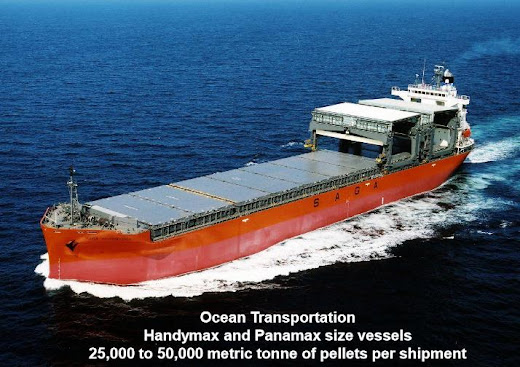
Wood pellet port with storage facility at Prince Rupert, BC, Canada
At present, wood pellet production generally only relies on sawmill waste and wood industry waste. Supply of raw materials fluctuating in both quality and quantity. In the rainy season in general, wood processing factories need more waste as fuel to dry wood they processed, so that wood waste that can be taken is reduced or only a little, even not left. This is different from the production of wood pellets from energy plantations because it guarantees a better supply of raw materials. But cultivation and harvesting technology must also be mastered properly to be able to better guarantee the supply of raw materials to the plant. For plants, guaranteed supply of raw materials is vital. The plant will immediately close if there are no raw materials to process. Wood pellet plant generally have a large warehouse of raw materials, which also functions as a buffer for their production.

Next is the mastery of wood pellet production technology itself. To maintain the quality and quantity of wood pellets that are as expected, the mastery of production technology is absolutely necessary, in addition to handling the product to the shipment. The critical points of the production process such as particle size, level of dryness, pelleting and cooling must be of particular concern. Wood pellet products that can be accepted by the international market almost all must meet two standard requirements, namely quality standards and environmental standards (sustainability). Quality standards are closely related to the technical aspects of the wood pellet itself or its production aspects. While environmental aspects are closely related to the origin of raw materials, and various environmental aspects that make wood pellet raw materials sustainable, and for more details can be read here.
The momentum of the energy plantation is predicted to not be long anymore, even Sri Lanka will soon produce wood pellets from the gliricidae energy plantation of 150 thousand tons/year or more than 10,000 tons/month, for more details, please read here. Gliricidae as well as calliandra are a group of leguminous plants (leguminoceae) and gliricidae are more popular and have been planted by the community since tens or even hundreds of years ago which is usually for hedgerows and leaves for animal feed. While the red calliandra, which may have been planted by the community for hundreds of years, is generally only for high areas. For a more detailed comparison of calliandra and gliricidae plants, please read here.

Reject (Non-Standard) Coconut Fruit for Bioavtur / SAF Production

The international civil aviation organization (ICAO) has included non-standard coconuts on the ICAO positive list – ICAO document – ​​CORSIA...