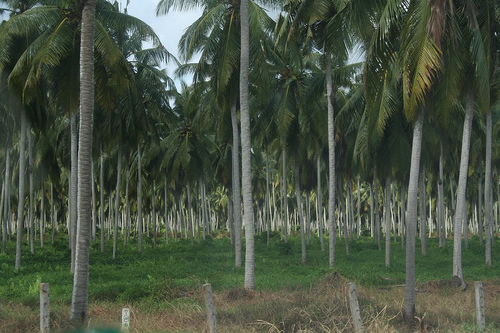
Indonesia is famous for the country of coconut island seduction. This is because the extent of coconut plantations in Indonesia reaches around 3.7 million hectares with most of them being smallholder plantations. The extent of the coconut plantations places Indonesia as the largest coconut plantation owner in the world, and the Philippines ranks second. Coconut trees mainly grow along the coast, and indeed Indonesia also has the longest coastline in the world. Although the number of Indonesian coconut plantations is the number 1 in the world, its productivity is still lower to the Philippines, so the Philippines is also the no. 1 coconut producer in the world. The coconut industry in the Philippines is also more advanced than Indonesia. Indonesia here is more prioritizing palm oil than coconut. The area of ??Indonesian palm oil plantations is currently around 12 million hectares or more than 3 times the size of its coconut plantations.
Coconut trees are also called the tree of life because all parts can be used for human life. But at present the sad fate of it because of the lack of attention to the development of plantations and industries. The main product of coconut is the oil which has high lauric acid content. Lauric acid is only found in three places, namely coconut oil, palm kernel oil and breast milk. Lauric acid is a medium chain fatty acid (MCFA) which has many benefits for human health. Lauric acid helps cure various diseases such as diabetes, cholesterol, hypertension and so on. VCO (Virgin Coconut Oil) is a form of coconut oil that can be directly consumed by humans. VCO is different from coconut cooking oil because the VCO is made without heating so that it produces medium chain saturated fatty acids or high MCFA, vitamin E, antioxidants and enzymes in the coconut fruit. Lauric acid in VCO is easily absorbed to the mitochondria so it will increase the body's metabolism. Besides that it can stimulate insulin production which causes glucose metabolism to run normally, which is especially useful for diabetics. The more common benefit of consuming pure coconut oil or VCO can also activate antiaging hormones and pregnenolone, progesterone, and DHEA, and prevent heart attacks, senility, obesity, cancer, and other diseases associated with premature aging.

Saturated fatty acids, lauric acid consists of 12 carbon atoms, which are bonded saturated (no double bonds) by hydrogen atoms. This makes it not easily rancid and can last up to 2 years. With 12 carbon atoms, lauric acid is called medium chain fatty acid (MCFA). Whereas other fats or fatty acids in general such as palm cooking oil, peanut oil and so on are long chain fatty acids (LCFA) and their chemical bonds are not saturated (double bonds). Lauric acid will be converted to monolaurin or a monoglyceride compound obtained by babies from breast milk which has antiviral, antibacterial and antiprotozoa properties. Medium chain fatty acids (MCFA) can be absorbed directly through the intestinal wall when they reach the digestive tract, this process is faster because without going through the hydrolysis and enzymatic processes. Then directly supplied into the bloodstream and immediately carried into the liver to be metabolized. In the liver VCO is processed into energy alone, not LDL cholesterol and not fat deposits, this energy is used to improve the function of all endocrine glands, organs and body tissues. Medium chain fatty acids (MCFA) have a small molecular size, so they are easily digested and can be absorbed directly by the body (absorbed by the intestinal wall) because MCFA easily penetrates mitochondria (an organ in every cell of our body that functions to produce energy for the body), So that the pancreas, digestive tract, and liver can work lighter. The ease of MCFA penetrates the mitochondria, making VCO acts as an instant energy source or quickly produces energy for the body. While LCFA needs hydrolysis and enzymatic processes before being absorbed by the intestinal wall. The form of the product or the result of the LCFA decomposition is energy, cholesterol, and there is residual fat accumulated in body fat tissue. Cholesterol and fat deposits can be the basis for a variety of chronic and degenerative diseases such as hypertension, stroke and diabetes. VCO can also be a drug and halal health supplement, because at present there are very few of us to find halal medicinal or pharmaceutical products.

Coconut water also has many benefits. Nata de coco is a popular product of coconut water processing. Nata de coco as a fiber-rich, low-calorie drink containing vitamin B and C is very well consumed for health. Coconut water can also be as an isotonic drink, which is a substitute for body ions, to restore new stamina and energy to the body. The biggest content is potassium, with the following details, namely 294 mg of potassium, 23 mg of sodium, 5 mg of sugar and 118 mg of chloride. These minerals are needed for our growth, even though the quantity is very little. Lack of minerals results in being a source of health problems. We should be able to get sufficient supply of these minerals through our food or drink. For example, lack of potassium (K) will cause digestive problems and Copper (Cu) causes the production and work of the enzyme to be disturbed. All health problems can arise because of this. Copper deficiency disrupts energy production, neurotransmission, increases cardiovascular risk and neurodegenerative diseases. To fulfill complete minerals, coconut water can be added to other minerals.
Biomass from coconut, among others, coir, shell, fronds, leaves and trunks. All biomass waste can be processed to be converted into energy. From coconut fiber can be processed directly into pellets and briquettes. But it could also be to give more added value, fibers are separated from the coir into cocofiber, while the waste is cocopeat or cocodust can be made pellets or briquettes. cocopeat or cocodust can also be compressed into a kind of briquette, or famous for cocopeat block. The use of cocopeat block, especially for planting media, can be read in more detail
here. Coconut trunks are quite expensive and are widely used in various building woods, so the use of
pellets or
briquettes is not suitable. While sawn waste or coconut stem processing waste is suitable for pellets or briquettes, because the price is cheap as waste wood in general. Coconut shells are now almost all processed into charcoal. Charcoal from the coconut shell can be directly used as fuel, raw material for briquettes and
activated carbon .
If the coconut is fully processed or integrated then all the benefits of coconut can be optimized, or at least a number of biomass can be converted as an attractive energy source. Various scenarios of integrated coconut utilization technology can be considered, so that optimal scenarios can be found. Central coconut areas such as Indragiri Hilir in Riau, Padang, Bengkulu, Lampung and so on must start looking for the potential of this coconut business. Besides the Philippines, India is also quite advanced in the coconut industry even though its biomass has not been focused on the energy sector. It is precisely this opportunity to steal the start to make coconut waste more efficient for the energy sector. When the energy sector is strong, the sovereignty of the state is also getting stronger.