
Showing posts with label pellets. Show all posts

Thursday, May 14, 2026

Indonesia's 2026 Palm Oil Replanting Target and Solutions for Utilizing Palm Oil Trunk Waste

Indonesia's stagnant national palm oil productivity requires an immediate solution. If this situation is not addressed promptly, Indonesian palm oil productivity will decline in the future. This is undesirable given the increasing demand for palm oil as a vegetable oil, including its use in biofuel, namely biodiesel. The launch of the B50 biodiesel program demands increased palm oil productivity. However, the question remains: why palm oil? Aren't there other crops that can produce oil with a comparable yield for biodiesel production? Nyamplung is a strong candidate for this; read more details here.

In palm oil, productivity can be increased through the use of superior seeds, replanting, and land intensification. In terms of land area, replanting palm oil plantations, with an ideal target of 5% per year, is very significant. With Indonesia's current 16.8 million hectares of oil palm plantations, that translates to 0.84 million hectares per year. Besides the high costs, the resulting biomass waste, or palm oil trunks, is also substantial. This clearly holds potential for an environmentally friendly bioeconomy-based industry, or circular economy.

With an area of Indonesia's palm oil plantations of around 16.8 million hectares, 9 million hectares are managed by private companies, 550 thousand hectares are owned by state-owned companies (PTPN), 6.1 million hectares belong to people's plantations or small farmers and the rest have not been verified. And based on data from the Central Statistics Agency (2024), recorded 10 provinces in Indonesia with the largest oil palm plantations in sequence, namely Riau province with 3.49 million ha, Central Kalimantan province with 2.03 million ha, North Sumatra province with 2.01 million ha, West Kalimantan province with 1.82 million ha, South Sumatra province with 1.40 million ha, East Kalimantan province with 1.32 million ha, Jambi province with 1.19 million ha, South Kalimantan province with 497.2 thousand ha, Aceh province with 487.5 thousand ha, and West Sumatra province with 379.6 thousand ha. And a total of 26 provinces in Indonesia as centers of palm oil plantations.

The palm oil industry, as one of the national strategic industries, receives significant government support, including the People's Palm Oil Replanting (PSR), which remains a national strategic program, although its realization has not yet reached the target. South Sumatra, as one of the national palm oil plantation centers, also recorded the highest PSR realization. PSR realization in 2025 is approximately 40,000 hectares, or 33% (one-third) of the target of 120,000 ha. This represents a slight increase compared to 2024, which was only 31% of that year's target. Specifically, South Sumatra has replanted approximately 75,000 ha of smallholder palm oil plantations from 2017 to 2025.

The government is targeting a national PSR of 50,000 ha for 2026, a much more realistic figure than in previous years, with South Sumatra province targeting 5,750 ha. However, given Indonesia's oil palm plantation area, the 2024 and 2025 targets of 120,000 ha are very low, especially for 2026, which is only 50,000 ha. Under these conditions, efforts that can be accelerated to increase national palm oil productivity are through the use of superior seeds and land intensification.

Furthermore, ganoderma can lead to the death of palm oil trees. Ganoderma, caused by the fungus Ganoderma boninense, attacks the palm oil's root system, disrupting nutrient and water transport. The process is very slow and is only detected when the infection is severe, resulting in yellowing leaves, drooping crowns, and even plant death. Waste from ganoderma-infected trunks must be removed or destroyed from the plantation to prevent further spread. Like waste from palm oil trunks from replanting, this waste must also be properly managed.

The issue of biomass waste from palm oil trees, which covers thousands of hectares, also presents a challenge. With such a large volume of old palm oil trees, utilizing them to create value-added products is crucial. With such a large volume, biomass processing plants or industries can be established and operate optimally, without worrying about raw material shortages. Products such as pellets, briquettes, and biochar are made from this waste biomass from old palm oil trunks. Old, dead palm oil trunks, often left unattended on land, should be utilized to create these useful, value-added products.

As shown in the diagram above, the potential for utilizing biomass waste, particularly oil palm trunks, is enormous. In the future, industrializing bioeconomics into various products is highly feasible. Palm oil trunk waste should not only pollute the environment and increase costs for palm oil farmers, but instead, it should become a profitable industrial raw material.

Thursday, January 1, 2026

Processing of Empty Palm Fruit Bunches (EFB) for Ash Production as Potassium Fertilizer and Energy

Palm oil mills produce a large amount of biomass waste, and one of the largest in their daily operations is empty fruit bunches (EFB). Comprising approximately 22% of the fresh fruit bunches (FFB) processed by the mill, the volume becomes enormous and piles up daily if not managed properly. For example, a palm oil mill with a capacity of processing 60 tons of FFB per hour for 20 hours per day produces 264 tons of empty fruit bunch waste per day (approximately 6,600 tons per month and 79,200 tons per year). This enormous amount would resemble a hill if piled up in one place.

Incinerators have recently become popular, particularly in Indonesia, for processing empty fruit bunches due to their speed and practicality. Furthermore, the ash produced by burning them can be used as fertilizer due to their high potassium content. However, these incinerators produce exhaust emissions that pollute the environment, including black smoke and particulate matter. These emissions, which pollute the environment and exceed the threshold permitted by the Ministry of Environment (KLH), have led to the prohibition of incinerators. This ban has led to an increasing number of unmanaged empty fruit bunches. Using empty fruit bunches for mulch is also less effective, and composting, a biological process, takes a long time.

Video link for conventional EFB incinerator here

This problem demands an immediate and effective solution. The quickest practical solution is to upgrade the incinerator to make it environmentally friendly or to reduce emissions below the required threshold. This can be achieved by using adequate emission control devices to meet these environmental requirements. While many emission control devices are available, cost and target output are crucial considerations when selecting them. This approach not only addresses the problem of empty fruit bunches, but the resulting ash can also be used as a potassium fertilizer.

Furthermore, by upgrading the incinerator with emission controls (basic type), the equipment can be developed into several types, as follows: the second type is a cogeneration boiler for palm oil mills, allowing 100% palm kernel shell (PKS) to be sold, even for export. The third type is by adding a new boiler and steam turbine for electricity production, which is then sold to PLN (Indonesia State Owned Electricity Company) under a power purchase agreement (PPA). The fourth type is equipped with waste heat recovery equipment, allowing for more general use. This also means the combustion process in the upgraded incinerator can also be upgraded so that the combustion process can run optimally. Several combustion technologies, such as chain grates, step grates, or reciprocating grates, can be considered to achieve maximum performance, including the removal and handling of ash product.

Empty fruit bunches (EFB) processing can vary, although the primary focus is addressing environmental pollution caused by them. However, their large volumes certainly represent a potential raw material for processing units. Therefore, in addition to addressing this waste, the technology used must also provide financial benefits. Of the numerous EFB processing technology options, the cost-to-benefit ratio of a technology application will be a crucial consideration for EFB processing.

In addition to combustion using conventional or this upgraded incinerator, thermal processing routes also include pyrolysis, with slow pyrolysis specifically for biochar production and fast pyrolysis for bio-oil production. Another pyrolysis variant is mild pyrolysis or torrefaction for the production of torrified biomass. Then there's gasification to maximize gas (syngas) production from biomass. Furthermore, empty fruit bunches of palm oil can be used as fuel or an energy source. To facilitate handling, storage, and reduce transportation costs, empty fruit bunches need to undergo biomass densification technology, with the final product being pellets or briquettes. 

Wednesday, December 31, 2025

Replanting Palm Oil Plantations in Indonesia to Maintain Palm Oil Productivity and Potential Utilization of Oil Palm Trunk Biomass Waste

One way to maintain or even increase the productivity of palm oil plantations is through replanting or rejuvenation, which is absolutely necessary. Old palm oil trees will decline in productivity, making them uneconomical. In keeping with the gradual planting of palm oil trees, replanting palm oil plantations is also carried out in stages and periodically. Furthermore, the use of superior seeds is also necessary, and one way to produce superior oil palm seeds is by using high-quality planting media, such as biochar. For more details, read here.

Palm oil companies generally replant 4-5% of their total land area annually. However, smallholders generally do not replant properly. This is due to the cost of replanting and the 4-5-year waiting period for fruiting to resume. However, because old palm oil trees naturally decline in productivity even with additional fertilizer, replanting is the only solution. Of Indonesia's approximately 16.8 million hectares of palm oil plantations, 9 million hectares are managed by private companies, 550,000 hectares are owned by state-owned enterprises (PTPN), 6.1 million hectares belong to smallholders or smallholders, and the remainder has not been verified. Specifically for replanting, the government is targeting 180,000 hectares per year for smallholders, but by 2024, only 38,244 hectares had been realized, far from the target.

Even in 2025, implementation of the replanting program will remain low, reaching only 11,777 hectares in the first quarter. Based on this reality, the government has finally lowered the annual replanting target from 180,000 hectares to 120,000 hectares. To accelerate the replanting program, the government could provide additional replanting funds to smallholder farmers. This additional funding would ideally come from business profits, specifically from the utilization of palm oil waste. Various biomass-based products are produced from the processing of palm oil waste.

For businesses based on the utilization of oil palm trunks, business readiness factors, both technologically and market-specific, require careful assessment. With an average hectare of palm oil plantations containing 125 trees, each tree having an average dry weight of 0.4 tons, per hectare yields 50 tons of dry biomass. For an area of ​​10,000 hectares, this translates to 0.5 million dry tons, and for an area of ​​100,000 hectares, this translates to 5 million dry tons. Optimistically, Indonesia could achieve 5% replanting, or 820,000 hectares, which would yield 41 million dry tons of biomass per year. Malaysia, with 5% replanting, or 285,000 hectares, would yield 14.25 million dry tons per year.

The issue of biomass waste from palm oil trees, which covers thousands of hectares, also presents a unique challenge. With the vast volume of old palm oil trees, utilizing them to create value-added products is crucial. This vast volume allows biomass processing plants or industries to be established and operate optimally without worrying about raw material shortages. Products such as pellets, briquettes, and biochar are made from this old palm oil trunk biomass waste. Old palm oil trunks, which are often left abandoned on land, should be utilized to create these useful, value-added products.

For a presentation on palm oil replanting, click here.

Tuesday, September 2, 2025

Replanting Palm Oil Plantations and Utilizing Old Palm Oil Trunks Waste (Presentation Version)

Aging plants are one factor in declining palm oil productivity. Palm oil trees begin to decline in productivity after 20 years and need to be replaced after 25 years. Therefore, rejuvenation or replanting must be carried out periodically according to the age of the trees.

Furthermore, the demand for palm oil continues to grow in line with global population growth. For the domestic market, biofuel use takes the form of a mandatory 40% palm oil blend in biodiesel (B40) this year, which is being reviewed to increase to 50% (B50) by 2026, and a 3% blend for jet fuel by 2026. Demand for the international market also continues to grow. The main destinations for Indonesian palm oil are India, China, Pakistan, Bangladesh, the United States, the Netherlands, Spain, Italy, Egypt, and South Africa.

Replanting palm oil plantations is crucial because it maintains sustainable palm oil productivity and prevents or reduces deforestation for new lands. The potential volume of old palm oil trunk waste generated is enormous, and there are numerous utilization options, including bioenergy, biocarbon, biomaterials, biofuels, and biochemicals.

To read and access the presentation, please download here

Monday, August 25, 2025

Palm Oil Replanting Movement and Utilization of Biomass Waste

Palm oil trees begin to lose productivity after 20 years and need to be replaced after 25 years, while new trees take about four years to begin bearing fruit. This generally renders the land unproductive during this four-year period, which discourages farmers from replanting their palm oil. However, intercropping during this period can still provide benefits for farmers. Planting short-term crops like upland rice and corn alongside palm oils can help farmers earn additional income while the palm oils bear fruit and mature.

In 2024, Malaysia, the world's second-largest palm oil producer, began implementing land intensification due to limited land area, only replanting 2%, or approximately 114,000 hectares. This is despite the country's target of replanting 5% of its land. The situation in Indonesia is not much different, with replanting predicted to be less than 2%. For example, if only 1.5%, or approximately 246,000 hectares, are replanted, it would be disproportionate to the area of ​​its oil palm plantations, which is nearly three times Malaysia's. Furthermore, replanting should be carried out periodically every year to achieve optimal palm oil production performance.

The reluctance or slow pace of replanting has led to a decline in national crude palm oil (CPO) production. Malaysian palm oil production has even stagnated for more than a decade due to limited land for new plantations and slow replanting. Meanwhile, in Indonesia, concerns about deforestation have also impacted the expansion of new oil palm plantations. Crude palm oil (CPO) production will decline further if labor shortages and the spread of ganoderma fungus reduce yields.

Given the above conditions, the replanting of palm oil plantations must be encouraged to maintain or even increase palm oil production. The issue of biomass waste from palm oil trees, which cover thousands of hectares, also poses a challenge. With such a large volume of old palm oil trees, utilizing them for value-added products is crucial. With an average hectare of palm oil plantations containing 125 trees, each tree yielding an average dry weight of 2 tons, this yields 250 tons of dry weight of biomass per hectare. For 10,000 hectares, this yields 2.5 million tons of dry weight, and for 100,000 hectares, this yields 25 million tons of dry weight. An optimistic estimate would be that Indonesia could replant 5% of its land, or 820,000 hectares, for 205 million tons of dry weight of biomass. Similarly, Malaysia, with 5% replanting, or 285,000 hectares, would yield 71.25 million tons of dry weight.

Business readiness factors, both in terms of technology and the market or user base for the product, need to be carefully assessed. With such a large volume, biomass processing plants or industries can be established and operate optimally without worrying about raw material shortages. Products such as pellets, briquettes, and biochar are made from waste biomass from old palm oil trunks. Dead old palm oil trunks, often left abandoned on land, should be utilized to produce these useful, value-added products.

Monday, July 15, 2024

Selling Wood Processing Machines and include Wood Waste Processing Machines

Various wood processed products are increasingly diverse and developing today. The utilization of wood is optimized for its function, especially those originating from production forests. To improve the quality and usefulness of the wood, it needs to be processed specifically, which is carried out in wood processing factories. This also includes the selection of wood plant species that are suitable for the purpose of their use or the product to be made. A number of wood processing products are plywood, blockboard, LVL, barecore, FJLB (Finger Joint Laminated Board), MDF (Medium Density Fiberboard), and pulp & paper.

Wood processing in the industry always requires a number of equipment ranging from the simplest, namely sawmills to complex processes such as pulp and paper mills. In addition to the physical or mechanical processing or production process, there is also a chemical process depending on the product to be produced. Sellers or providers of processing equipment or production machines are generally a complete set (complete line) so that they can be used directly and produce when the raw materials are ready. The more efficient and quality the equipment will be comparable to its price which is a fixed investment in the wood processing industry. The cost and benefit ratio factor is very important in selecting the machine or equipment, especially those that are export-oriented with large production volumes.

The concept of zero waste in the wood processing industries has not been fully implemented. There are still many wood processing industries whose waste pollutes the environment and can have social impacts. This includes sellers or providers of these machines, most of whom are still focused on providing machines or production equipment for the main product but not on the aspect of handling and processing waste. In fact, with the potential for waste produced being quite large, processing this waste is important. Pellet and briquette production is one solution to overcome this. Wood waste in the form of wood chips, offcuts, sawdust, slab and bark can be processed into briquettes and pellets. Sellers or providers of machines or production equipment that are innovative and environmentally sustainable will implement this concept. 

Briquette and pellet production will not only solve the waste problem but will also provide economic benefits. With raw materials for briquettes and pellets coming from waste itself, the cost of raw materials can be said to be zero so that in the end it will provide great benefits. Waste production of up to 1000 tons/month is very suitable for the production of briquettes, while if the waste is very large, for example 5000 tons/month or more, pellet production is more recommended. Briquettes can also be charcoaled to become charcoal briquette products which are in high demand from Turkey, Saudi Arabia and the Middle East. Meanwhile, wood pellets are widely used for power plants abroad, the need for which is expected to continue to increase along with the decarbonization trend. If the seller of wood production or processing machines also offers waste processing equipment such as pellet machines and briquette engines, it will make it easier for wood product producers to manage their environmentally friendly industry, namely zero waste and maximize profits because all parts of the wood can be utilized optimally.

Friday, May 3, 2024

Young Coconut Waste Processing: Briquetted or Pelleted!

When the weather is very hot like recently, drinking coconut water is very refreshing. This is because coconut water, apart from meeting the body's fluid needs, also meets the needs of electrolytes (ionically charged minerals found in cells, tissues and body fluids) which the body really needs. This electrolyte plays a role in supporting the activity of cells and body tissues and maintaining the balance of body fluid levels. When the body loses electrolytes due to physical activity or dehydration, consuming coconut water can help replace lost electrolytes and restore body fluid balance. There are many sellers of young coconut ice, especially in big cities. Apart from being sold in glasses, young coconut water is also sold in the form of whole young coconuts. The combination with young coconut flesh adds to the deliciousness of the drink. But it turns out that the waste from young coconuts is very polluting and has not been processed or used properly. The volume of young coconut waste is quite large, in fact, in the city of Makassar, South Sulawesi,  it is estimated that there is 15 tons/day of young coconut waste.

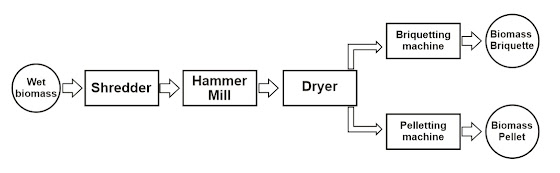
Young coconut waste can be processed into briquettes or pellets. Biomass densification technology is suitable for application as a solution for young coconut waste. The young coconut waste needs to be reduced in size (size reduction), namely with a shredder and hammer mill, then dried with a dryer before being compacted / densified into briquettes with a briquetting machine or into pellets with a pelletiser (pelleting machine). By briquetting or pelletizing the waste, it can be used as fuel or energy source for SMEs or boilers in industry. Many SMEs or processing industries can use this fuel. Apart from being environmentally friendly, it is also easy to use. Simple furnaces can be developed to use these briquettes and pellets.

Indonesia is famous for its seductive land of coconut islands. This is because the extent of coconut plantations in Indonesia reaches around 3.7 million hectares, most of which are smallholder plantations. The extent of these coconut plantations places Indonesia as the owner of the largest coconut plantations in the world. Coconut trees mainly grow along the coast, and indeed Indonesia also has the second longest coastline in the world, after Canada.

Thursday, November 16, 2023

Don't Choose The Wrong Machine: Wood Pelletizer With Feed Pelletiser, and Wood Extruder With Charcoal Extruder

The visual appearance alone can sometimes be unbelievable. Two things can visually appear the same or very similar but turn out to be different. This often happens in the production of wood pellets and wood briquettes (pini kay briquette / uncarbonised briquette). And what's worse, this machine is the heart of the industrial production process, namely the pelletiser in the wood pellet industry and the extruder in the wood briquette industry (pini kay briquette / uncarbonised briquette). So that errors in selecting the machine can also have fatal consequences, namely not only is the production target not achieved, even the product in question is not successfully produced. This is why the buyer or user of the machine must be careful about the machine that will be purchased and used.

In the wood pellet industry, mistakes often occur, namely pelletisers are used for animal feed but are used for wood pellets. As a result, wood pellets may not be formed at all because the power for feed pelletisers is much smaller compared to pelletisers for wood or wood pellet production. Offers of cheap prices often make buyers or users tempted and do not look further, so that as a result they will be disappointed.

Likewise in the wood briquette industry (pini kay briquette / uncarbonised briquette). Wood extruders also have much larger motors than charcoal extruders. Briquettes produced with a wood extruder apart from not requiring additional adhesive are also denser and harder due to the use of a high-powered motor. The mistake that can occur is that a charcoal extruder is used for a wood extruder and this also usually happens because the price is cheaper. The briquettes produced from the wood extruder can then also be made into charcoal, producing the final product in the form of charcoal briquettes. Although charcoal briquette production using a charcoal extruder will also produce this product, the process route and product quality are different. Below is the route for the charcoal briquette production process.

The raw material used in route 1 is wood dust such as sawdust which is then pressed or compacted with a wood extruder. With strong pressure and high heat, no additional adhesive is needed, but lignin, which is a natural polymer found in wood, acts as an adhesive. The resulting briquettes can then be charcoaled in a carbonization furnace and the final product is charcoal briquettes. Meanwhile, in route 2, the raw materials are charcoaled or carbonized first, then the charcoal is mixed with adhesive, usually starch and pressed or compacted using a charcoal extruder. The use of additional adhesive is because in charcoal, lignin has been decomposed in the previous carbonization or carbonization process. The final product produced is charcoal briquettes. The quality of the charcoal briquettes in the route 1 process is better than the route 2 process because apart from being denser so the burning time is longer as well as the heat produced.

So, in order not to make the wrong choice, buyer / user have to be careful and precise about the specifications of the machine, as well as knowing the raw materials and production process and don't be easily tempted by offers of cheap prices. The greater the production capacity, the greater the need for pelletiser and extruder equipment, so that if the wrong choice occurs, the risk is fatal, because these machines are expensive. It is also important to note that the equipment purchased also comes from a manufacturer that has been tested so that it has reliable performance.

Monday, August 14, 2023

EFB Pellets with Low Potassium (K) and Chlorine (Cl) for Power Plants

Palm oil mills that have excess energy, especially electrical energy, will have more freedom to develop their business. The excess electrical energy could have come from the production of electricity from the use of biogas. Liquid waste (pome) from palm oil mills is the raw material for biogas production. A palm oil mill with a production capacity of 30 tons of FFB/hour will be able to generate 1 MW of electricity and so on. One of the products that can be processed from the utilization of palm oil solid waste as well as the development of this business by utilizing excess energy is EFB pellets production. With the high price of palm kernel shells or PKS and wood pellets, the driving force or need for EFB pellets is increasing. Global awareness regarding decarbonization or CO2 removal (CDR) or CO2 reduction is the main driving force.

Apart from that, the production of EFB pellets can also be carried out by a separate company by purchasing the raw materials for EFB from palm oil mills. With conditions in Indonesia where there are still very few palm oil mills that have biogas units so that they have electricity supply and can process EFB into EFB pellets, there is still a lot of EFB that has not been utilized and becomes waste that pollutes the environment. This makes EFB pellet producing companies not have to worry about the supply of EFB raw materials. In fact, because the amount or volume of EFB is very large, the EFB pellet plant will be overwhelmed by the abundance of this raw material.
However, due to the high content of EFB in potassium and chlorine (ash chemistry), the use of EFB pellets is limited or can only be used in certain types of power plants, especially stokers and fluidized beds. In fact, most power plants currently use pulverized combustion technology. This is so that the chemical content of ash in EFB must be made as friendly as possible to boilers, especially those with pulverized combustion technology. This can be done so that the chemical content of the ash in the form of potassium (K) and chlorine (Cl) is only less than 2000 ppm. Potassium (K) with a low melting point causes deposits or scale to form in the heat exchanger pipes in the boiler so that the efficiency of heat exchange decreases while chlorine (Cl) is corrosive which shortens the life of the equipment. The treatment was even successful in reducing K and Cl by up to 80% so that the problem of fouling thickness and corrosivity was also reduced by 80%. With the number of palm oil mills in Indonesia reaching around 1000 units, of course the amount of EFB that can be processed into EFB pellets is also very large.

Thursday, January 19, 2023

Production of Cow Dung Briquettes / Pellets as Fuel and Bioeconomy

The use of renewable energy is increasing along with global awareness of environmental and climate issues. Materials that used to be considered waste and polluted the environment, now with the concept of zero waste and circular economy, many have been converted into alternative energy or renewable energy. Large industries such as power plants, cement industry and so on have started to use this renewable energy in the framework of CO2 emission reduction or decarbonization programs. This decarbonization program is increasingly popular and is applied to various lines of life. 

As a real example is the cement industry in the UAE, namely Gulf Cement Co., which uses renewable energy from camel dung. From the results of operational trials it was found that every 2 tons of camel dung can replace 1 ton of coal. The use of animal dung as fuel is actually not a new thing for them, from ancestral stories cow dung has been used as heating or fuel, but many have not thought of camel dung. Gulf Cement Co currently uses 50 tons/day of camel dung as fuel. The UAE has a population of around 9000 camels for milk production, racing and beauty contests. Each camel produces 8 kg of manure per day, more or more than the farmer needs. Through a government program, camel breeders collect the camel dung at collection points. 
Cow dung has also been used as an energy source from the United States, Zimbabwe to China. In Indonesia this should also be done. With each cow producing an average of 15 kg of dung per day (about 2 times that of a camel), this is the same as the conditions in the UAE above, the volume of dung is more or more than what farmers need. The excess of this waste becomes an environmental problem and even has to be thrown into rivers and so on. Hundreds of tons of cow dung every day are not utilized in a number of areas in Indonesia, even though the dung can be used as fuel, especially when processed into briquettes or pellets (dried first). Compaction of cow dung into briquettes or pellets aims to obtain uniform size and shape, compactness, ease of storage and use, as well as saving on transportation costs. And to meet the needs of cement factory materials, such as briquettes / cow dung pellets are needed in large quantities, so large capacity production equipment is needed that works continuously. It is estimated that the need for pellets or briquettes is thousands to tens of thousands of tons every month.

In a cement plant there are 2 places that need heat energy: 1. calciner (where the calcination process occurs), 2. Rotary kiln (the heart of the cement factory, where the clinker is made). Renewable energy, such as briquettes or cow dung pellets, will usually be used in calciners with separate feeding points. Meanwhile, in rotary kilns that require higher heat, cement plants generally still use fossil fuels. The gradual use of renewable energy will reduce environmental pollution and accelerate the global decarbonization program. The cement plant itself can be said to be an industry that processes and destroys waste. This is because the cement plant can process waste such as slag and fly ash as an additive to the cement it produces - more details can be read here and also destroys waste, such as using cow dung as the fuel.


Monday, December 5, 2022

Wood Pellet Production to Penetrate the European Market

The condition of the Russian-Ukrainian war that occurred had an impact on the wood pellet industry, namely the shortage of supply in England and other European countries. They have made efforts to increase supply to secure the availability of these wood pellets. The shortage of wood pellets both for industrial and household use (room heating / pellet heating). Wood pellet production from Russia cannot be accepted by the European market even though the amount is large (Russia exported more than 870,000 tons to Denmark alone last year) and this condition is expected to occur for at least the next 12 months. The supply shortage of wood pellets is estimated at 3.4 million tons, which is production from Russia, Ukraine and Belarus. The Russia-Ukraine conflict has led to high wood pellet prices for various reasons, mainly due to the scarcity of wood pellets and other fuels coming to Europe and high electricity prices.

The need for wood pellets also continues to increase along with the decarbonization program (substitution of fossil fuels for renewable energy). According to Hawkins Wright's data, from 2020-'21, demand for wood pellets for the global industry grew by 18.4%, with production only growing 8.4%. Especially now with the disappearance of Russia, the price of wood pellets is higher, which reaches $ 300 per ton, but even at high prices, the supply of wood pellets is still constrained. The high price of fossil fuels has also created an increase in demand for wood pellets, especially households in Europe who have switched to wood pellets for space heating and it is estimated that the increase in demand will reach 2.5 million tons in 2022, according to the Austrian proPellets report. In Austria—and most of their representatives across Europe—wood pellet prices broke records by increasing more than 53% over the previous year with no signs of slowing down anytime soon. Even the June 2022 survey completed by Austrian proPellets resulted in an average price of wood pellets rising 66% compared to the previous year. However, despite the increase, wood pellets still offer a price advantage of 82.7% compared to heating oil and 18.3% compared to natural gas. Meanwhile, packaged wood pellets (bagged pellets) increased 52.8% compared to last year.

ProPellets Austria also reported that to respond to the demand for wood pellets, especially to ensure long-term needs, the Austrian wood pellet industry built 11 new wood pellet factories by accelerating the utilization of wood residue. The international energy market is in a state of upheaval, not least because of Russia's invasion of Ukraine, and this also affects the wood pellet market globally, especially in Europe. Whereas the UK has also faced a shortage of 200,000 tonnes of wood pellets in the domestic/household heating market and that new supply chain pathways are being explored, importing larger volumes is one solution. With a very tight market, supply chain bottlenecks, inflation and the ripple effects of ongoing wars, strategy, creativity and supply chain flexibility will be required from wood pellet stakeholders. As for whether global wood pellet supply is expected to be closer to meeting demand, that likely won't be in the near future, according to Matthews, biomass consultant from Hawkins Wright. . Economic strength will have an effect over time — high prices are the driving force of investment in a new wood pellet plant. The wood pellet industry is currently investing hundreds of millions of Euros so that supply is guaranteed in the long term, but they also need support from political decision makers.


Indonesia, with its vast territory and tropical climate, has the potential to develop large capacity wood pellet production, including the use of energy plantations. Indonesia's wood pellet production, which is currently still small or estimated at only 200 thousand tons per year, needs to be boosted so that it responds to European needs. Even though so far Asia, Japan and Korea are the target markets for wood pellets, recent developments in European conditions have also become a new impetus. The high price of wood pellets in Europe due to the Russia-Ukraine war made suppliers in North America (United States and Canada) also start supplying Europe. In fact, this opportunity was also seized by a number of suppliers from Asia. Vietnam is the second largest exporting country in the world for wood pellets. The volume and value of wood pellet exports has continued to increase since October 2021 and export prices have soared to an average of nearly US$150 per tonne, up more than 27% compared to the average price recorded last year. The sharp rise in export volumes and prices can be attributed to the sudden increase in demand from the European Union. With this extraordinary production capacity, Vietnam's wood pellet industry is starting to face a number of challenges, namely limited raw materials and more stringent requirements demanded by importers such as sustainability certification. This condition should be seen as an opportunity for the wood pellet industry in Indonesia.

Thursday, June 2, 2022

Biomass Pellets in India

India has hundreds of millions of biomass waste, especially from agricultural wastes or about 230 million tons per year. Hundreds of millions of tons of biomass waste is of course an environmental problem, especially because most of the waste is simply burned in fields where the smoke pollutes the environment, but on the other hand it will be a solution, namely for decarbonization programs and climate change. Technically, the biomass waste from agricultural waste will be processed into fuel pellets (biomass pellets) which are used for fuel in power plants by cofiring. In the early stages, the Indian government targeted 5% for the cofiring ratio in their coal power plants, where the 5% figure when translated into biomass pellet production would reach around 50 million tons of biomass pellets per year. This is a very large amount, especially with a short time target, which is only one year since it was ordered on October 8, 2021 and will take effect in October 2022 or this year, so hard efforts are needed to achieve this target. Meanwhile, in 2021, the world's demand for wood pellets for power plants will only be around 23 million tons.

The establishment of factories for the production of biomass pellets must be carried out immediately to achieve the production target. These factories must also be supported by logistical readiness to supply raw materials so that the factory can be completed, so that the production of biomass pellets can be carried out as soon as possible. With an average power generation capacity of 275 MW in India, with a cofiring ratio of 5%, the annual need for biomass pellets is estimated at 50 thousand tons or 170 tons per day. With the number of power plants reaching around 900 units with an average consumption of 50 thousand tons of biomass pellets per year or a total of almost 50 million tons per year, the distribution of biomass pellets is also a challenge. A factory with a capacity of around 5 thousand tons/month is likely to be suitable, and even if each factory supplies one power plant, the need for a biomass pellet factories will also be the same as the number of power plants, which is 900 units. A huge amount.

Biomass pellets or agri-waste pellets, namely pellets from agricultural wastes do have a number of differences with wood pellets. Wood itself is also a part of biomass so it can also be called biomass pellet. Biomass has a wider range, including wood pellets and agri-waste pellets. Agri-waste pellets have higher ash content, and some have higher chlorine, potassium and silica content in the ash. The content of these substances is not friendly to the heat exchanger pipes in the boiler which will cause fouling and corrosiveness, so that in addition to decreasing boiler efficiency, the service life of the boiler is shortened. In addition, the harvest of agricultural products usually coincides at certain times, while the pellet factory must continue to produce every day. This is why it is necessary to store and allocate raw materials in the form of agricultural waste for the routine production of these pellets. And because these agricultural wastes cannot be left alone in the agricultural area, they need additional investment in the form of storage warehouses and to be able to store more agricultural waste they need to be temporarily compacted by baling. These things usually don't happen in wood pellet production, so the agri-waste pellet production approach is different.

And because the ash chemistry of agricultural wastes causes many problems in the operation of power plants, their use is also limited. With a cofiring ratio of 5%, the problem can still be tolerated, but when the ratio is enlarged, the impact will be more pronounced. The exception is the CFB (circulating fluidized bed) type plant which can use 100% of the agricultural waste pellets, but in India the power plants using CFB technology are very small, around 1% (9-10 units). Indonesia and Malaysia also produce biomass fuel that is almost similar to pellets and even in the international market is the pellet competitor, namely palm kernel shells or PKS. The volume of PKS also reaches millions of tons, so it can be exported to India to help meet India's needs for biomass pellets, which so far have been mainly for export to Korea and Japan. PKS is also produced by a number of countries in West Africa. But it seems that the Indian government for now will prioritize the use of their agricultural waste first, so it has not provided financial support for the import of the biomass fuel.

Currently, India must make every effort to accelerate the construction of biomass pellet factories to achieve this target. However, 1 year to achieve this target is very difficult. With these conditions in the future, it is possible that power plants in India will import biomass fuels such as wood pellets and PKS to meet their needs. With the currently planned cofiring ratio of 5%, the need for biomass pellets reaches around 50 million tons, if only 2% of the biomass fuel needs are imported, both PKS and/or wood pellets, it will reach 1 million tons, the amount is still very big.

Reject (Non-Standard) Coconut Fruit for Bioavtur / SAF Production

The international civil aviation organization (ICAO) has included non-standard coconuts on the ICAO positive list – ICAO document – ​​CORSIA...