Showing posts with label screw extrusion wood briquette. Show all posts

Tuesday, March 21, 2017

Popularizing Wood Briquette For Renewable Fuels and Environmentally Friendly


The title of the utilization of renewable energy and environmentally friendly, has a bustling decorate various print and electronic media at this time. Availability of fossil energy are dwindling and unsustainable become a major driving force to give attention to renewable energy. Over time by increasing energy needs, it is inevitable renewable energy will become a mandatory requirement in time. Lignocellulose biomass such as woody is an abundant source that is easily obtainable as well as easily cultivated to the sustainability of their supply. Facts about the low use of renewable energy such as biomass can be viewed from a number of factors, including environmental awareness is still low, including letting productive lands without results even tend to occur desertification, lack of awareness of self or sovereign in the energy sector as one of the vital needs, the lack of or the lack of mastery of technology for renewable energy production and utilization resulting in the inability to see the potential of biomass is very large in tropical areas like our country.

Wood briquette is a product compaction (densification) biomass. Compared to wood pellets, wood briquette is also less popular and production not as much wood pellets. Technically wood briquette quality is not inferior to wood pellets, because in general the density of wood briquette is higher than wood pellets. In addition to the surface of wood briquette also occurr partial carbonized that makes it easy ignited. The large size of wood briquette makes it not easy to flow or be poured as well as wood pellets, which could be a factor that makes wood briquette less desirable. Basically wood briquette similar to wooden sticks as firewood used for cooking, with a density of approximately 2 times the hardwood so to burn is also not a difficult thing. Some furnaces are accustomed to using firewood will easily adjust to the wood briquette. 

Wood briquette is also less publicity than wood pellets, so wood pellets usually more popular. The use of wood pellets for various industries also have started to bloom as in the tea industry for the process of withering and drying the tea leaves themselves. The content of anthraquinone also be very low when using wood pellets as fuel for the process so that it can be accepted by European market in particular. Characteristics of wood pellets which can bulk this is what makes many selected.
Basically wood briquette also has the same functionality, only slight modifications to the furnace may be needed due to the large size. Resume biobriquette or wood briquette application can be read here. The use of wood briquette and mastery of production technology should be easier to do. Wood briquette has a longer produced in various regions in Indonesia, more than 20 years ago as an intermediate product in the production of sawdust charcoal briquette. Fabrication or manufacture of equipment for wood briquette production also has a 100% have been able to be produced in the country, in contrast to wood pellets that most of its production equipment is still imported.


In addition to the woody biomass waste, plantation waste such as empty fruit bunches of palm oil is also good potential compacted into pellets or briquettes. In the palm oil mill the energy needs both heat and electricity in general have been able to be satisfied by the mesocarp fiber and palm kernel shell. Palm Kernel shell even many left, and they can be sold because it can be directly used for fuel and could bulk as well as wood pellets. Large palm oil industry does not only produce crude palm oil or CPO (crude palm oil) but with a range of derivative products or purification/refinery to increase the added value of the CPO will need a lot of energy for the production process. Picture below about purification scheme (refinery) CPO to produce a wide range of derivative products. 

EFB briquettes as a source of energy that CPO refinery. A palm oil mill operations are efficient and zero waste with optimal utilization of wastes for energy resources could have done well with the above-mentioned mechanism. The ash from burning briquettes that are rich in potassium (K) also can be levied which will be used for organic fertilizer on palm plantations.

Tuesday, November 8, 2016

Wood Shaving Processing: When Size Being Problems


Wood shaving of barecore mill has a particle size that is big enough but has a small moisture content (MC = 4-6%) or dried. In addition in the form of waste-sawdust shavings also has a low bulk density, at around 150 kg / m3 or about half of sawdust. Densification technology (compaction) suitable for processing the waste. Briquettes and pellets are the two densification technology products are very popular today.

Wood shaving characteristics as mentioned above make some adjustments need to be used directly on the densification technology. The advantage of the dry shaving wood so it does not require longer drying with a dryer (dryer), even as it is too dry so even need water/moisture level is lowered (wetted). While on the other hand because of the small particle size and density, making it hard for densification (compaction) for densification of some densification equipment  that require these materials get into the small diel eg wood pellets or wood briquette type of screw (extruder).

In many cases the wood shaving can be used to manufacture wood pellets or wood briquette (type screw extruder) directly by use waste of barecore that form of wood shaving is used as a mixture (mixed material) with the limited percentage , for example, 10% of wood shaving and 90% sawdust. The densification equipments can run that because the average particle size of the raw material is accepted in the tolerance range of densification technology with small die size.
Hydraulic Press type briquette
Specifically on high pressure briquetting is known three groups of technologies that are currently used, namely:
1. Screw press (Extruder)
2. Piston / ram mechanical press
3. Piston hydraulic press

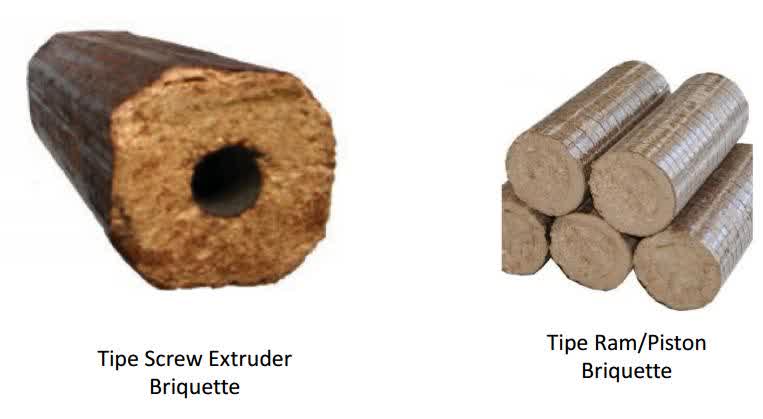
In piston / ram mechanical technology and piston hydraulic press, wood shaving can be press directly into briquettes and without any additional sawdust or 100% of the wood shaving (single material). This is because the equipment does not encourage the raw materials into the small size of die, but the raw materials are simply filling a particular room and then compacted. While the briquette type of screw (extruder) raw materials pushed and pressed at the same time / simultaneous and entered the mold (die) with small size, so the big size of the particle and low density of raw materials that make the briquette failed to form. In briquetting equipment with type screw (extruder) if it will use 100% wood shaving it needs some modifications from the standard machine so that it can adapt to the characteristics of the wood shaving. Comparison between piston with screw-type briquettes can also be read here.

In the end,the quality or briquette product specifications requested by buyers (market) and manufacturing costs of the use of the densification technologies will be the driving factor of the wood shaving processing business. The mindset of waste management is the early stage is how to cope with such waste, which does not disturb the environment and so while the next stage how such waste can also take advantage or financial profit.

Friday, October 16, 2015

Wood Briquette Left Behind 25 Years of Wood Pellet

Common areas with wood burning application it will be appropriate to use wood briquette and less suitable when using wood pellets. Various areas in various parts of the world use wood for heating (wood burning stove or boiler) or for cooking. If the ratio of wood as fuel is much so the business of  wood briquette production will be more attractive than wood pellets. Globally wood briquette are less popular than wood pellets, so the wood briquette production is also far below the wood pellets. Wood briquette also has its own characteristics compared to wood pellets.


In general, wood briquette production is also much easier than wood pellets. The particle size, raw materials, moisture content and operations slightly more stringent than the requirements for the production of wood pellets. All wood pellets have a cylindrical shape which is only distinguished diameter of the cylinder, and a commonly used the diameter of 6 mm and 8 mm, while the wood briquette in addition to its shape can vary in terms of size also vary, for example, of the diameter of 50 mm (5 cm) to 90 mm (9 cm). Wood pellets almost all using mechanical compression on the wood briquette production while there is some compression options, namely mechanical, hydraulic and extrusion (screw). The different compression technology will also produce different product characteristics, such as differences in mechanical compresssion (ram / piston briquette) and by extrusion (screw briquette). Raw materials that can be made pellets almost certainly be made briquette, but all the raw materials that could be made briquette may not be successful to make pellets. Wood briquette density is also higher than wood pellets, which ranges from 1000-1400 kg/m3 (62.4 to 87.4 pounds/ft3) while on wood pellets range from 700-800 kg/m3 (43.7 to 50 pounds/ft3 ).

Whereas when compared with wood (round wood/log) are usually capable of burning (burning time) about 30 minutes then with a high density on the wood briquette made have burning time of about 6-7 time. Another factor that cause the long burning time is low moisture content than round wood/log.  In many ways wood briquette production process has many similarities with wood pellets or both in the biomass densification technology group. Although both carbon neutral because both biomass fuel, but the process of burning wood briquette produces 60% fewer emissions than using firewood. Then for the cool areas that burn a lot of wood for the fireplace (heating), the wood briquette is the right choice.

Biochar, Soil Health, and the Sustainability of Palm Oil Productivity

Healthy soil is invariably fertile, but fertile soil is not necessarily healthy. Healthy soil teems with life—such as earthworms and other o...