Friday, January 8, 2016

History Repeated Back In The Field of Biomass


Biomass and wood in particular have been known and used very long for an energy source. The wood is burned to produce heat that can be utilized for human life. The utilization of biomass including wood also became a main source of energy when fossil fuels has not been found or exploited. When fossil fuels become a major fuel source as it is today, then the fuel from biomass is reduced. Conditions such as this makes oil-producing countries have a strategic role in the international arena. Energy is in many ways identical to the petroleum fuel, because its role is vital for human life today.

When there is a state of war, including World War II, namely in 1940 and the Yom Kippur war in the 1970s, many countries experienced an energy crisis that forced them to develop a range of alternative energy. Biomass as a renewable energy back received great attention. Biomass as an energy source to produce energy is relatively stable compared to wind and solar are affected by weather conditions. Conversion of biomass into various forms of energy are also carried out on-era World War II, this is due to adapt to the various needs of the moment. Vehicles, and various industrial original equipment using fossil fuels is replaced with a source of energy from biomass. This makes the findings of biomass utilization technologies that can run a number of existing equipment including fulfilling life. Biomass is the only renewable source of carbon-based so that it can be synthesized into a wide variety of hydrocarbons such as petroleum. In conditions of war, biomass have been converted to solid fuels, liquid fuels, gaseous fuels and other chemicals.
Technologies such as gasification, pyrolysis, combustion, and densification are some of the main technologies used for the conversion of biomass energy. By gasification will be the main product obtained in the form of gas that can be directly used as fuel or synthesized into oil or other chemicals.  With (slow) pyrolysis will be obtained charcoal as a primary product, then gas and liquid products as the byproducts. As well as gas produced from gasification, pyrolysis gas from the results of these also can be used as fuel directly or synthesized into other chemicals. The Liquid product of pyrolysis, bio-oil that can be used as fuel or source of chemicals. While other liquid product namely wood vinegar can be used for a variety of uses in the agricultural sector.
Steam Railway, at the Ambarawa Railway Museum, Central Java, Indonesia
Combustion is the most popular technology used for steam engine, especially in the mid-19th century. James Watt made improvements to the steam engine so that makes it rotates continuously used as a driver in a variety of industrial and transportation or mark the era of the industrial revolution in Europe at that time. Steam train (steam locomotive) is the application of the steam engine in transportation. The first time the steam engine to the train running on rails was made by Richard Trevithick in 1804. While to produce electricity, the steam engine that produces mechanical energy is connected to a dynamo (generator). Charles Parsons was the first to connect the steam engine with dynamo and done in 1884. This makes the electric becoming easily available and widely available.


Densification technology also received serious attention during World War II in 1940s and the during the oil crisis of 1973 as a result of OAPEC embargo as a impact of the Yom Kippur War. Densification technology makes biomass initially have size irregular, low density, large volume, high water content into a uniform shape, high density, low water (moisture) content and volume decreases or there are a number of improvements physical properties so that it becomes more economical to transport , easier handling in use and storage. Briquettes and pellets are the two forms of biomass densification products are most popular and became the forerunner of today's densification technology.

Today, when the environmental crisis-induced excessive human hand in exploiting natural resources including massive fossil fuel use become the driving force for the use of renewable energy then so biomass energy again received fresh momentum and become a focus for some circles. Recorded since the UNFCCC in 1992 until the signing of the Kyoto Protocol in 1997 by 83 countries and at the time of enactment of approval in February 2005, it has been ratified by 141 countries is in order to address the environmental crisis, especially due to the high concentration of greenhouse gases (CO2) in the atmosphere are believed to cause climate change and global warming. Kyoto Protocol in force until 2012 and then extended to the Kyoto Protocol Extension (2012-2020).

Policies that are more regional and technical hereafter devised based Kyoto protol include RED (EU's Renewable Energy Directive), commonly known as the 20-20-20 targets or mandates that are intended to reduce 20% of greenhouse gas emissions from 1995 as the level basically; 20% decrease in energy consumption; and to 20% for renewable energy. Wood energy needs of approximately 30 million tonnes / year by 2020. Furthermore, South Korea has issued a Renewable Portfolio Standard (RPS) which requires a minimum of coal to the power plant using renewable energy 2% in 2012, with an increase of 0.5% / year until 2020. In 2020 they will need a minimum of 10% renewable energy with the expected composition of 60% of renewable energy derived from woody biomass (wood energy), while the remaining 40% from other sources. Japan issued regulations Feed in Tariff and so on which makes the wave era of world energy use of biomass increasingly felt.

Drax England, The Current Largest Biomass Power Plant 
Biomass energy is grouped carbon neutral it will be able to reduce the concentration of CO2 in the atmosphere today that has exceeded the threshold. Biomass then become an important material and use on a large scale. Technologies of processing biomass in World War II and the oil embargo back in use, of course with some improvements adapted to current technological advances such as improved efficiency, safety, automation up to computerization but fundamentals or principles of process technology used virtually unchanged. These technologies today raised again. More so the environmental crisis coupled energy crisis will be the driving force of its own to the larger switch to renewable energy, including biomass. And is not it back indicates to the era before the 19th century when most of the energy used by humans are a group of renewable energy?

Tuesday, December 29, 2015

Looking Wood Pellet Market In Asia


Wood pellet market growth projections indicate Europe as the main market with a consumption of 25-30 million tons in 2020, about 2.5 times more than the consumption in 2010 of 12 million tonnes. The  countries main producing wood pellet currently are Canada, USA, Sweden and Germany. The United States is the largest producer of wood pellets, but the majority of its production for domestic consumption for space heating (home heating), while Canada as the largest manufacturer of wood pellets after the United States, approximately 80% of production is for export. The big market changes that occurred in the Asian markets of less than 1 million tons in 2010 to about 15 million tonnes in 2020. Global wood pellet production also increased which grow up to 300% from 2012 to 2020, from 16 million tons to 40-50 million tons.
Global Energy Production by Source
Source: EIA 2008

Areas that are able to produce wood pellets with low prices would be a major exporter of wood pellets. Two components that are very influential in the production of wood pellets is the price of raw materials to factories and transportation costs to market. The position of Indonesia is located in the Asian region with a tropical climate so the potential to becomethe largest producer of biomass has a strategic role of being a manufacturer of wood pellets for the Asian market. Below are three major countries in Asia as market for wood pellets:
South Korea’s energy consumption by type. Source: Economic Intelligence Unit 2009

South Korea Market Development
Although South Korea is a small country, but a country 10th in the world with the energy user fifth oil importer and second importer of coal. Currently produces about 65% of the electrical of fossil fuels. South Korea seriously to reduce greenhouse gas emissions to 30% reduction in CO2 emissions from 2010 levels by 2020. South Korea has also issued a RenewablePortfolio Standard (RPS) which requires a minimum power plant to use the 2% renewable energy by 2012, with an increase of 0.5% / year until 2020. In 2020 they will need a minimum of 10% renewable energy with the expected composition of 60% of renewable energy derived from wood biomass, while the remaining 40% from other sources.
Japan’s energy portfolio. Source: U.S. Energy Information Administration 2010

Japanese Market Development
Japan has almost no natural resources, so that imports nearly all of almost all the coal, oil and gas. Japan is the largest importer of natural gas and petroleum ranked second in the world. Since the accident or the explosion of Fukushima nuclear power plant in 2011, the Japanese government review of national energy policy and resource development. The policy indicates that for the next 10 to 20 years for renewable energy, the increased use of non-fossil energy to 50% and greenhouse gas reductions in electricity generation from 34% to 70% in 2030.

China’s energy consumption by type. Source: Economic Intelligence Unit 2009

China Market Development
China is currently the second largest energy user after the United States. Energy is the foundation of economic growth in China. Coal is the main energy in China that make this country the largest user of coal in the world. Although very little renewable energy policy announced by the Chinese government, China in its five-year plan to allocate $ 750 million in direct subsidies, incentives and tax exemptions for building 200 green energy demonstration project in 2015 or at least 15% of its energy needs from renewable energy. China has also set up a biomass energy production with a target of 50 million tonnes of coal equivalent by 2012. Although the 5-year plan does not indicate specific green energy projects to be addressed, a number of assumptions stated China will produce wood pellets to replace coal. The majority of the production of wood pellets also comes from domestic production so that its import was minimal.

Saturday, December 26, 2015

Planting Trees For Answering The World Problems


By planting a variety of essential human problems in life can be overcome, namely food, energy and water. These problems currently faced by humans for a variety of environmental damage is also caused by the act of the hands of men themself. There are many types of plants created by Allah SWT  (God Almighty ) in this world, so choose the one most suitable is the thing we need to do. Revive dead land and making it productive so will productive for human life, of course is highly recommended especially when the world is plagued by crises such as food, energy, water supply, including clean air. Currently there are an estimated 1 billion people on this earth who are facing the problem of hunger.  Millions of hectares of land are still abandoned and not used, even globally each year there are approximately 6 million hectares of land or farmland into deserts (desertification) due to the barren and unused. Forest area continued to narrow so it is still very far from the standard minimum requirement for a region is a concern in itself.


When the soil has been damaged so it needs to be restored, the plant species of legumes (Leguminosae) is the most suitable in these conditions. This is because the plant species of legumes have characteristics: cool / moisten the surface of the soil, the root nodule being able to fix nitrogen from the atmosphere means able to fertilize the soil damaged / barren, and capable of preventing erosion. Calliandra is the type of crop legumes (Leguminoceae) suitable for these conditions. The main results of wood for energy as for the production of wood pellets and byproducts in the form of leaves for farm goat or cow and flowers for honey bee breeding is to address the problem of food. Integration plantation / forest of calliandra with farm goat / cow will make the business optimally. Addition of new water sources is also very likely arise as a result of the plantation or the forest of calliandra. Calliandra plants that can be harvested relatively quick at an average of 1 year and still be productive until about 25 years into the future without having to plant every year because of the pattern coppice, has its own charm. Furthermore, on the sidelines of the Calliandra plants can be planted from other types that are tailored to local needs and conditions, for example caliandra with corn, Calliandra with bananas, Calliandra with pine, Calliandra with olives, Calliandra with dates palm and so on.
Calliandra age 1 week

Calliandra age of 2 weeks

Calliandra nursery for 1,200 hectares energy plantation


Another thing that should we acknowledge is the position we are in the tropics with beautiful nature, vast territory and fertile land (before it breaks). With the tropical climate of the sun will shine throughout the year so that the process photosintesa of the plant will run optimally it will accelerate the productivity of plants such as Calliandra.  With these conditions in Indonesia Calliandra timber productivity on average 4 times faster with plants poplar / willow in the sub-tropical or take 1 year in Indonesia, which is equal to 4 years in sub-tropical regions for the same amount of timber (wood). If all optimized then Indonesia is very likely going to be the largest biomass producer in the world capable of answering the problems of the world. Whereas in the energy sector are very suitable conditions when the world is also vying for loweringthe temperature of the earth with its biomass energy waves. 

Scrambling Biomass Waste Empty Fruit Bunch of Palm Oil: For Paper or Pellets?

In an effort to optimize the full potential of a number of oil companies are planning to process their wastes that resulting from the CPO production process. One of them is empty fruit bunches (EFB).  Two alternatives are being hotly debated is made pellets for energy and for the paper. Viewed from the business side, if it is profitable so is certainly not a problem for the production of both products. Availability of raw materials into one of the important factors in terms of production and business in general.

Further analysis can be done by looking in more detail in the production process technology, the amount of investment, ROI, environmental aspects, sustainability of core business (palm oil) and benefits of the products produced are a number of factors that will make it easier to eventually choose one. Further know more detail about the characteristics of each business such products will also further increase the stability of both products. In the end, the higher score determines the choice or priority of both, and if it turns out an analysis of both the same score then also no problem if both run concurrently if the resource is also capable.

Although the quality of pellets and paper products from palm oil waste raw material was also not the best grade when compared with paper products or pellet of woody raw material, but then when the business is profitable then it is nice to be produced as well. This dilemma is also experienced as agro-based plant (agro-industry), such as sugar cane factories, where baggase can be processed into paper or pellets.

Friday, October 16, 2015

Italy, The Largest Wood Pellet User for Heating in Europe

Unlike the Asian region in general, using wood pellets for fuel in power plants or boilers in a number of industries, Europe and America use wood pellets as heating in large quantities. The amount of use of wood pellets for heating (home heating) in the region is not too much different from the use of wood pellets for power plants and industrial boilers. Italy is the country in Europe which was recorded as the biggest user of wood pellets for heating which is 2.5 million tons in 2013 with a projected increase of 15% annually or according to the expectations of heating market growth and statements National Renewable Energy Action Plan, the use of wood pellets will achieve 3.5 million tonnes in 2015 and 5 million tons in 2020.

Growth in the use of pellets as a result of a unique incentive program from the Italian government on renewable energy, namely Conto Termico (Feed-in-tarrifs for heating and cooling), which is conducted by the Ministry of Economic Development at the end of 2012. Conto Termico incentive is based on nominal power (kW), the estimated hours of operation (based on climate zone), the coefficient of incentives, and the level of emissions. The incentives are given to every 2 years for stove and 5 years for boiler. Tax deductions are also given in 10 years to 50% of the cost of purchase and installation pellet stove. The decision was budgeted 700 million euros for projects implemented in private parties (individuals, block apartments etc.). Italy as one of the countries in Europe, the efforts mentioned above are part of the EU Renewable Directive, which instructs the use of renewable energy to 20% in their energy mix by 2020.


Currently around 2 million stoves and 200,000 boilers installed in homes in Italy, and marketing of both products is quite stable and strong. One pellet stove manufacturers have even created an application that allows it to communicate and interact remotely with the pellet stove using a smart phone. To turn on and off, set the temperature, program the hours of operation, or even listening to the combustion process in the pellets stove. The application can also tell when the stove runs out of pellets, or if combustion is not perfect or even call aftersales-service provider. The presence of glass that was able to see the flames and increase efficiency up to 94% with natural convection is another advantage of the pellet stove.


The magnitude of these pellets turns demand can not be met entirely by domestic production, or just a small part that can still be satisfied from domestic production, so that Italy relied on import pellets to meet these needs. Wood pellets production conditions of the European region alone is not able to meet these needs so that imports from other continents also increased. Italian production of wood pellets is estimated at only 300,000 tonnes/year while the demand reaches more than 3,000,000 tons for this year.

Quality wood pellets for household heating  are generally higher than the wood pellets for industry. The A1 ENplus premium pellets quality is a standard quality that is used for space heating. The A1 Premium pellets is the highest level of the wood pellet especially for private end users. In addition almost 60% of the pellet supplier also has been certified ENplus. A number of distributors also said that ENplus certificate good for a number of Italian companies but not needed by the majority. This is because the certificate Enplus require extra surcharge that affects their impact on the sensitive market price of the wood pellets.

Wood pellets imported into Italy by using 3 ways. Bulk shipment coming by ship is the lowest cost but with almost all the distributors in Italy with a small capacity, they are not able to handle such large volumes. The second option is to receive pellets that have been bagged or bulk containers, but most distributors prefer to bagged (plastic packaging). The third way is by truck, which can each day comes with plastic packing 15 kg or big size (jumbo bag). Italy can also be said the largest consumer of wood pellets in packaging in Europe.

Wood Briquette Left Behind 25 Years of Wood Pellet

Common areas with wood burning application it will be appropriate to use wood briquette and less suitable when using wood pellets. Various areas in various parts of the world use wood for heating (wood burning stove or boiler) or for cooking. If the ratio of wood as fuel is much so the business of  wood briquette production will be more attractive than wood pellets. Globally wood briquette are less popular than wood pellets, so the wood briquette production is also far below the wood pellets. Wood briquette also has its own characteristics compared to wood pellets.


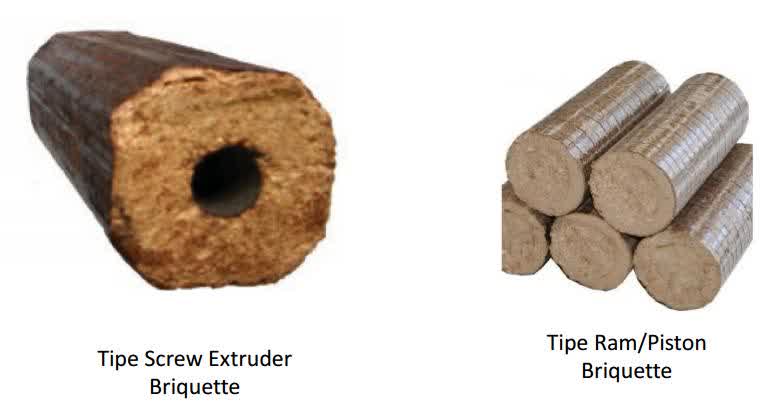
In general, wood briquette production is also much easier than wood pellets. The particle size, raw materials, moisture content and operations slightly more stringent than the requirements for the production of wood pellets. All wood pellets have a cylindrical shape which is only distinguished diameter of the cylinder, and a commonly used the diameter of 6 mm and 8 mm, while the wood briquette in addition to its shape can vary in terms of size also vary, for example, of the diameter of 50 mm (5 cm) to 90 mm (9 cm). Wood pellets almost all using mechanical compression on the wood briquette production while there is some compression options, namely mechanical, hydraulic and extrusion (screw). The different compression technology will also produce different product characteristics, such as differences in mechanical compresssion (ram / piston briquette) and by extrusion (screw briquette). Raw materials that can be made pellets almost certainly be made briquette, but all the raw materials that could be made briquette may not be successful to make pellets. Wood briquette density is also higher than wood pellets, which ranges from 1000-1400 kg/m3 (62.4 to 87.4 pounds/ft3) while on wood pellets range from 700-800 kg/m3 (43.7 to 50 pounds/ft3 ).

Whereas when compared with wood (round wood/log) are usually capable of burning (burning time) about 30 minutes then with a high density on the wood briquette made have burning time of about 6-7 time. Another factor that cause the long burning time is low moisture content than round wood/log.  In many ways wood briquette production process has many similarities with wood pellets or both in the biomass densification technology group. Although both carbon neutral because both biomass fuel, but the process of burning wood briquette produces 60% fewer emissions than using firewood. Then for the cool areas that burn a lot of wood for the fireplace (heating), the wood briquette is the right choice.

Thursday, October 15, 2015

Wood Pellet and AEC (Asean Economic Community)

Economic integration among ASEAN members in the AEC, which is planned to begin later this year, is an advanced form of AFTA relationship that is more thorough than just trade. The highest integration on economic aspects as well as in countries belonging to the European Economic Community (EEC) is the unification of the currency, but this seems pretty yet to be done in the near future on the AEC. AEC makes various ASEAN countries to make a regulation or rule together in the area of economic region. Trading blocs and the economy was a lot made today based on a specific area that is clearly also has a specific purpose as well. The economic integration in the AEC make various ASEAN countries competing to increase competitiveness in order to maintain the lead in the regional arena. Indonesia with the largest area and population (approximately 250 million) plus the abundance of natural resources is a tremendous economic potential or emerald equatorial country will be the main focus or attention on the AEC. 


Demographic bonus in the form of productive age population exceeds the number of non-productive age will also be another factor that will add to the attractiveness of Indonesia, which is the opposite condition with the condition of European countries, Japan and countries other strong economies. Of course with these conditions Indonesia should not only be market of various overseas products and a strong economy that makes the trade balance is not balanced and will always make Indonesia conditions worsen. Opportunities and challenges to be faced so that the necessary preparations should a serious and mature. ASEAN countries have set up ahead of time to deal with this AEC, but Indonesia has not seen seriously prepare to face this AEC.


Wood pellets have a strategic role in facing the AEC because of the high demand. The extent of land, fertile soil and tropical climate make the raw material for wood pellets which can be said to be one of the key success factors in the business of wood pellets, are not difficult to cultivate.A number of forest management area which is prepared for industrial plantations and can be cooperated with the private sector with tens to hundreds of thousands of hectares available. Besides the millions of hectares of marginal and unused land are also potential, considering the plant for wood pellet raw material is also very easy to grow and cultivated. Making the energy plantations that term used for the production of raw material for wood pellets have many advantages. In principle, create a mutually beneficial business between the various parties and does not destroy nature so that it can continue to be sustainable in any strongly held to be faced include these AEC.

Stages in the Utilization of Empty Fruit Bunches at Indonesian Palm Oil Mills

In addition to palm kernel shells (PKS) and mesocarp fiber, another solid biomass waste product available in large quantities at palm oil mi...