
Showing posts with label post mining. Show all posts

Thursday, June 15, 2023

Sustainable Business in Post-Mining Land: A New Paradigm

The land area of 8 million hectares (80,000 km2) is a large area, even the area is roughly equivalent to twice the size of the Netherlands or Switzerland or as large as Austria. Various types of plants can be planted or cultivated on the land, both food crops, energy (bioenergy), feed and biomaterials. This is very much in line with the current era of bioeconomics and decarbonization where world attention is focused on reducing carbon (CO2) emissions from fossil fuels to non-carbon in an environmentally friendly and sustainable way. And moreover Indonesia's location is on the equator so it has a tropical climate so it is very suitable for plant cultivation or biomass production for the purposes as above. The 8 million hectares of land is unproductive land or more precisely damaged land, namely post-mining land in Indonesia. Restoring (recovering) the land to a minimum condition like pre-mining is the responsibility of the mining companies. Of course it would be even better if the recovery was better than pre-mining conditions considering that a number of mining businesses generate large profits so environmental improvement efforts such as reclamation and post-mining rehabilitation should be carried out easily.

In addition to residential areas, tourism, water sources and cultivation areas, revegetation is one of the efforts for reclamation and rehabilitation of post-mining land (OP phase reclamation program attachment VI Kepmen ESDM No. 1827 K/MEM/2018). Revegetation for the ultimate goal of an environmentally friendly, sustainable and profitable business activity is certainly the best solution. The general characteristic of ex-mining land is a thin layer of top soil and subsoil so that little soil organic matter and soil microbes are needed for plant growth. It is impossible to simply revegetate land with these extreme conditions, therefore successful revegetation of ex-mining land can only be achieved by combining soil amendments, species selection and application of appropriate silvicultural techniques. This is because these business activities provide environmental, social and financial benefits. Revegetation with productive plantations or forests is an effort to achieve this. How big the benefits are, of course, needs to be studied in more depth on the types of productive plantations or forests that will be created.

The type of mine also influences the post-mining reclamation and rehabilitation work. In almost all coal mines there is no further processing, in contrast to mineral mines which require further processing. In post-mining reclamation coal mines it is simpler just to return the soil to its original condition whereas in mineral mines, apart from returning the soil as in coal mines, the problem of tailings (waste soil left over from the mining ore extraction process) is also another problem, whereas in smelters or smelters (processing/refining) of these minerals also produces slag (post-operation) which can also be another additional problem. The damaged lands in the post-mining reclamation area need to be repaired or rehabilitated so that they can return to their previous condition. The addition of organic fertilizer and biochar, will accelerate the improvement of soil fertility. Acceleration of soil fertility is important to accelerate the growth of plants planted in the area so as to reduce the potential for natural disasters such as floods and landslides. The use of biochar can also provide valuable additional income from carbon credit through a carbon sequestration / carbon sink mechanism. 

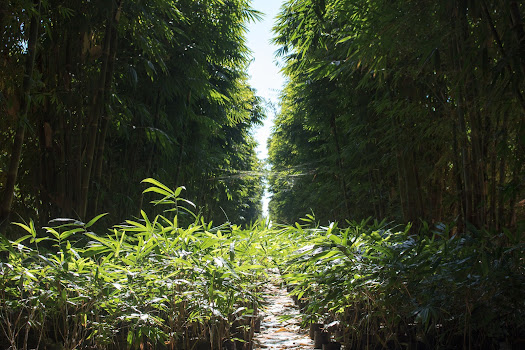
In these land conditions, not all types of plants or trees can be planted on the land. Trees or plants that can live and grow in marginal and even extreme conditions are the choices for these land conditions. Energy plantation of legumes (fast growing species) and bamboo is the best choice for the land. In energy plantations from legumes (fast growing species), apart from having high adaptability to marginal conditions including minimal water availability, the root nodules are also useful for fertilizing the soil. Wood from energy plantations is used for bioenergy into products such as wood pellets, while the leaves are for animal feed and honey from beekeeping which utilizes the flowers of these plants. Bamboo plants also have high adaptability. Products from bamboo plantations can be in the form of food, namely from bamboo shoots and the bamboo itself for various purposes. Industrialization of bamboo so that it becomes high added value products must be carried out. Almost all wood products can be replaced with bamboo and even the quality can be better, such as furniture, bamboo boards, ply bamboo and so on. With the existence of a sustainable industry that takes advantage of the products from the post-mining reclamation land, a number of benefits as mentioned above will be obtained.

The potential of 8 million hectares of land will produce very large biomass products if managed properly and correctly. The era of electric vehicles which is also expected to soon become a world trend will also require electrical energy stored in the battery. The electrical energy used should also come from renewable energy, not from fossil energy sources. The energy source from biomass to electricity is an ideal renewable energy source for the electric vehicle energy source. Production of biochar by pyrolysis and production of biogas from livestock manure as organic matter can be used for electricity production. With a number of driving forces and future trends, it is important to consider the utilization of the 8 million hectare land.
 

Friday, November 4, 2022

Post Mining Land Reclamation With Bamboo

Bamboo is a tree that is easy to grow, tall quickly and has many benefits. One of them is the use of bamboo trees for post-mining land reclamation. Damaged and barren post-mining land is indeed not easy to plant directly. Certain treatments or efforts are needed so that the land can be planted with certain plants. When the land has become fertile soil, of course almost all plants can be planted on the land. And to achieve these conditions it takes time and a process that is not short.

Soil improvement efforts in the sense of improving soil fertility are the first thing to do so that plants can grow well on the land. Plants that can be planted at this stage are also only certain types of plants such as pioneer plants in the form of fast growing plants such as legumes. And bamboo as a group of grass plants is also easy to plant and grow on marginal lands such as post-mining land. Availability of water, adequate nutrients, pH or adequate soil acidity are some of the things needed to achieve optimal growth.

As an illustration, sand is a bad planting medium because there are almost no nutrients in it and this is almost the same as the condition of post-mining land in general. Substances or organic materials need to be added so that they become fertilizers or nutrients for the land. Animal dung is the best organic material for this, so integration with livestock is the best concept for post-mining land reclamation. Biochar with its various advantages also needs to be added to the land. Biochar can be produced from biomass wastes from plantations, agriculture and forestry for this purpose. The use of biochar on a wide scale can also provide income in the form of carbon credits because biochar is applied to the soil as a carbon sink with carbon sequestration.

Bamboo trees as a type of grass plant have fibrous roots. Large bamboo clumps have a large network of fibrous roots as well. The success of bamboo roots is one of the keys to bamboo growth. The use of biochar in bamboo nurseries will also improve the roots of the bamboo seedlings produced. While in bamboo plantations, the use of biochar also has many benefits, especially on post-mining land the results will look more real, such as maintaining moisture, more available nutrients, not acidic soil pH and so on. Biochar is useful for improving soil fertility, so it can be used in nurseries and plantations.

Currently a number of mining companies have carried out land reclamation with these trees, but most of them are still testing and do not yet have a comprehensive concept. Post-mining land reclamation with bamboo in Indonesia is estimated to start in 2010 or has been going on for about 12 years until now. A number of bamboo species have also been identified as suitable for the post-mining area. Scale up or capacity enlargement is an important and current challenge, especially when it is supported by information on 12 years of reclamation with these bamboo trees. With this capacity expansion, besides bamboo production, commercial production can also be achieved, the application of biochar will also find its optimum benefits, namely improving soil fertility and carbon sinks (carbon sequenstration).

The use of bamboo in particular is an aspect that has not received serious attention in these reclamation projects. Whereas only with the use of bamboo which is a plantation product can the reclamation effort be known to provide economic benefits or not. The lack of serious attention to the use of bamboo is thought to be because the bamboo reclamation is still in the experimental stage with a small area. But if it has been pursued professionally, the economic aspect will become an important concern.

The use of bamboo, for example, is to make people's houses around the mine. With bamboo treated first and also using the art of building architecture, the bamboo house produced will be of high quality, in the sense of being sturdy and beautiful and far from being cheap. This will reduce the use of certain wood for houses, some of which have limited types, such as ironwood in Kalimantan. Indeed, there are many ways to use the bamboo, but it is necessary to choose the best one based on the related conditions and situations. Ruminant farming, especially for the production of organic matter or land fertilizers, will also require cages or in rotational grazing, poles for paddock will also be required. The cages and poles can also be made with these bamboo products.

And when bamboo production is used for biomass production and then used for biochar production, it is also technically possible. But economically, it is necessary to study whether it also provides benefits, both from the effect of improving soil fertility and carbon credit. In this case, the most important thing is the production of the biomass itself so that the bamboo species that produce the most biomass are selected. The more soils that can be repaired with biochar treatment, the more land that can be recovered so that it becomes productive land. When the soil is fertile again, various food crops are also very possible to be planted on the land. The increasing population also demands more food needs, so food production needs to be increased, including the use of these recoverable lands.

Reject (Non-Standard) Coconut Fruit for Bioavtur / SAF Production

The international civil aviation organization (ICAO) has included non-standard coconuts on the ICAO positive list – ICAO document – ​​CORSIA...