Friday, October 16, 2015

Italy, The Largest Wood Pellet User for Heating in Europe

Unlike the Asian region in general, using wood pellets for fuel in power plants or boilers in a number of industries, Europe and America use wood pellets as heating in large quantities. The amount of use of wood pellets for heating (home heating) in the region is not too much different from the use of wood pellets for power plants and industrial boilers. Italy is the country in Europe which was recorded as the biggest user of wood pellets for heating which is 2.5 million tons in 2013 with a projected increase of 15% annually or according to the expectations of heating market growth and statements National Renewable Energy Action Plan, the use of wood pellets will achieve 3.5 million tonnes in 2015 and 5 million tons in 2020.

Growth in the use of pellets as a result of a unique incentive program from the Italian government on renewable energy, namely Conto Termico (Feed-in-tarrifs for heating and cooling), which is conducted by the Ministry of Economic Development at the end of 2012. Conto Termico incentive is based on nominal power (kW), the estimated hours of operation (based on climate zone), the coefficient of incentives, and the level of emissions. The incentives are given to every 2 years for stove and 5 years for boiler. Tax deductions are also given in 10 years to 50% of the cost of purchase and installation pellet stove. The decision was budgeted 700 million euros for projects implemented in private parties (individuals, block apartments etc.). Italy as one of the countries in Europe, the efforts mentioned above are part of the EU Renewable Directive, which instructs the use of renewable energy to 20% in their energy mix by 2020.


Currently around 2 million stoves and 200,000 boilers installed in homes in Italy, and marketing of both products is quite stable and strong. One pellet stove manufacturers have even created an application that allows it to communicate and interact remotely with the pellet stove using a smart phone. To turn on and off, set the temperature, program the hours of operation, or even listening to the combustion process in the pellets stove. The application can also tell when the stove runs out of pellets, or if combustion is not perfect or even call aftersales-service provider. The presence of glass that was able to see the flames and increase efficiency up to 94% with natural convection is another advantage of the pellet stove.


The magnitude of these pellets turns demand can not be met entirely by domestic production, or just a small part that can still be satisfied from domestic production, so that Italy relied on import pellets to meet these needs. Wood pellets production conditions of the European region alone is not able to meet these needs so that imports from other continents also increased. Italian production of wood pellets is estimated at only 300,000 tonnes/year while the demand reaches more than 3,000,000 tons for this year.

Quality wood pellets for household heating  are generally higher than the wood pellets for industry. The A1 ENplus premium pellets quality is a standard quality that is used for space heating. The A1 Premium pellets is the highest level of the wood pellet especially for private end users. In addition almost 60% of the pellet supplier also has been certified ENplus. A number of distributors also said that ENplus certificate good for a number of Italian companies but not needed by the majority. This is because the certificate Enplus require extra surcharge that affects their impact on the sensitive market price of the wood pellets.

Wood pellets imported into Italy by using 3 ways. Bulk shipment coming by ship is the lowest cost but with almost all the distributors in Italy with a small capacity, they are not able to handle such large volumes. The second option is to receive pellets that have been bagged or bulk containers, but most distributors prefer to bagged (plastic packaging). The third way is by truck, which can each day comes with plastic packing 15 kg or big size (jumbo bag). Italy can also be said the largest consumer of wood pellets in packaging in Europe.

Wood Briquette Left Behind 25 Years of Wood Pellet

Common areas with wood burning application it will be appropriate to use wood briquette and less suitable when using wood pellets. Various areas in various parts of the world use wood for heating (wood burning stove or boiler) or for cooking. If the ratio of wood as fuel is much so the business of  wood briquette production will be more attractive than wood pellets. Globally wood briquette are less popular than wood pellets, so the wood briquette production is also far below the wood pellets. Wood briquette also has its own characteristics compared to wood pellets.


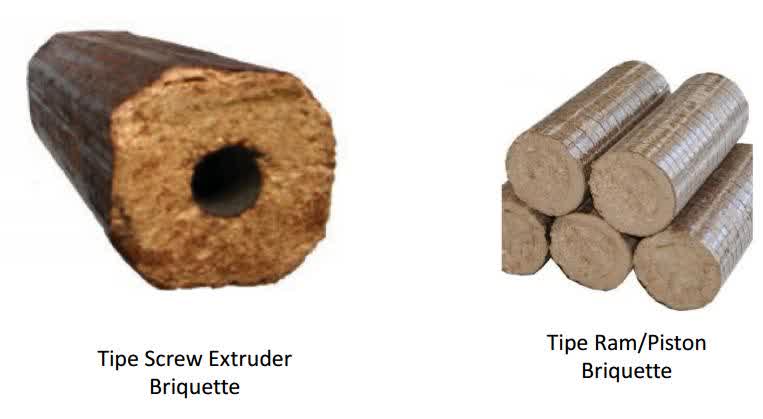
In general, wood briquette production is also much easier than wood pellets. The particle size, raw materials, moisture content and operations slightly more stringent than the requirements for the production of wood pellets. All wood pellets have a cylindrical shape which is only distinguished diameter of the cylinder, and a commonly used the diameter of 6 mm and 8 mm, while the wood briquette in addition to its shape can vary in terms of size also vary, for example, of the diameter of 50 mm (5 cm) to 90 mm (9 cm). Wood pellets almost all using mechanical compression on the wood briquette production while there is some compression options, namely mechanical, hydraulic and extrusion (screw). The different compression technology will also produce different product characteristics, such as differences in mechanical compresssion (ram / piston briquette) and by extrusion (screw briquette). Raw materials that can be made pellets almost certainly be made briquette, but all the raw materials that could be made briquette may not be successful to make pellets. Wood briquette density is also higher than wood pellets, which ranges from 1000-1400 kg/m3 (62.4 to 87.4 pounds/ft3) while on wood pellets range from 700-800 kg/m3 (43.7 to 50 pounds/ft3 ).

Whereas when compared with wood (round wood/log) are usually capable of burning (burning time) about 30 minutes then with a high density on the wood briquette made have burning time of about 6-7 time. Another factor that cause the long burning time is low moisture content than round wood/log.  In many ways wood briquette production process has many similarities with wood pellets or both in the biomass densification technology group. Although both carbon neutral because both biomass fuel, but the process of burning wood briquette produces 60% fewer emissions than using firewood. Then for the cool areas that burn a lot of wood for the fireplace (heating), the wood briquette is the right choice.

Thursday, October 15, 2015

Wood Pellet and AEC (Asean Economic Community)

Economic integration among ASEAN members in the AEC, which is planned to begin later this year, is an advanced form of AFTA relationship that is more thorough than just trade. The highest integration on economic aspects as well as in countries belonging to the European Economic Community (EEC) is the unification of the currency, but this seems pretty yet to be done in the near future on the AEC. AEC makes various ASEAN countries to make a regulation or rule together in the area of economic region. Trading blocs and the economy was a lot made today based on a specific area that is clearly also has a specific purpose as well. The economic integration in the AEC make various ASEAN countries competing to increase competitiveness in order to maintain the lead in the regional arena. Indonesia with the largest area and population (approximately 250 million) plus the abundance of natural resources is a tremendous economic potential or emerald equatorial country will be the main focus or attention on the AEC. 


Demographic bonus in the form of productive age population exceeds the number of non-productive age will also be another factor that will add to the attractiveness of Indonesia, which is the opposite condition with the condition of European countries, Japan and countries other strong economies. Of course with these conditions Indonesia should not only be market of various overseas products and a strong economy that makes the trade balance is not balanced and will always make Indonesia conditions worsen. Opportunities and challenges to be faced so that the necessary preparations should a serious and mature. ASEAN countries have set up ahead of time to deal with this AEC, but Indonesia has not seen seriously prepare to face this AEC.


Wood pellets have a strategic role in facing the AEC because of the high demand. The extent of land, fertile soil and tropical climate make the raw material for wood pellets which can be said to be one of the key success factors in the business of wood pellets, are not difficult to cultivate.A number of forest management area which is prepared for industrial plantations and can be cooperated with the private sector with tens to hundreds of thousands of hectares available. Besides the millions of hectares of marginal and unused land are also potential, considering the plant for wood pellet raw material is also very easy to grow and cultivated. Making the energy plantations that term used for the production of raw material for wood pellets have many advantages. In principle, create a mutually beneficial business between the various parties and does not destroy nature so that it can continue to be sustainable in any strongly held to be faced include these AEC.

10 Advantages By Making Energy Plantations for Wood Pellet Production


Assuredness of supply of raw materials is one of the key factors of business success in the wood pellets. There are two ways to obtain raw materials commonly done today:
a. Buying from the owner of source of raw materials.
b. Producing its own the availability of raw materials.
While the 3rd way and there is still few for business owners make wood pellets is by mix way, which is partly provide by their own of raw materials and some rest buy from the other source of raw materials.

While examining at the types of biomass raw materials there are two kinds, namely :
a. Woody biomass
b. Non-wood biomass such as agricultural wastes (empty fruit bunches of palm oil trees, corn cobs, rice husks and so on). Currently woody biomass remains a priority to be products of wood pellets as a number of advantages over non-wood biomass which is generally an agricultural wastes, are included in the category of biomass pellets or agri-waste pellets. The comparison between wood pellet and biomass pellet / agri-waste pellets can be read here.

While wood biomass when viewed more specifically for the production of wood pellets, the raw material sources can be divided into 2 types:
a. Wastes from wood processing industry.
b. Wood product from energy plantations/forests.
While in term the degree of dryness of raw materials, then there are dry raw material and wet raw material. The degree of dryness of raw materials should also be arranged so that it can produce quality wood pellets.


Energy plantations / forests as a source of raw materials which strived itself has many advantages, among others :

1. Energy plantations can be made so that the internal control of raw material for wood pellet business easier, as fluctuations in supply, changes in market prices, irrespective of the sources of waste wood and so on.

2. Byproducts of energy plantations as the leaves can be used for livestock such as cattle or sheep, and honey bee farm that utilizes the flowers of energy crops.

3. Wood pellet mill site could be very close or even in the midst of the energy plantations (raw material oriented), so the cost / price of cheap raw materials.

4. Energy plantations also absorb CO2 from the atmosphere (Carbon negative), application of wood pellets is carbon neutral activity that can be included in carbon trading, climate change mitigation through afforestation (planting / addition of carbon stocks), and the construction unit of SFM (Sustainable Forest Management)

5. The pattern of mixed supply of raw materials with partly from energy plantations owned company (the core) and others belonging to the community (plasma) can be done. This pattern will include the role of the community and develop it.


Photos of calliandra nursery for making 1200 hectares of energy plantation

6.Additional income by utilizing the sidelines of energy crops with other crops (agroforestry models) so that the cultivation of polyculture are more resistant to disease.

7. Uncultivated land or marginal land that the millions of hectares can be utilized effectively.

8. Fertilize and improve soil conditions, including the prevention of erosion. Calliandra plant roots in the form of a pimple is able to bind nitrogen that fertilizes the soil.

9. Short crop harvest and grow again, without the need for replanting. Energy crops such as calliandra only be planted once and then grow again after the cut (harvest) for decades, more results and very easy maintenance.

10. Development or enlargement wood pellet plant capacity is possible as long as the land is still available. And this time there are still millions of hectares of potential for the creation of the energy plantations.

Indonesia as a tropical country and fertile land potential for the development of energy plantation and also the world's leading manufacturer of wood pellets.

Saturday, October 3, 2015

The Wave of World Biomass Energy

According to the organization of FAO (Food and Agricultural Organization), the production of wood pellets in 2013 exceeded 22 million tons and more than half are traded internationally with 80% of the production is consumed by European countries. The main factors that affect it is the European Union's Renewable Energy Directive, which instruct the use of renewable energy to 20% in their energy mix by 2020. While in 2024 global production of wood pellets predicted 50 million tons.

The development of wood pellets industry very massive actually can be traced, in 2007 when the European Commission issued an ambitious program of the Renewable Energy Directive as mentioned above, which is the first factor driving world countries ratified the Kyoto Protocol. Furthermore from the Renewable Energy Directive,  the European countries individually create its own policy mechanisms to achieve these goals. One inexpensive and effective approach is to reduce CO2 at the power plant by replacing a number of coal burned in power plants with biomass, which is mainly wood pellets. Policy makers are interested in the above approach, because it would result in the acceleration of implementation rather than wind, solar, water and geothermal.


In the UK policy is initially set in the Renewables Obligation subsequently revised to become a mechanism Program Contracts-for-Difference (CFD), while in the Netherlands a similar program was originally known MEP and subsequently also revised the currently named SDE-plus. Countries in Asia are also slowly began to follow, this time two strong economies namely South Korea and Japan began to implement it. The program in South Korea set in RPS (Renewable Portfolio Standard) and Japan implement policies in FIT (Feed-in-tarrif). Gradually various countries began to follow him. While in the United States and Canada, most of the wood pellets used for heating (residential / space heating), especially in winter.


The Fear of Deforestation
The development of the massive production of wood pellets is much feared by some parties will stimulate the flow of deforestation including the scientist and policy observers have questioned whether energy generated from wood pellets capable of achieving these goals. Actually it does not need to worry, if it knows the production process at the same time selling price of wood pellets itself. Wood pellets are made from raw material of woody biomass could come from wood-waste or  cultivated through the energy forests or plantations, but with a note that the price of woody biomass as a raw material for wood pellets must worth as wood waste. If the price the price of woody biomass exceeds the wood waste in the market, so the production of wood pellets become uneconomical.

Trees or plants from industrial forests or community forests will produce wood especially for the sawmill, processing industries wood such as plywood, wood carpentry, furniture, construction, or even CLT (cross laminated timber) and so at rates far above the waste timber. Wood pellet mill also will not buy the wood due to economic reasons. Whereas if the energy plantation forests or plantations so  short rotation coppices or fast growing plants will produce woody biomass in large quantities and faster time with use marginal lands or unused lands, so will be economical for the production of wood pellets.

Wood from trees as a source of energy is a carbon-neutral fuels in combustion. Forests as Carbon Sink if the speed of harvesting and use of wood does not exceed the speed of growing trees or plants, in this case mainly energy forests or plantations. In addition, each MWh of electricity from coal is also emit more CO2 than from wood pellets, which at 150 kg CO2 released coal with wood pellets while only 45 kg. So the use of wood pellets is said to be also a low carbon economy activity.


Opportunities for Indonesia
Indonesia has a huge opportunity to capture these opportunities, it is because the extent of land available, the fertility of the soil and tropical climate. Short rotation coppice like calliandra very suitable to be cultivated to obtain the raw material of wood pellets. If the conditions in Europe or sub-tropical countries took 4 years to harvest woody biomass from SRC like the poplar and willow, then in Indonesia only took one year for calliandra achieve conditions such as poplars and willows. Energy forests or plantations are integrated with other agro-forestry and cattle or goats livestock could be the main attraction.

Monday, September 28, 2015

Racing for Lowering The Temperature Of The Earth (Part 2)

Biomass as 'carbon neutral fuel' certainly does not stand alone as a great scenario to lower the temperature of the earth due to global warming by greenhouse gas emissions. Advantages of biomass as a renewable energy source because  stable in use, in the sense that is not affected by climatic and weather conditions into a product that is reliable in various scale applications. Efforts to optimize the potential of biomass as an energy source can be viewed from the supply side to use.

On the supply side, the assuredness of supply of biomass as a raw material is an absolute must if you want to use as a primary energy source, for the amount of effort from collecting a variety of waste biomass that was originally only disposed to look for species with a short rotation coppice (SRC), high productivity and a positive effect on nature with is made energy plantations. One of these plants is Calliandra to the tropics, while in sub-tropical regions such as Europe using poplar and willow species. We should be grateful to Allah SWT because of the location in tropical Indonesia make caliandra crop productivity could be 4 times faster than the temperate sub-tropical or concrete four years poplar and willow in Europe as 1 year calliandra in Indonesia. 


While looking at the utilization, biomass energy should be used widely, easy, inexpensive and efficient. Biomass can be used in place or used elsewhere far enough. On the use of on-site or a short distance, biomass usually uniform in size or plus drying.  Whereas for use in locations far enough biomass need to be added process again with compaction (densification) in the form of pellets or briquettes. The biomass is then processed  in thermal route (the most popular) by combustion, pyrolysis or gasification to extract energy content.


The position of Europe has surpassed North America in a race to lower the temperature of the earth or the effort to reduce global warming. After previous EU implementing RED (EU's Renewable Energy Directive) commonly known as the 20-20-20 targets or mandates that are intended to reduce 20% of greenhouse gas emissions from 1995 as base level; 20% decrease in energy consumption; and to 20% for renewable energy. It also makes Europe is the largest consumer or market  of wood pellets with an estimated 80% of world production, followed by the United States and third, South Korea.

Currently the EU is being approached in 2020 for the realization of the 20-20-20 targets but on the other hand they began to prepare the draft for the new policy climate and energy issues from years 2020-2030. EU has proposed a new target in 2030 including a 40% decrease in greenhouse gas emissions, a 30% decrease in energy consumption and 27% for the use of renewable energy. Currently they are also looking for a strategy to achieve the 2030 targets. History also shows how biomass policies is the main driver for the development of pellets market in Europe. It is also widely used as a model of a particular region or country to implement renewable energy policies, especially biomass sector.

Saturday, September 26, 2015

Biomass Pelletisation Process and Maintain Stability Wood Pellets Production Plant


The characteristics of biomass will determine production processes including die shapes and characteristics of wood pellets product. Woody biomass is the most common and popular biomass of the biomass pelletisation. Die shape can not be common or generic for all types of biomass because it has its own characteristics. The efficient pelleting process will be produced pellets product with the amount of powder or fine which is very little, that is meaning almost all the particles of the material that is fed into the pelletiser converted into pellets. Judging sequence of processes that occur in the pelletiser, the biomass will have the following things before finally formed into pellets.

A number of materials from a particular timber, there is an expanding again when exiting from the pelletiser or in general the compaction equipmnent. This phenomenon is more easily seen in briquettes because it was bigger than pellets. This happens because these materials absorb more air from the atmosphere to add moisture to the pellets or briquettes, whereas when the particle material into the die in the presence of strong pressure and high temperature, the amount of water vapor in the particles of the material will come out and so is lignin serves as the glue will come out at this stage.

On the specifics of wood pellets also there is little difference of quality, logistics and consumer needs between Europe and the United States. The difference between the others, especially that on wood pellets for the European market generally use a die with a size of 6 mm, while for the US market generally use the die to the size of a quarter inch or 6.35 mm or it could be using equipment that is more suitable, for example, to adjust to the European, EN method while the Americans with ASTM method. But the different sectors also allows the use of different pellet sizes. Most retailers in Europe using a 6 mm pellet size, so that when using the US standard with the size of a quarter inch or 6.35 mm and after production also will typically expand to 6.5 mm making the European market less acceptable. In addition the European market also liked the wood pellets with a length of 1.5 to 2 cm, so it is not too short and not too long. Durability is also an important factor for the target market, the European issuing durability requirements limit is 97.5 primarily for industrial bulk market, but for the bulk of residential delivery majority of distributors are looking for products with a durability from 98.5 to 99.0. This is because the residential delivery typically use pneumatic conveyor and the strong desire to reduce fine (powder).

The market target aso will determine how the process of the production of wood pellets. Asian markets with relatively new age do not yet qualify as strict as Europe or America with the target users are also a number of differences. A large number of requests with strict quality also makes the need for reliable equipment or machinery becomes absolutely necessary. A number of manufacturers pelletiser for wood pellets has also been applying heat sensor technology at the pelletiser that they make as an option for the producers of wood pellets. This technology includes installation of high heat sensor directly on a roller to monitor in real time the critical temperature. The intended use of these technologies is to reduce downtime and accidents caused by overheating on the roller and the bearing shaft so that production targets can be achieved more easily.


As for supplies of raw material supply of wood pellets, wood sawmill wastes and wood processing wastes could be used but the energy plantations or forests  will be the best choice, especially for long-term orientation. Good forest management service that will produce a sustainable supply of raw materials. Optimizing the use of land in a number of locations, the selection of appropriate plant species and supported tropical climate conditions that support are some of the things that support the integration of energy plantation or forest with wood pellet business. Because of the availability of raw materials is one of the key success factors in the business of wood pellets, so it needs special attention of its own.

Biochar, Soil Health, and the Sustainability of Palm Oil Productivity

Healthy soil is invariably fertile, but fertile soil is not necessarily healthy. Healthy soil teems with life—such as earthworms and other o...