Showing posts with label EAF. Show all posts

Saturday, August 23, 2025

Biochar-Based DRI / Sponge Iron Production

In the steel industry, carbon neutral production will be achieved when iron and steel production use 100% renewable energy. Electric arc furnaces (EAFs) can be used as long as the electricity is generated from renewable energy sources. However, EAFs, which still use electricity from fossil fuels, can be a transitional medium before 100% carbon neutral production due to their lower CO2 emissions compared to blast furnaces (BF) using coke from coal. The raw materials processed with EAFs are steel scrap and direct reduced iron (DRI/sponge iron). Steel scrap or DRI (sponge iron) is directly fed into the electric arc furnace (EAF) for steelmaking, resulting in lower carbon emissions compared to the blast furnace (BF) method. CO2 emissions from the blast furnace (BF) are approximately 2.33 tons for each ton of crude iron/pig iron, while with the EAF, they are only approximately 0.66 tons for each ton of crude steel.

Currently, approximately 80% of steel scrap is recycled using EAFs. Globally, EAFs account for approximately 22% of steel production (based on scrap and sponge iron). India is the largest producer of sponge iron, or DRI. Other major producers include Iran, Russia, Mexico, and Saudi Arabia. In 2023, India produced 49.3 million tons, while Iran produced 33.4 million tons. Global sponge iron, or DRI, production reached 135.5 million tons in 2023, while pig iron reached nearly 1.5 billion tons.

And the fact is that currently, to achieve the goal of producing carbon neutral steel is still far away because the construction of blast furnaces - basic oxygen furnaces (BF -BOF) is still being carried out a lot, which should be EAF (Electric Arc Furnace) or currently only about 30% globally the iron and steel industry uses this EAF. The construction of new blast furnaces does tend to increase, in fact, by mid-2024, around 207 million tons per year of new production has been announced and around 100 million tons per year is under construction.

Sponge iron, or DRI, is produced from iron ore that has been processed to remove oxygen, resulting in a porous, sponge-like material. The process for producing DRI is called direct reduction. Direct reduction processes can be roughly divided into two categories: gas-based and coal-based. Just as coal can be used, so charcoal (biochar) can be used as the carbon source. The difference is that charcoal (biochar) is derived from wood or biomass, which are renewable resources. The process typically involves a rotary kiln where iron ore and coal or charcoal (biochar) are fed together, and the reduction reaction occurs in the solid state. India is a major producer of coal-based DRI, with production increasing substantially in recent years, as shown in the map below. Other major producers of DRI, or sponge iron, generally use natural gas-based processes.

The availability of biochar that meets specifications and sufficient volume, as well as its sustainable supply, is needed to substitute coal in DRI production. Therefore, on the upstream side, the availability of biomass raw materials from forestry waste, wood processing, agricultural waste, and agro-industrial waste is crucial for the sustainability of biochar production, including the establishment of energy plantations for this purpose. In addition to replacing the reductant or fuel from coal to charcoal (biochar) in DRI or sponge iron production, efforts to reduce carbon emissions in steel production on the DRI-EAF route also include replacing the EAF electrode from fossil-based synthetic graphite to biochar-based biographite. For more details, read here

Monday, July 14, 2025

Biochar and Biographite for Decarbonization in the Iron and Steel Industry

The decarbonization trend continues across all sectors, particularly strategic industries such as the energy industry, iron and steel industry, and transportation. These industries contribute significantly to CO2 emissions, which increase atmospheric concentrations (carbon positive). The energy industry, particularly power generation, contributes 27.45%, the steel industry 8%, and the transportation sector 24%. With an estimated total CO2 emissions from fossil fuels of 36.3 gigatonnes (36.3 billion metric tons) in 2024, the iron and steel industry's contribution is approximately 2.9 gigatonnes (2.9 billion metric tons).

In the steel industry, carbon neutral production will be achieved when iron and steel production in the industry uses 100% renewable energy. The use of electric arc furnaces (EAFs) can be done as long as the electricity is generated from renewable energy sources. However, the use of EAFs that still use electricity from fossil fuels can be a transition medium before 100% carbon neutral production because of its lower CO2 emissions compared to blast furnaces that use coke from coal. CO2 emissions from blast furnaces are around 2.33 tons for each ton of crude iron / pig iron, while with EAFs, they are only around 0.66 tons for each ton of crude steel. The raw material processed with EAFs is steel scrap, and approximately 80% of steel scrap is currently recycled with EAFs. Globally, steel production with EAFs reaches approximately 22%.

And the fact is that currently, to achieve this goal is still far because the construction of blast furnaces - basic oxygen furnaces (BF -BOF) is still being carried out a lot, which should be EAF (Electric Arc Furnace) or currently only about 30% of the global iron and steel industry uses this EAF. The construction of new blast furnaces is indeed tending to increase, in fact, by mid-2024, around 207 million tons per year of new production has been announced and around 100 million tons per year is under construction.

Nearly all CO2 emissions in the steel production sector come from blast furnaces (BF) for refining iron ore into crude iron or pig iron. The challenge is enormous: there are approximately 1,850 steel mills worldwide, with approximately 1,000 using blast furnaces, with pig iron production reaching approximately 1.5 billion tons per year. The International Energy Association (IEA) has even highlighted this critical issue in achieving the Paris Agreement's net-zero target by 2050. With an average blast furnace lifespan of 20 years, the iron and steel industry's efforts to achieve this target must be well-formulated and programmed. Failure to replace blast furnaces within the specified timeframe will jeopardize the 2050 net-zero emissions target.

This makes the use of charcoal to replace coal-based coke in blast furnaces crucial. Charcoal derived from biomass is a renewable, sustainable material used as a reducing agent or fuel in blast furnaces. The chemical reaction separates oxygen atoms from iron atoms, releasing CO2. This converts iron ore (Fe2O3) into crude (pig) iron. The difference is that because the carbon source as a reducing agent or fuel in blast furnaces comes from renewable and sustainable sources, this process is carbon neutral. Using coke from coal, which comes from fossil fuels, is carbon positive. Similarly, using natural gas as a reducing agent or fuel in blast furnaces, despite its lower carbon intensity, is still carbon positive. 

However, if hydrogen from renewable energy sources (green hydrogen) is used as a reductant in the blast furnace, it will not produce carbon emissions but will produce water vapor (H2O), thus it is also a carbon neutral process. However, this will still take a long time, predicted to take several decades to implement. To produce a carbon negative process, the iron and steel mills that are already operating carbon neutrally must be equipped with CCS (Carbon Capture and Storage) devices, which will certainly be the next step. Furthermore, the use of renewable energy as an EAF energy source is also becoming increasingly important and must be accelerated, which should also be in line with the use of bio-graphite in the EAF.

The use of EAF in iron and steel mills is estimated to reach 550 units worldwide with steel production reaching around 548 million tons or around 30% of the world's steel production which will reach around 1.8 billion tons in 2024. The use of EAF requires graphite electrodes and every ton of steel produced requires an average of 3 kg of graphite. The current source of graphite is almost all derived from fossil sources so it is a source of carbon emissions (carbon positive) and also currently around 80% of the world's graphite supply comes from China. With steel production from EAF of 548 million tons, the annual graphite demand reaches more than 1.6 million tons. Every ton of graphite production from fossil materials emits CO2 emissions of 17-40 tons.

This makes the use of biographite crucial because it is carbon-neutral, producing CO2 emissions. Biographite is produced from biochar, or charcoal, which undergoes a special purification process. The biochar is converted into high-purity graphite suitable for EAF electrodes. Biographite is used for its strength, density, and conductivity, not only because of the CO2 emissions mentioned above, but also because of its technical advantages. Naturally mined graphite cannot meet these technical specifications, while synthetic graphite from fossil fuels is not environmentally friendly and is highly dependent on imports. This is the driving force behind biographite production.
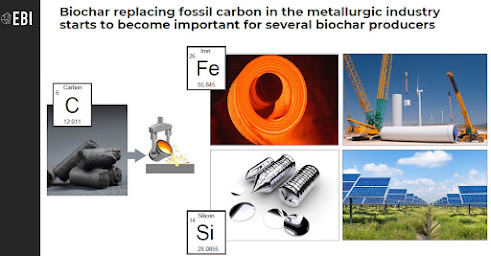
The demand for biochar or charcoal as a reducing agent in BF will be very large, while for biographite as an EAF electrode is not as large as in BF. This makes it crucial to obtain a source of biomass raw materials as a source of biochar or charcoal in sufficient volume, good quality, and sustainable. Similarly, in terms of biochar or charcoal production, which primarily uses pyrolysis/carbonization technology, it must also be able to produce products with adequate quality and quantity, sustainably, and with a production process that is high in productivity, efficient, and environmentally friendly. Biochar or charcoal with specifications of at least 85% fixed carbon and a minimum conversion (gravimetric yield) of 30% is the reference for selecting this pyrolysis technology. 

In addition to biomass waste groups such as forestry waste and plantation waste, energy plantations can also be specifically created for this purpose, for more details read here. These energy plantations must also be created according to the land allocation and area of ​​monoculture energy plantations in accordance with proper planning and procedures, as well as efficient and environmentally friendly pyrolysis / carbonization technology. Biomass sources as raw materials for charcoal / biochar can also be said to be sustainable if the harvested product is less or at most equal to the growth of the plantation's wood. This is to prevent what happened in Brazil, namely in the state of Minas Gerais. Due to the large area of ​​monoculture eucalyptus plantations whose wood products are mostly for charcoal production for iron and steel mills, this has caused various negative impacts on the environment. Brazil is the world's largest charcoal producer and produced 5.2 million tons in 2017, 90% of which was used by the iron and steel industry, with 80% of the charcoal produced from eucalyptus plantation wood.

Approximately 70% of Brazil's iron and steel production occurs in the state of Minas Gerais, and this sector is unique in that 34% of iron production uses charcoal, not mineral coke/coal, and coke is also widely used in steel production. Historically, this was due to a lack of mineral coke in Brazil, but abundant forests for coke production. Minas Gerais currently has nine steel mills and 41 iron plants producing 3.1 million tons of crude iron in 2018, approximately 50% of which was exported. In 2018, Brazil had 5.7 million hectares of eucalyptus plantations, and Minas Gerais continues to have the largest plantation area in the country, covering 24% (1.4 million hectares) of Brazil's eucalyptus. Iron and steel companies also have eucalyptus plantations in an effort to secure a supply of charcoak for their iron and steel mills. Indonesia also has vast land potential, reaching hundreds of millions of hectares for these energy plantations. 

Sunday, June 1, 2025

Biochar for Biographite, Important Material for Future Strategic Industries

The decarbonization trend continues in all sectors, especially in strategic industries such as the energy industry, iron and steel industry, and transportation equipment industry. The contribution of a number of these industries in producing CO2 emissions that increase concentrations in the atmosphere (carbon positive) is very significant, namely the energy industry, especially power plants, contributing 27.45%, the steel industry contributing 8%, and the transportation sector industry 24%. Various efforts have been made to reduce CO2 emissions from these fossil sources. Biographite is one of the important components for this purpose. The use of graphite currently comes from fossil sources, namely petcoke and coal tar, which are synthetic graphite. This is because graphite mined in nature cannot meet the expected technical specifications in the form of strength, density and conductivity.

Graphite is a material that is used for steel making, lithium ion batteries, nuclear power plants, fuel cells and the defense industry. In the steel industry, every ton of steel produced with EAF uses 2-4 kg of graphite electrodes. On average, each electric car battery contains 70 kg of graphite. According to the Economist, in 2030, the demand for graphite is expected to exceed supply by 1.2 million metric tons, threatening the steel and battery industries. Meanwhile, according to the IEA for Europe, the need for graphite is predicted to increase by around 20-25 times from 2020 to 2040. Including why currently there is no very large battery capacity so that even coal-fired power plants or from fossil sources can be eliminated, it is very possible because of this graphite problem. In addition to graphite, nickel is an important component in lithium-ion batteries used in electric cars with an average of 30 kg, especially in the cathode. Nickel helps increase the energy density and storage capacity of batteries, allowing electric cars to have a longer range.

In the steel industry, carbon neutral production conditions will be achieved when iron and steel production in the industry uses 100% renewable energy. The use of electric furnaces (EAF / Electric Arc Furnace) can be done as long as the electricity is generated from renewable energy sources. And the fact is that currently to achieve this goal is still far because the construction of blast furnaces - basic oxygen furnaces (BF -BOF) is still widely carried out, which should be EAF (Electric Arc Furnace) or currently only around 30% of the global iron and steel industry uses this EAF. Even the International Energy Association (IEA / International Energy Association) highlighted this critical issue to achieve the Paris Agreement's net-zero target by 2050. With an average blast furnace life of 20 years, the iron and steel industry's efforts to achieve the target must be formulated and programmed properly. Even if the blast furnace replacement effort does not follow the target time, it will put the achievement of net zero emissions 2050 in danger. This makes the use of renewable energy as an energy source for EAF increasingly important and must be accelerated, which should also be in line with the use of bio-graphite in the EAF.

The use of biographite will reduce CO2 emissions and reduce dependence on imports. Bio-graphite which is basically derived from biomass offers a sustainable alternative solution to graphite derived from fossil materials. When applied in steel mills with EAF, although biographite emits CO2 emissions when used, this CO2 or carbon comes from biomass. And the biomass from the plant absorbs CO2 from the atmosphere when it grows, making the process carbon neutral. The bio-graphite production process begins by converting biomass into biochar. Furthermore, with special purification, the biochar is converted into high-purity graphite which is suitable for electric arc furnace (EAF) steel electrodes and battery anodes.

Graphite demand / supply showing market deficit beginning 2025E 
 Source: Macquarie Research (March 2023)

With the potential for various applications in a number of strategic industries, bio-graphite is not just a new environmentally friendly material but an important material supporting future industries. The shortage of this material could slow the transition to electric vehicles and renewable energy storage, which has an impact on many industries. And specifically in the steel industry, the shortage of this material will threaten to increase the cost of steelmaking and hinder progress towards climate goals. This is why the development of biochar production for biographite is very important and needs to be accelerated for the growth of various green industries or renewable industries in the future. 

Friday, June 21, 2024

Decarbonization of the Iron and Steel Industry Part 3: from Low Carbon Production to Carbon Neutral Production

When the decarbonization target must be achieved according to the specified deadline, various efforts will also be made, including through a transition phase. The transition phase in the iron and steel industry is from low carbon production to neutral carbon production. There are a number of factors that influence towards this goal, especially the readiness of the market to buy iron and steel products produced from the production process and also the readiness of fuel and reducing agents for blast furnaces in the iron and steel industry. Charcoal is a fuel and reducing agent derived from biomass which has great potential for use in this transition phase. Charcoal as a carbonization or biomass pyrolysis product has a high calorific value, high fixed carbon and is stable.

Meanwhile, carbon neutral production conditions will be achieved when iron and steel production in the industry uses 100% renewable energy. The use of an electric furnace (EAF/Electric Arc Furnace) can be done as long as the electricity is produced from renewable energy sources. Likewise, the use of hydrogen fuel in blast furnaces (with electrical energy for plant operations also from renewable energy) is also able to achieve carbon neutral production conditions, and even the use of hydrogen fuel in blast furnaces is considered to be the ultimate goal in decarbonization of the iron and steel industry. With the target of achieving net zero emissions by 2050 and the average service life of blast furnaces being 20 years, the iron and steel industry's efforts to achieve the target must be well formulated and programmed. Even if efforts to replace blast furnaces do not follow this target time, it will put the achievement of net zero emissions by 2050 in jeopardy.

In fact, currently it is still far from achieving this goal because the construction of blast furnaces - basic oxygen furnaces (BF -BOF) is still being carried out, which should be EAF (Electric Arc Furnace) or currently only around 30% of the global iron and steel industry uses this EAF. Even the International Energy Association (IEA) highlighted this critical issue to achieve the Paris Agreement's net-zero target by 2050. CO2 intensity in this industry has only slightly decreased so that the use of renewable energy becomes increasingly important and accelerated.

A case example is the Japanese iron and steel industry. As a steel producer of more than 85 million tons per year with main use in domestic construction projects and automotive manufacturing and with more than 25% (more than 21 million tons) being exported, the Japanese steel industry has a significant influence on the global market. The dominant dependence on coal is the main problem of decarbonization and moreover, Japan is also the third largest coal importer in the world. Furthermore, decarbonization in Japan is considered inadequate because the Japanese steel industry lags behind other major world steel producers. Japan is a G7 country that does not implement a coal phaseout period.

Nippon Steel has even been labeled a climate laggard or slow to respond to the climate crisis in the Asian region. This is because the decarbonization strategy is inadequate or not in accordance with the IPCC's 1.5°C warming pathway or the IEA's net-zero pathways. This condition threatens national and global decarbonization targets and puts Japan's steel industry at risk. Meanwhile demand for low-carbon steel is increasing rapidly because steel industries and governments around the world are committed to reducing carbon emissions from fossil fuels. The Japanese steel industry needs to immediately decarbonize to remain competitive in the global market. Decarbonizing by investing in low-carbon steel production will address these risks and can position the Japanese steel industry as a leader in the green transition of the global steel industry.


Regarding the issue of fuel or renewable energy sources, biomass has a strategic position and role, namely in blast furnace operations, charcoal, which is a product of biomass carbonization, is used as a fuel and reducing agent, while in electricity production for iron and steel plant operations, biomass can be used as a renewable energy sources or biomass power plants. This is why the availability of biomass is very important so that the creation of energy plantations as a source of biomass is very necessary. Not only is the plantation a source of energy, it can also play a role in the production of food and feed, both of which are very beneficial for human life. And of course optimizing the use of the plantation by utilizing all parts of the tree (whole tree utilization) also provides maximum financial / economic benefits and with good management it will also provide benefits or improve the environment. And ideally by 2050 the steel industries will use electric arc furnaces / EAF, 100% hydrogen in blast furnaces and even a combination of carbon capture, to achieve net zero emissions in 2050 or even negative emissions so it is very good for the climate.

Monday, May 20, 2024

Decarbonization in the Steel Industry Part 2: Charcoal as Fuel and Reductant in Blast Furnace

Basically, the conditions in each steel industry vary so that the decarbonization process is also carried out using different and gradual routes to achieve net zero emission conditions. The conditions of each steel industry have a unique configuration of production technology, raw materials and energy sources, capacity and yield, regulatory requirements and so on. To achieve Net-zero by 2050, a number of things need to be done, such as efficient use of raw materials, increasing the portion of reuse and recycling, retrofit and advanced technology, and especially efforts to use renewable energy sources as fuel and reductant in the iron and steel industry. But the fact is that the construction of blast furnaces - basic oxygen furnaces (BF -BOF) is still being carried out, which should be EAF (Electric Arc Furnace) or currently only around 30% of the global iron and steel industry uses this EAF, but there are transition efforts that can be made as described below. The transition is influenced by market demand, policy interventions, and incentives given to producers to reduce emissions in steel production.

To create policies related to this transition, providing incentives to reduce emissions for producers and creating market demand for "green steel", a clear definition is needed between low emissions vs. almost zero emissions (near zero emissions) vs zero emissions (net-zero emissions). It is estimated that in 2021 CO2 gas emissions from this industry will be 3.8 Gt globally (this has not even taken into account methane emissions from coal mining). Meanwhile, for Net-zero 2050 conditions, direct CO2 emissions from the global iron and steel industry must be reduced to 1.8 Gt CO2 in 2030 and 0.2 Gt in 2050. It seems that a lot of hard work is still needed to achieve this target, even with the current conditions. Many people are pessimistic.

One use of biomass as a carbon neutral fuel in the iron and steel industry is the use of charcoal as a fuel and reductant. Biomass such as wood must be carbonized or pyrolyzed to become charcoal. The use of charcoal in blast furnaces not only reduces carbon dioxide (CO2) emissions, but also sulfur dioxide (SO2) emissions because the sulfur content of charcoal is very low (around 100 times lower) than coke. Likewise, the use of limestone will decrease so that slag production will also automatically decrease. Likewise, it makes the blast furnace operation acidic.

Apart from a number of advantages obtained as above, it turns out that there are drawbacks to using charcoal in blast furnaces, namely in large blast furnaces which causes operational problems because the strength of charcoal is usually lower than coke. As a solution, there are three methods of using charcoal in the blast furnace process. First, with pulverized charcoal injection (PCI). With this method the charcoal must be crushed into a powder and injected into the blast furnace. Second, with charcoal powder mixed with coke powder into pellets or briquettes called charcoke. By making this charcoke, its strength is sufficient for use in conventional blast furnaces. And third, by replacing coke with lump charcoal for small capacity blast furnaces (inner volume 60 – 550m3). In small capacity blast furnaces, the compression pressure on each charcoal particle is much smaller than in large capacity blast furnaces. Sintering and pelletisation are not required in this case.

Energy plantations or biomass plantations can be created specifically to supply raw materials for charcoal production. The energy plantation will also absorb carbon from the atmosphere (carbon sink) in a certain volume. The volume of carbon from the atmosphere can be maintained in such a way that its function as a carbon sink can be carried out, namely by the amount of wood harvested for charcoal production not exceeding the growth rate of the wood biomass. In this way, the energy plantation cannot be finished in one harvest but is sustainable while maintaining its volume or area.

With continuous pyrolysis technology, charcoal production can be optimized. With this continuous pyrolysis technology, apart from the large charcoal production capacity, multi-use by-products are also produced, such as gas products which can be used as an energy source as well as biooil. Biooil can also be used as a raw material in the chemical industry. Charcoal production of tens to hundreds of tons per day is also possible with continuous pyrolysis technology.

And especially in Indonesia, as the owner of the largest oil palm plantations in the world, which is estimated at more than 15 million hectares and with palm oil mills reaching around 1,000 units, there is a lot of palm oil waste that can be utilized, especially empty palm fruit bunches or EFB (empty fruit bunch). The potential for charcoal production from EFB is also very large. Apart from that, as the 5th largest coal producer in the world with production of around 570 million tons per year, coal also needs to be processed into coke. Charcoal from empty bunches or EFB can be made into powder for PCI or into charcoke by compacting it, namely making pellets or briquettes with coke.

Reject (Non-Standard) Coconut Fruit for Bioavtur / SAF Production

The international civil aviation organization (ICAO) has included non-standard coconuts on the ICAO positive list – ICAO document – ​​CORSIA...