
Showing posts with label net zero emissions. Show all posts

Sunday, July 7, 2024

Energy Plantation: Wood Pellet or Wood Charcoal Production?

Energy plantations are starting to develop and large-capacity wood pellet production is emerging in line with the development of these energy plantations. It could be that now is the right momentum as predicted several years ago by the author in the following article. It is also possible that the Covid-19 era which has lasted for about 3 years has slowed down this momentum. The vast area of ​​industrial plantation forests (HTI) in Indonesia allows for the creation of energy plantations for large-capacity wood pellet production along with additional products such as animal feed and food (honey). The production of wood pellets as biomass fuel or carbon neutral fuel is mainly made or produced in the context of the energy transition towards the net zero emission era.

Viewed from the business side, the production of wood pellets is demand driven because efforts to achieve the net zero emission target require industries, especially coal-fired power plants, to carry out gradual decarbonization through cofiring biomass fuel (wood pellets) with coal. The target, which is getting closer in time, with various efforts that require planned programs and large costs, does require serious and sustainable efforts. Not only in the power generation industry, especially coal-fired power plants, but also other industries such as the iron and steel industry. Coal-fired power plants contribute 40% of CO2 concentration globally, while the iron and steel industry contributes 9% globally.

In the current power generation industry, more than a third of global electricity production still uses coal. That portion must drop to 4% by 2030 and 0% by 2040 if the world is to limit global warming to 1.5 degrees Celsius (2.7 degrees Fahrenheit) and prevent the devastating impacts of the climate crisis. Developed countries should be able to reach zero coal faster because they have a stronger financial position than developing countries, most of which still rely on coal. The world has 6 years from now to reduce coal use in power generation to less than 4% by 2030, and a number of countries have taken rapid steps to eliminate coal use, which can be read here.

Meanwhile, in the decarbonization of the iron and steel industry, the fact is that currently it is still far from achieving this goal because the construction of blast furnaces - basic oxygen furnaces (BF -BOF) is still being carried out, which should be EAF (Electric Arc Furnace) or currently only around 30% globally the iron and steel industry uses this EAF. Even the International Energy Association (IEA) highlighted this critical issue to achieve the Paris Agreement's net-zero target by 2050. The CO2 intensity in this industry has only decreased slightly so that the use of renewable energy is becoming increasingly important and accelerated.

Currently, large energy plantations have begun to be created in the context of the energy transition. The main production of energy plantations is wood pellets which can be said to be carbon neutral fuel. Almost none of these energy plantations are designed for charcoal production, even though the need for charcoal is also projected to be very large. The difference is that wood pellets will be used in power plants while charcoal is for the iron and steel industry. The production process for wood pellets is biomass compaction / densification while charcoal is carbonized or pyrolysis. In the future, a number of these energy plantations could be designed for wood pellet production while other energy plantations are designed for wood charcoal production. Given that the agreed time target for net zero emissions is not long away, the creation and utilization of energy plantations for these things will automatically not be long away.

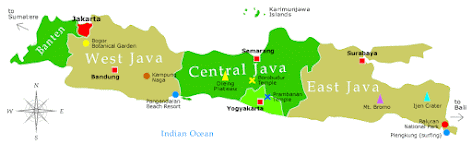
Large Capacity Wood Pellet Production Cannot Be Done on Java Island?

Raw materials are a vital aspect of a production activity. No raw materials means no production. Likewise in the wood pellet industry. The availability of raw materials is absolutely necessary for the continuity of the wood pellet business. To maintain the supply of raw materials, wood pellet factories must have reliable sources of raw materials. Currently, most or even all wood pellet factories on the island of Java rely on sources of raw materials for wood pellet production from wood waste, especially sawdust from sawmills and wood processing industries. 

Currently, coal-fired power plants in Java are running a coal cofiring program with biomass to reduce carbon dioxide emissions or decarbonization. The use of coal in these power plants will be reduced while the use of renewable energy, especially biomass, is increased. The biomass currently used for cofiring is sawdust with a volume of up to hundreds of thousands of tons per year. A very large amount. Wood pellet factories that use sawdust as raw material must compete with the cofiring program in these power plants. This competition increases the price of sawdust because the supply remains the same but demand increases. Disruptions in the supply of raw materials in these wood pellet factories result in disruptions in production and automatically their business aspects.

With these conditions, large-capacity wood pellet production in Java Island becomes less attractive. In fact, the portion of biomass use, especially sawdust, will continue to increase along with the decarbonization program to achieve net zero emissions by 2060. This is increasingly burdensome for wood pellet factories that rely on raw materials from buying sawdust. Wood pellet factories in Java can run well if the availability of raw materials can be maintained and this can only be realized in two ways, namely first using their own raw materials, this can be done by sawmills and wood processing industries that utilize their own waste for wood pellet production, and secondly with raw material sources from energy plantations. Energy plantations that are specifically dedicated to wood pellet production will be able to maintain the stability of the supply of raw materials for wood pellet factories. Wood pellet factories can partner with Perhutani for the second point above.

Friday, June 21, 2024

Decarbonization of the Iron and Steel Industry Part 3: from Low Carbon Production to Carbon Neutral Production

When the decarbonization target must be achieved according to the specified deadline, various efforts will also be made, including through a transition phase. The transition phase in the iron and steel industry is from low carbon production to neutral carbon production. There are a number of factors that influence towards this goal, especially the readiness of the market to buy iron and steel products produced from the production process and also the readiness of fuel and reducing agents for blast furnaces in the iron and steel industry. Charcoal is a fuel and reducing agent derived from biomass which has great potential for use in this transition phase. Charcoal as a carbonization or biomass pyrolysis product has a high calorific value, high fixed carbon and is stable.

Meanwhile, carbon neutral production conditions will be achieved when iron and steel production in the industry uses 100% renewable energy. The use of an electric furnace (EAF/Electric Arc Furnace) can be done as long as the electricity is produced from renewable energy sources. Likewise, the use of hydrogen fuel in blast furnaces (with electrical energy for plant operations also from renewable energy) is also able to achieve carbon neutral production conditions, and even the use of hydrogen fuel in blast furnaces is considered to be the ultimate goal in decarbonization of the iron and steel industry. With the target of achieving net zero emissions by 2050 and the average service life of blast furnaces being 20 years, the iron and steel industry's efforts to achieve the target must be well formulated and programmed. Even if efforts to replace blast furnaces do not follow this target time, it will put the achievement of net zero emissions by 2050 in jeopardy.

In fact, currently it is still far from achieving this goal because the construction of blast furnaces - basic oxygen furnaces (BF -BOF) is still being carried out, which should be EAF (Electric Arc Furnace) or currently only around 30% of the global iron and steel industry uses this EAF. Even the International Energy Association (IEA) highlighted this critical issue to achieve the Paris Agreement's net-zero target by 2050. CO2 intensity in this industry has only slightly decreased so that the use of renewable energy becomes increasingly important and accelerated.

A case example is the Japanese iron and steel industry. As a steel producer of more than 85 million tons per year with main use in domestic construction projects and automotive manufacturing and with more than 25% (more than 21 million tons) being exported, the Japanese steel industry has a significant influence on the global market. The dominant dependence on coal is the main problem of decarbonization and moreover, Japan is also the third largest coal importer in the world. Furthermore, decarbonization in Japan is considered inadequate because the Japanese steel industry lags behind other major world steel producers. Japan is a G7 country that does not implement a coal phaseout period.

Nippon Steel has even been labeled a climate laggard or slow to respond to the climate crisis in the Asian region. This is because the decarbonization strategy is inadequate or not in accordance with the IPCC's 1.5°C warming pathway or the IEA's net-zero pathways. This condition threatens national and global decarbonization targets and puts Japan's steel industry at risk. Meanwhile demand for low-carbon steel is increasing rapidly because steel industries and governments around the world are committed to reducing carbon emissions from fossil fuels. The Japanese steel industry needs to immediately decarbonize to remain competitive in the global market. Decarbonizing by investing in low-carbon steel production will address these risks and can position the Japanese steel industry as a leader in the green transition of the global steel industry.


Regarding the issue of fuel or renewable energy sources, biomass has a strategic position and role, namely in blast furnace operations, charcoal, which is a product of biomass carbonization, is used as a fuel and reducing agent, while in electricity production for iron and steel plant operations, biomass can be used as a renewable energy sources or biomass power plants. This is why the availability of biomass is very important so that the creation of energy plantations as a source of biomass is very necessary. Not only is the plantation a source of energy, it can also play a role in the production of food and feed, both of which are very beneficial for human life. And of course optimizing the use of the plantation by utilizing all parts of the tree (whole tree utilization) also provides maximum financial / economic benefits and with good management it will also provide benefits or improve the environment. And ideally by 2050 the steel industries will use electric arc furnaces / EAF, 100% hydrogen in blast furnaces and even a combination of carbon capture, to achieve net zero emissions in 2050 or even negative emissions so it is very good for the climate.

Monday, May 20, 2024

Decarbonization in the Steel Industry Part 2: Charcoal as Fuel and Reductant in Blast Furnace

Basically, the conditions in each steel industry vary so that the decarbonization process is also carried out using different and gradual routes to achieve net zero emission conditions. The conditions of each steel industry have a unique configuration of production technology, raw materials and energy sources, capacity and yield, regulatory requirements and so on. To achieve Net-zero by 2050, a number of things need to be done, such as efficient use of raw materials, increasing the portion of reuse and recycling, retrofit and advanced technology, and especially efforts to use renewable energy sources as fuel and reductant in the iron and steel industry. But the fact is that the construction of blast furnaces - basic oxygen furnaces (BF -BOF) is still being carried out, which should be EAF (Electric Arc Furnace) or currently only around 30% of the global iron and steel industry uses this EAF, but there are transition efforts that can be made as described below. The transition is influenced by market demand, policy interventions, and incentives given to producers to reduce emissions in steel production.

To create policies related to this transition, providing incentives to reduce emissions for producers and creating market demand for "green steel", a clear definition is needed between low emissions vs. almost zero emissions (near zero emissions) vs zero emissions (net-zero emissions). It is estimated that in 2021 CO2 gas emissions from this industry will be 3.8 Gt globally (this has not even taken into account methane emissions from coal mining). Meanwhile, for Net-zero 2050 conditions, direct CO2 emissions from the global iron and steel industry must be reduced to 1.8 Gt CO2 in 2030 and 0.2 Gt in 2050. It seems that a lot of hard work is still needed to achieve this target, even with the current conditions. Many people are pessimistic.

One use of biomass as a carbon neutral fuel in the iron and steel industry is the use of charcoal as a fuel and reductant. Biomass such as wood must be carbonized or pyrolyzed to become charcoal. The use of charcoal in blast furnaces not only reduces carbon dioxide (CO2) emissions, but also sulfur dioxide (SO2) emissions because the sulfur content of charcoal is very low (around 100 times lower) than coke. Likewise, the use of limestone will decrease so that slag production will also automatically decrease. Likewise, it makes the blast furnace operation acidic.

Apart from a number of advantages obtained as above, it turns out that there are drawbacks to using charcoal in blast furnaces, namely in large blast furnaces which causes operational problems because the strength of charcoal is usually lower than coke. As a solution, there are three methods of using charcoal in the blast furnace process. First, with pulverized charcoal injection (PCI). With this method the charcoal must be crushed into a powder and injected into the blast furnace. Second, with charcoal powder mixed with coke powder into pellets or briquettes called charcoke. By making this charcoke, its strength is sufficient for use in conventional blast furnaces. And third, by replacing coke with lump charcoal for small capacity blast furnaces (inner volume 60 – 550m3). In small capacity blast furnaces, the compression pressure on each charcoal particle is much smaller than in large capacity blast furnaces. Sintering and pelletisation are not required in this case.

Energy plantations or biomass plantations can be created specifically to supply raw materials for charcoal production. The energy plantation will also absorb carbon from the atmosphere (carbon sink) in a certain volume. The volume of carbon from the atmosphere can be maintained in such a way that its function as a carbon sink can be carried out, namely by the amount of wood harvested for charcoal production not exceeding the growth rate of the wood biomass. In this way, the energy plantation cannot be finished in one harvest but is sustainable while maintaining its volume or area.

With continuous pyrolysis technology, charcoal production can be optimized. With this continuous pyrolysis technology, apart from the large charcoal production capacity, multi-use by-products are also produced, such as gas products which can be used as an energy source as well as biooil. Biooil can also be used as a raw material in the chemical industry. Charcoal production of tens to hundreds of tons per day is also possible with continuous pyrolysis technology.

And especially in Indonesia, as the owner of the largest oil palm plantations in the world, which is estimated at more than 15 million hectares and with palm oil mills reaching around 1,000 units, there is a lot of palm oil waste that can be utilized, especially empty palm fruit bunches or EFB (empty fruit bunch). The potential for charcoal production from EFB is also very large. Apart from that, as the 5th largest coal producer in the world with production of around 570 million tons per year, coal also needs to be processed into coke. Charcoal from empty bunches or EFB can be made into powder for PCI or into charcoke by compacting it, namely making pellets or briquettes with coke.

Reject (Non-Standard) Coconut Fruit for Bioavtur / SAF Production

The international civil aviation organization (ICAO) has included non-standard coconuts on the ICAO positive list – ICAO document – ​​CORSIA...