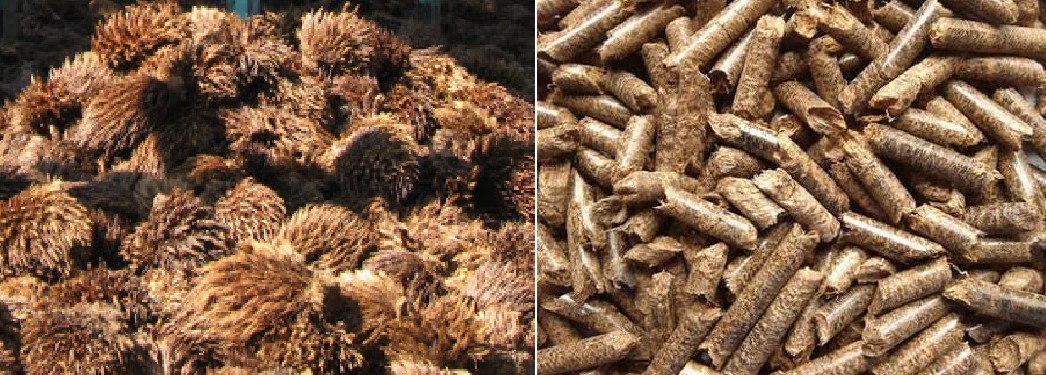
When the EFB pellet properties cannot be accepted by the market, and the solution to upgrade the fuel is not yet economical, it needs a precise solution that can really solve the problem. Most power plants that use pellets as fuel use pulverized combustion technology, where pellet EFBs that have high chlorine levels are less acceptable. Chlorine is corrosive to metals so that the lifetime of the power plant is short. Whereas EFB pellets will be more suitable for power plants that use fluidized bed combustion technology, or even gasification, as a reference can be read
here.
The right solution to overcome the EFB problem is to be processed into EFB charcoal briquette, which is by briquetting and followed by carbonization. The market segment of EFB charcoal briquette for barbecues is clearly very different from a power plant. So the product specifications needed are also a little different. Electricity needs for the production of EFB charcoal briquette can also use the EFB, so some of it is used for fuel in electricity generation and partly for the raw materials of the EFB charcoal briquette. The electricity needs for the production of charcoal briquette EFB are not as big as for palm oil mills and also do not need steam, so they do not have to use steam turbines, but it can be with Stirling engines which are external combustion engines, ORC (Organic Rankine Cycle) or even gasification.

EFB is the most solid waste produced by palm oil mills, as an illustration for palm oil mills with a capacity of 60 tons / hour FFB will produce 264 tons of EFB. The EFB continues to be produced and if it is not treated it will cause more problems. Most EFB is currently only as waste and untapped. As a profit-oriented business entity the palm oil industry, EFB processing or utilization is certainly sought not only to overcome environmental problems but also generate profits. And with the production of EFB charcoal briquette, InsyaAllah, this goal can be achieved. Although the quality of the EFB charcoal briquette will be below
the sawdust charcoal briquette, which is woody biomass raw material, there should be a reasonable price for the charcoal briquette EFB product.
The main markets or users of sawdust charcoal briquette are Turkey, Middle East and Saudi Arabia, which use them to roast meat, especially lamb. The charcoal briquette EFB can be used for substitution or an alternative to
the sawdust charcoal briquette. Even for the palm oil mill industry which has very large land, it can also develop the livestock industry on the land. Cattle farming in oil palm plantations has started to be done a lot, but what about sheep? Why are sheep farms not getting enough attention? I try to explain in writing
here, to try to answer the question above. As in palm oil cultivation on its extensive plantations using certain techniques to maintain its productivity, so also with livestock businesses should also use certain techniques to maintain productivity such as rotation grazing.
The implementation of the EFB charcoal briquette business and livestock in the palm oil industry also requires processes, such as adjusting the company's organizational structure. If the current palm oil industry company organization is only divided into plantation units and CPO mill units, then for the development of new businesses it can create new divisions such as the EFB charcoal briquette division, sheep breeding division and so on, so that the potential of land and all resources can be optimized.