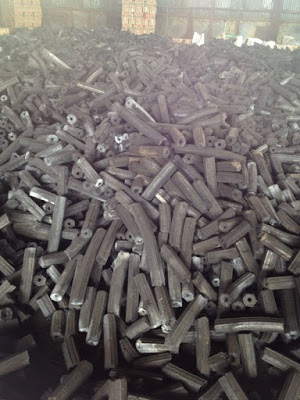
Showing posts with label carbonised briquette. Show all posts

Sunday, June 2, 2019

Wood Waste of Replanting For Sawdust Charcoal Briquette Production

Palm Oil Trunk
Rubber Wood
At a certain age the trees on large plantations are no longer productive so they need to be replanted to maintain the sustainability of the plantation business. Two large plantation groups in Indonesia, which cover millions of hectares, are palm oil plantations and rubber plantations. Wood waste from the trunks of these trees can reach thousands or even millions of tons, and is generally not utilized. Indeed, there are uses of replanting wood waste for furniture, buildings and household appliances industries, but the portion is still very small so it cannot absorb the huge volume of wood. For example rubber wood can also be used for industrial furniture, wood and building wood, as well as palm oil logs. Even rubber wood is also used for making particle boards such as MDF (Medium Density Fibreboard) or HDF (High Density Fibreboard).

Sawdust Charcoal Briquette
Sawdust Briquette Charcoal in Carton Box
The utilization or processing of replanting wood waste for the production of wood charcoal briquette (sawdust charcoal briquette) is the right solution for this problem. Large market potential factors and product specification requirements that are not too difficult make this business attractive. In contrast to wood pellet products which are usually for power plants that require large volumes of supply and very strict specifications, so sawdust charcoal briquette products in addition to the volume of supply also do not have to be large and the specifications are more loose. This is because the use of sawdust charcoal briquette is for barbecue or more specifically mostly for roasting lamb meat in Saudi Arabia, the Middle East and Turkey. In wood pellets for electricity generation specifications are often difficult to fulfill, especially in the chemical aspects of ash such as chlorine, potassium and even sulfur, to be more clearly read here. Whereas in the production of sawdust charcoal briquette for chemical ash, the level of which is only ppm is not a problem at all.
Charcoal Briquette Production Route
Many people think that the production of sawdust briquette charcoal requires additional adhesives such as starch (tapioca), this is understandable because many people still do not know about the production process of the sawdust charcoal briquette. To produce charcoal briquettes in general, using charcoal raw material is then crushed into powder and added adhesive (such as starch) and then briquetted. The briquette product is then dried and packaged to be marketed. The production process of charcoal briquettes in this way is less good and less acceptable to the market. While the production process by means of the wood is crushed about the size of sawdust and then dried and then briquetted. The briquetting does not require adhesive because in wood there is always a lignin compound, which is useful as the adhesive. Furthermore, the briquettes are carbonized to increase fixed carbon and reduce volatile matter. Charcoal briquette products in this way, commonly called sawdust charcoal briquette, have better quality and are in demand by the market. The above scheme is enough to explain 2 routes of the production process of two types of charcoal briquettes.
Wood waste of replanting in time will also run out and be replaced by new plants. How can the sawdust charcoal briquette production business continue? A production unit certainly requires a supply of raw materials. To be able to continue to supply raw materials for production, one alternative is to make energy plantations. The energy plantations can be with fast rotation plants such as calliandra or gliricidae. To optimize woody biomass productivity and business, the energy plantation should be integrated with sheep, cattle and honey bee farms. And for more details can be read here.

Thursday, February 14, 2019

EFB Charcoal Briquette for Substitution of Sawdust Charcoal Briquette


Continuity of raw material supply is the main thing for the sustainability of a production, as well as the sawdust charcoal briquette industry. The lack or even stop of supply the sawdust or wood waste as raw material for sawdust charcoal briquette makes production disrupted and even stops. And such conditions have now been experienced by some the sawdust charcoal briquette factories. In fact, from the market side the demand for sawdust charcoal briquette is very large, especially in Turkey, Saudi Arabia and the Middle East. Continuous alternatives to raw materials and availability in large quantities are the choices. An empty fruit bunch (EFB) can be an option. Why? EFB is a solid waste of oil palm mills which are large in number and are generally not utilized. Palm oil mills with a capacity of 60 tons / hour FFB produce EFB waste of 13.2 tons / hour or 264 tons / day. And currently there are approximately 1,000 oil mills throughout Indonesia.
The next question is, can the quality of charcoal briquette made from EFB compete with sawdust or wood waste? Judging from its use for fuel or energy, the quality of EFB is lower than sawdust or woody waste belonging to woody biomass while EFB is a biomass of agricultural waste (agro waste). The measure of quality can be shown mainly from the calorific value and ash content. The calorific value of the EFB charcoal briquette is lower and the ash content is greater than the sawdust charcoal briquette. Based on these conditions, the price of sawdust charcoal briquette should be slightly lower than sawdust charcoal briquette. But in an effort to overcome the problem of waste and be able to increase income, the profits from the production of the EFB charcoal briquette should still be very attractive.
The implementation of EFB charcoal production can work with palm oil mills, namely as a provider of raw materials as well as electricity providers for their operations. A number of palm oil mills with excess biomass waste such as palm kernel shells and mesocarp fiber can be used for electricity production. If it is still lacking, waste in the plantation such as fronds and leaves can also be used to fuel the power plant. The location of many palm oil mills is in the remote areas and there is no other electricity source that is sufficient so that's make the palm oil mill automatic as a power plant also which is generally used internally but can also be upgraded for external use. As for management and business, it is possible to produce EFB charcoal briquette that are integrated palm oil mill or separatd and managed by ownself. Of course the choice is very dependent on the management pattern of the company, especially in its business development division.

Sunday, July 29, 2018

Set Up Wood Charcoal Briquette Production in ASEAN Countries

ASEAN countries have large forests and various forest resources. However, there is a decrease in some countries due to irregular logging in some countries. This is why sustainable forest management is needed to maintain the biomass of forest resources. Indonesia has the largest forest area, but has declined since 1990 primarily due to illegal logging and forest fires. Malaysia has the highest number of biomass and forest growth in area ratio, while Thailand is the lowest. This could also be due to higher rainfall in Malaysia compared to other ASEAN countries, which is 2,875 mm / year, with an world average of 900 mm / year and Indonesia 2700 mm / year. For more details can be seen in table below. Indonesia and Malaysia mainly produce sawn wood and plywood, while Thailand is wood chip and particle board. Vietnam produces many sawn wood, while Cambodia and Laos consume lots of logs as fuel.
Wood charcoal briquette or sawdust charcoal briquette have a very high market especially in Middle East, Saudi Arabia and Turkey. These countries use sawdust briquette charcoal to bake the meat, especially the lamb which is a favorite food there. The production of sawdust briquette charcoal uses logging residues and industrial wood residues. This should be the extent of forest and wood processing industries comparable to the sawdust briquette charcoal industry. The abundant logging wastes are usually the tops of small diameter trees and branches. The logging waste is about 100% average for the production of the logs themselves, so that the amount is huge. Sabah, Malaysia and Kalimantan, Indonesia produces many of these logging wastes at very cheap prices.
As for waste wood processing industry is usually in the form of sawdust, and wood pieces both board and round wood. It is estimated there are 1600 sawmills and 120 plywood factories in Indonesia. The raw materials of the plywood industry are originally from natural forest, but as demand continues to increase the supply of natural forest timber decrease so that it shifts with wood from the planted trees. When using wood from natural forest, the diameter of wood can be more than 70 cm and when using wood the trees planted wood diameter is only about 30 cm. Samarinda, East Kalimantan, Indonesia at first many plywood factories were operating but due to the declining timber supply of many of these factories which shut down production. The yield of plywood from raw materials is 50%, while the remainder becomes waste. Part of the waste is used for block board and packing material, but only about 10%, so 40% is still waste. 
While in Malaysia, the total volume of wood industry waste estimated 7.5 million cubic meters per year. The highest sawmill waste in Sabah, while plywood waste in Sarawak. Sawmill produces sawn wood products ranging from 40-65% and the remaining 35-60% are sawdust. While yield for ply wood ranged 50-60%, while 40-50% as waste. For the molding plant its yield is higher ie 70-74%, means waste 26-30%. Percentage of wood waste from 75% ply wood industry and 25% from saw mill industry. Utilization of wood industry waste is still not optimal, even just stockpiled and then burned because it is considered polluting the environment.

In Laos, there are about 200 wood processing factories (furniture, packing materials, flooring and doors) located mostly around Vientiane, the capital of Laos and only one plywood factory. Charcoal producers are scattered everywhere in the country due to high demand for households. The yield of the wood processing industry is about 60%, so that 40% is waste. Utilization of waste is also not optimal, such as sawdust just dumped just behind the saw mill.
Production of sawdust briquette charcoal (wood briquette charcoal) will be the solution for the utilization of such waste. Sawdust is the best raw material because it does not need size reduction and can be shorter production process. Whereas if the waste is still in the form of pieces of wood then it needs for size reduction first to the size of the particle like sawdust. After that if the wood powder is still wet (moisture content more than 10%) it is necessary for drying with a rotary dryer or drum dryer. Furthermore, after dry powder material is followed by briquetting and carbonisation process into sawdust briquette charcoal as the product. 

Biomass Boiler Testing and Selection of Suitable Biomass Fuel

In line with the trends toward decarbonization and sustainability across various sectors of life, particularly in the processing industries ...