Showing posts with label grazing. Show all posts

Thursday, March 24, 2022

Sheep Breeding with Rotation Grazing

Efforts to achieve self-sufficiency in meat, especially for Muslims to strengthen their aqidah (faith) by means of qurban and aqiqah, are still facing many obstacles. The main obstacle is the number of seed sheep which are difficult to obtain because of the large number of productive females that are slaughtered for both aqiqah and daily consumption. Muslims are important and obligated by law (fardhu kifayah) or as a collective obligation to raise sheep to achieve the above objectives. Do not let Muslims can not perform these prayers because there are no livestock, especially sheep. Of course, it is also not good if because they are reluctant to raise sheep, Muslims will have to buy sheep from non-Muslims, even though the number in Indonesia is the majority and is also the largest in the world.

There are at least two things to overcome the problem of the sustainability of the supply of sheep, namely, firstly with a set of regulations to provide strict sanctions and provide a deterrent effect for anyone who is proven to slaughter productive females, and secondly, by increasing the production of seed sheep or lamb breeds as much as possible so that they can keep pace with the rate of productive ewes that are slaughtered. In the first point, although there is  a regulation, in fact it is difficult to implement because the government is not firm and the light sanctions. While in the second point, anyone can do it, so it seems that the second point is easier to do.

The location of sheep farming can be done anywhere, whether in villages, mountain slopes, forest edges and even in urban areas. These livestock models adapt to the characteristics of the location, especially regarding the source of feed. For example, in urban areas with limited land, the sheepfolds must even be leveled, with feed sources especially from food industry wastes. In the food industry, the main product are for human food and by-products or waste for animal feed, such as tempe and tofu factories, noodle factories, biscuit factories and so on. Meanwhile, in rural areas with large areas of land, grazing is also very possible. Grazing will save on feed costs and is very suitable for seed sheep production or breeding. While rotation grazing is a better grazing technique so that the efficiency and performance of the farm is better. Even on land that is close to an energy plantation, apart from grazing with abundant sources of feed, a feed factory can also be built in that location. And basically the more models with various variations, the more regions in Indonesia that can be worked on for self-sufficiency in meat especially halal meat.

In rotation grazing, the grazing area will be divided into paddocks. And basically the more paddocks, the better because pasture can be utilized as a source of animal feed to the fullest. In general to start with 5 to 10 paddock with each paddock for grazing 3 to 7 days then rested 25-30 days. Of almost all rotation grazing practices, 4 paddock is the minimum number to start with. The square shape is the best shape for the paddock, so try to get as close to it as possible. The shape of the small elongated and circular paddock is not good because it is more difficult to achieve an even utilization of grass by livestock.


By increasing its production centers, the problems of seed sheep will be overcome. Of course this takes time and continuous effort. The unused, marginal and critical lands which amount to millions of hectares can be converted into the livestock area. Divine motivation to strengthen aqidah and part in enforcing Islamic law will continue to motivate Muslims to raise sheep farming, in addition to meeting their daily protein needs in the form of meat. The people's culinary shift from protein consumption of chicken meat to duck meat and currently more and more lamb is consumed. The halal industry should also be growing with Muslim business actors themselves. 

Tuesday, April 7, 2020

Integration of Farm with Biomass Plantation or Energy Plantation


The long and expensive social costs for the production of hardwoods such as teak which require a minimum of 15 years make Perhutani company replace them with fast-rotating plants such as gliricidia. As for private companies, the main reason for growing fast-rotation species is mainly profit. Commodities that provide quick returns, with minimal risk. Short harvest time of wood which is only around 2-3 years and can be repetitive (coppice) repeatedly without the need to replanting is the advantage of these plants. Planting and caring for the tree is also very easy. The price of wood that is only worth the waste wood or firewood also mitigates the social cost of securing wood theft. The use of wood as a source of biomass or raw materials in the wood processing industry such as the manufacture of particle boards or as an energy source for example by processing it into wood pellets and wood briquettes. Hundreds of thousands of hectares have been planned for the planting and will take several years to come.
In addition to the main product namely wood, there are actually two products from the tree that can be utilized namely flowers and leaves (whole tree utilization). Flowers for beekeeping or production of honey and leaves for animal feed or meat production. Sheep, goat and cattle farms can be developed close to the plantation so that they are close to feed sources. Although the protein content in gliricidia leaves ranges from 18-24% or high enough for animal feed in general, so it is very good for animal feed, because concentrated feed usually only contains about 15% protein, but to get a balanced feed is still needed a number of other nutrients . Other complementary nutritional needs can be obtained from the surrounding community by collaborating through community empowerment. Nutrients needed for animal feed to become complete feed are complete sources of fiber, sources of protein, vitamins and minerals. Gliricidia leaves with 18-24% protein content as a source of protein, while grass or straw as a source of fiber and added vitamins and minerals.

Grazing
To produce superior livestock products, livestock grazing is the solution. With grazing, livestock will be healthier and feed costs can be cheaper because grass can be directly obtained. With an area of biomass or energy plantations that reaches tens to hundreds of thousands hectares, then allocating several tens or hundred hectares is certainly not difficult. The area can be used for pasture herds. Certain grasses can be planted as a source of food in the pasture. Sheep and cattle can even be farmed and herded in the same pasture field. Rotational grazing is a shepherding technique that can be applied because it is more effective and efficient than conventional grazing.
Single grazing
Mixed grazing
Feed Factory
With the composition of gliricidia leaves produced from each tree reaching around 30% and an average of 10,000 trees per hectare planted, the number of leaves produced from biomass or energy plantations is huge and excessive for consumption on farms. Then it also has the potential to create animal feed factory. The livestock feed produced can then supply feed to a number of farms in various regions so that the livestock business is growing and self-sufficiency in meat is easily achieved. Meat imports that reach tens or even hundreds of thousands tons should be avoided and sufficient from domestic livestock businesses.
The main problems of livestock are feed and markets. When the feed problem has been resolved it means 50% of the problem has been solved. As for starting a business, the first thing to note is the market or the buyer. If the products produced from the business that we do have no market or buyer, then the business will lose money and go out of business. The potential lack of meat in the country can become a large market potential and export market. Regarding sheep and goats, In Indonesia indeed a number of regions prefer goats such as Jakarta, Central Java and East Java while other regions prefer sheep like Yogyakarta. This should also be a concern regarding the target market.

Saturday, August 31, 2019

Sheep Farm Based Startup Business

Lamb meat is the best meat for human consumption. Prophets and Messengers of Allah SWT must have been herdsmen. There are many lessons from the pastoral activity, for more details, you can read here. Increasing consumption of lamb and even become a favorite food is something that is encouraging. A number of satay shops and also offers a number of lamb dishes are always crowded. It is estimated that around 250 satay shops yand processed sheep are scattered throughout Yogyakarta special province, Indonesia. The high interest and consumption of lamb meat will also have an effect on the high supply of sheep needed. Other cities in Indonesia should also follow it. Surely this will be an interesting opportunity, including the pattern of business startup. Even when the supply of sheep increases, the export market is also ready to wait.

In Indonesia, grass cultivation is certainly not difficult, even without planting grass has grown thick and filled our gardens. Unmanaged grass is just annoying and causes problems. But on the other hand, if the growth of grass is well designed and managed so that the sheep grazing area will certainly be a different story. In any livestock industry the feed factor is the highest cost component. If the sheep are managed by herding in the pasture, the cost of feed will be minimized so that the profits are maximized. Rotational grazing is a grazing technique that can maximize these benefits.
In addition to grass which can be regarded as a staple food for the sheep, additional food in the form of supplements is also needed to get the best quality meat. Energy plantation such as the calliandra plantation can support the sheep farm. Leaves from the energy plantation harvest can be used for additional feed. Calliandra leaves with high protein content will be nutritious feed for the sheep. In addition, wood from energy plantations can also be used for the production of charcoal briquette. By using charcoal made from energy plantations wood that means it does not damage the environment such as cutting down forest wood and so on. The quality of charcoal briquette (sawdust charcoal briquette) is also better than ordinary charcoal that is not briquetted, because it is denser, has a uniform size and a longer burning time.
At a large capacity these sheep can also become export commodities. Extensive grasslands and energy plantations can be made for many of these export purposes. Utilization of technology is increasingly needed for such large capacities such as drones to monitor the movement of these sheep. Locations outside of Java and can even be integrated with large plantations have huge potential, for additional information can be read here. Indonesia as the owner of the largest palm oil plantation in the world with an area of ​​12 million hectares has the potential to integrate this sheep farm. Previously we have also heard that cattle farming has been integrated in a number of oil palm plantations, for more details, please read here. In addition to the sheep which will become an export commodity as well as sawdust charcoal briquette from the energy plantations.
Lamb satay in packaging
The sheep-based startup business will encourage improving the quality of our food and at the same time improving the environment. And so that various regions can also easily get the supply of lamb meat, lamb meat can also be packaged in the form of ready satay, so it is also easy if you want to consume lamb satay every day. At the time of Eid al-Adha, this business startup also supports the provision of sacrificial animals, as part of upholding Islamic law (QS. Al-Kautsar: 2; QS. Al-Hajj: 34) which will continue to exist until the Day of Judgment. Even sheep is permitted for qurban animals that are still six months old, entering seven months old (jadza'ah) while other qurban animals are eligible if they are at least one year old or more (mussinnah) such as goats are tsany (one year old, enter second year ), two-year-old cattle, entering the third year and camel five years, entering the sixth year. Furthermore also the need for halal food is an absolute necessity for all Muslims so running a business for the fulfillment of halal food should also be the domain of Muslims as well as the business of Umrah and Hajj to halal tourism. Moreover, there are many verses in the Qur'an concerning the superiority of sheep over other livestock, for more details, please read here. Let us be part of the world's food and environmental solutions and uphold the Shari'a of Allah SWT.
Sunday, March 3, 2019

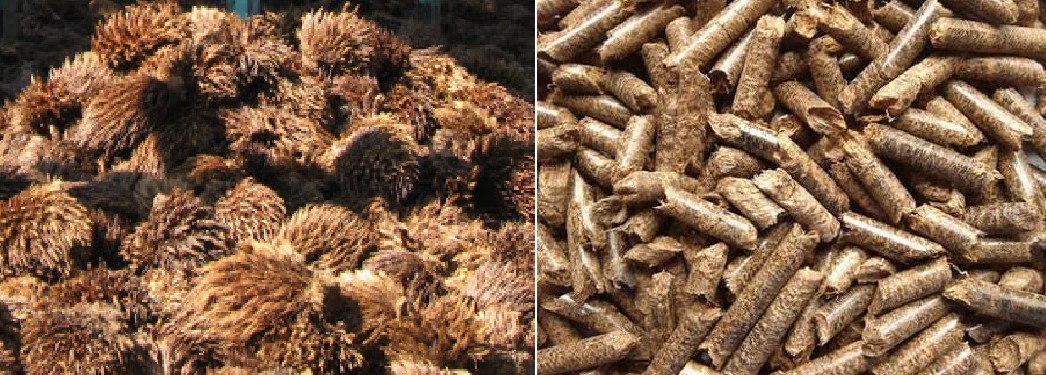
EFB Pellet is Difficult Accepted by the Market, It's Time for EFB Charcoal Briquette to Come as a Solution


When the EFB pellet properties cannot be accepted by the market, and the solution to upgrade the fuel is not yet economical, it needs a precise solution that can really solve the problem. Most power plants that use pellets as fuel use pulverized combustion technology, where pellet EFBs that have high chlorine levels are less acceptable. Chlorine is corrosive to metals so that the lifetime of the power plant is short. Whereas EFB pellets will be more suitable for power plants that use fluidized bed combustion technology, or even gasification, as a reference can be read here.
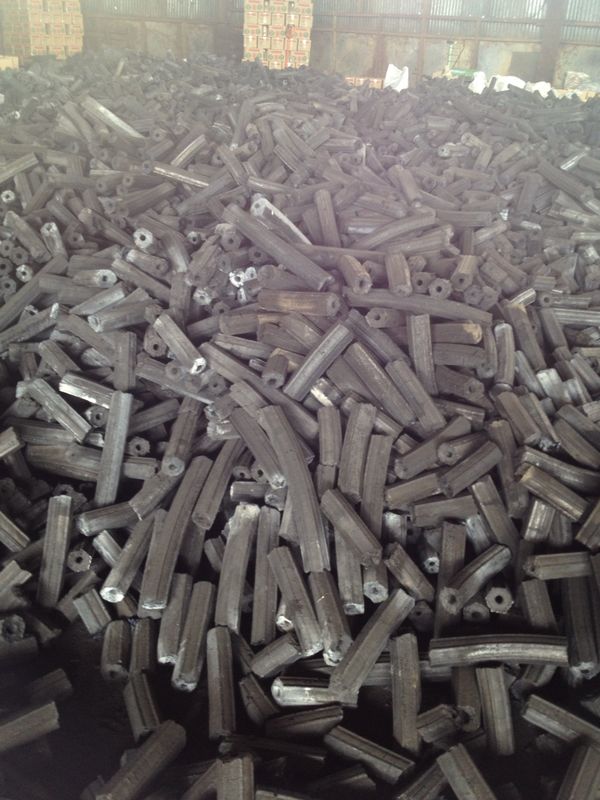
The right solution to overcome the EFB problem is to be processed into EFB charcoal briquette, which is by briquetting and followed by carbonization. The market segment of EFB charcoal briquette for barbecues is clearly very different from a power plant. So the product specifications needed are also a little different. Electricity needs for the production of EFB charcoal briquette can also use the EFB, so some of it is used for fuel in electricity generation and partly for the raw materials of the EFB charcoal briquette. The electricity needs for the production of charcoal briquette EFB are not as big as for palm oil mills and also do not need steam, so they do not have to use steam turbines, but it can be with Stirling engines which are external combustion engines, ORC (Organic Rankine Cycle) or even gasification.
EFB is the most solid waste produced by palm oil mills, as an illustration for palm oil mills with a capacity of 60 tons / hour FFB will produce 264 tons of EFB. The EFB continues to be produced and if it is not treated it will cause more problems. Most EFB is currently only as waste and untapped. As a profit-oriented business entity the palm oil industry, EFB processing or utilization is certainly sought not only to overcome environmental problems but also generate profits. And with the production of EFB charcoal briquette, InsyaAllah, this goal can be achieved. Although the quality of the EFB charcoal briquette will be below the sawdust charcoal briquette, which is woody biomass raw material, there should be a reasonable price for the charcoal briquette EFB product.

The main markets or users of sawdust charcoal briquette are Turkey, Middle East and Saudi Arabia, which use them to roast meat, especially lamb. The charcoal briquette EFB can be used for substitution or an alternative to the sawdust charcoal briquette. Even for the palm oil mill industry which has very large land, it can also develop the livestock industry on the land. Cattle farming in oil palm plantations has started to be done a lot, but what about sheep? Why are sheep farms not getting enough attention? I try to explain in writing here, to try to answer the question above. As in palm oil cultivation on its extensive plantations using certain techniques to maintain its productivity, so also with livestock businesses should also use certain techniques to maintain productivity such as rotation grazing.

The implementation of the EFB charcoal briquette business and livestock in the palm oil industry also requires processes, such as adjusting the company's organizational structure. If the current palm oil industry company organization is only divided into plantation units and CPO mill units, then for the development of new businesses it can create new divisions such as the EFB charcoal briquette division, sheep breeding division and so on, so that the potential of land and all resources can be optimized.

Friday, February 8, 2019

When the Wood Pellet Industry is 100% Foreign Owned

Wood pellet has bright prospects in the future and is very well developed in Indonesia. Wood pellet whose application for energy is very strategic for the development of the nation. Even Europe in the Renewable Energy Directive (RED) program is part of their large bioeconomy program. The RED (Renewable Energy Directive) has targeted the use of renewable energy to reach a minimum of 20% in 2020 with biomass consumption reaching 70% of the total renewable energy and by 2030 to be a minimum of 27%. For biomass energy, Europe is the largest wood pellet producer, with an estimated 13.5 million tons / year while consumption is 18.8 million tons / year, meaning that there is still a shortfall of 5.3 million tons / year. America and Canada are the main suppliers of wood pellet needs of European countries with the majority of the use of wood pellets for electricity generation. Indonesia as a tropical country and rich in various biomass, especially woody biomass, has the potential to become the world's leading producer of wood pellets.

In 2024, wood pellet needs are projected to reach 50 million tons while the current production of 20 million tons and Indonesia's wood pellet production is also still small, which is around 80 thousand tons / year. The increasing need for wood pellets is mainly driven by a number of policies to reduce the use of fossil fuels and substitutes with renewable energy, one with biomass and especially wood pellets. Fossil fuels produce CO2 gas which is increasingly heating up the earth's temperature (global warming) and climate change that have a negative impact on life on earth. Counted 24 earth conferences held almost every year and attended by hundreds of heads of state in the world to address global warming and climate change. The Earth Conference was first held in Rio de Janeiro in 1992, last year (2018) in Katowice, Poland. Whereas in the Asian region there are at least 2 countries that need wood pellets of up to tens of millions of tons, namely South Korea and Japan.
Indonesia has great potential for wood pellet production and is even a major player in the world due to its tropical climate and vast and fertile land. With its tropical climate, it only takes 1 year to produce biomass equivalent to 4 years in sub-tropical countries such as Europe and America, which are fast rotating plants (Short Rotation Coppice / SRC) such as calliandra. But when the wood pellet industry was controlled by 100% foreign according to what the Indonesian government announced some time ago, it is certainly very unfortunate, this is because it will also be very possible that the land will be controlled by foreigners as well as producing wood for wood pellet production, citizens only have a role very minimal even just as an audience. In addition, the contribution that the state receives is also very minimal and will not provide welfare for citizens. No less important is that it is projected that in the next 10 years Indonesian petroleum will run out, then wood pellets can be a very potential replacement energy source. The development of wood pellets with wood raw materials from energy plantations and integrated with livestock is expected to make Indonesia self-sufficient in energy and even environmentally friendly and self-sufficient renewable energy. Integration of large plantations such as energy plantations and large farms for more details can be read here.
Energy is clearly a strategic sector even very closely related to state sovereignty. If a country is not sovereign in its energy sector, it is very easy to make a shock in that country. This should be realized together so that it does not easily provide control of the strategic business sector to foreigners. Indonesia should also develop its bioeconomy with its biomass potential, more details can be read here. Although the tropical country and rich in oceans turned out to make Indonesia a lot of rain and cloudiness, even Indonesia's rainfall is higher than the world average, so the development of solar photovoltaic energy becomes expensive and not an option, and biomass returns to the right choice and solution for the condition of Indonesia, more details are read here.
"The Muslims are syirkah (sharia business cooperation) in three ways, in terms of grasslands (land), water and fire (energy) "(Hadith Narrated by Sunan Abu Daud).

Syirkah is an effort to capture the great opportunity of wood pellets. Muslim fellow in particular must cooperate with each other to prosper the earth by making lands that are not or underutilized into productive land such as the hadith instructions above. If don't do syirkah it will be very difficult to capture this great opportunity. Landowners, capital owners and managers can work together to seize this opportunity and not become foreign property. Of course pro-people policies will increasingly support the wood pellet business that conducts syirkah.

Sunday, November 4, 2018

Finding The Best Treasure From Energy Plantation Implementation Part 7

"It is He Who has brought down the rain from the sky for you, some of it has become a drink and some of it has grown up, the plants which are in your place of grazing your cattle. "(Qur'an 16:10)

"Eat and graze your animals. Verily in this, there are signs of the power of Allah for those who understand "(Qur'an, 20:54)

"Muslims are syirkah (sharia business cooperation) to three things, in terms of pasture (land), water and fire (energy)". (HR. Sunan Abu Daud).

Farmers outside Java island generally have 5-10 hectares of land, but not a few that have tens of hectares to hundreds of hectares. Many of these lands have not been planted or optimized so as to provide benefits for their owners. These lands are very potential to be made efficient pasture by rotating grazing. Sheep grazing and mixed sheep and cattle can be cultivated in these areas. Rotation grazing is to divide the pasture into several units such as the horse training arena (paddock), and then the cattle take turns grazing in the boundary grazing area. In rotation grazing there is always a pasture field that is rested to restore the growth of the grass. The landowners can also be syirkah (sharia business cooperation) to reach a certain area of ​​land to be used as an energy plantation. Energy plantation will produce wood for energy, namely wood pellets or wood briquettes or derivatives of other products. The leaves are used for animal feed namely sheep and sheep with cow. Farm animals can even be grazed in an energy plantation area with certain techniques or sacrifice some land for grazing areas.
Rotation grazing will provide efficient results in both meat productivity and the sustainability of the pasture. Grass growth can be maintained in such a way by rotating grazing, which is maintained at height of 8-10 cm. If the grass is eaten out (overgrazed) to the base of the stem it will be difficult to grow properly again. The technique regulates that the grass continues to grow well by regulating the duration of grazing on the grazing block, this will also be affected by the season factor. Grass will grow faster in the rainy season and oppositely in the dry season. With good irrigation, the growth of grass in the dry season can be maintained. Pasture is essentially farming of grass itself. In addition, by rotation grazing of sheep or livestock, they will graze more evenly because the grazing area is limited by the barriers. As a comparison, continuous grazing is used, where animals tend to only eat grass that is preferred and even overgrazed so that the sustainability of grass pasture is less optimal.

Then how can the sustainability of pasture be optimal? Fertilization is an important thing to achieve this, in addition to the things above. Distribution of livestock manure must be made as well as possible in the pasture field. With a ratio of land area compared to the number of animals small or the number of livestock made more so that the larger population makes the distribution of fertilizer evenly distributed. The distance of livestock mobility in this way is short and limited. Of course the availability of feed in the form of grass is an important consideration for the technique. Dense grass, although not so broad, may provide more food than large land with rare grass populations. If the area of ​​1 m2 with the condition of dense grass produced 1 kg of grass, then for every hectare there is 10 tons of grass for feed.
The Qur'an shows that pasture animals like the shade under the trees and also near the source of water (QS 16:10). This has also been proven from professional grazing in various countries over the globe. For this reason the pasture should also be overgrown with trees like the Qur'an's instructions. Among these trees can also grow a lot of grass. Farm animals will spend a lot of time in the shade under the trees. Water sources also need to be provided at that location for the place to drink the grazing animals. As a result, livestock manure will also accumulate in these locations so that it also fertilizes the soil. Fruit trees and woody trees can be used in the pasture. Leaves from the energy plantation can be used as additional feed for the sheep. Sheep farming can also include supporting the Shari'a qurban ie Islamic Shari'a slaughtering sacrificial animals on every 10 Dzulhijah or Idhu Adha feasts. In addition to these lands being used for energy plantations, plantation lands in Indonesia is very broad, for example palm oil which reaches 12 million hectares, coconut 3.7 million hectares, rubber 3.5 million hectares, various fruit plantations also very broad can be modified by sheep grazing to optimize land and increase soil fertility.

Saturday, February 17, 2018

Market Condition of Biomass Fuel

Indonesia has enormous biomass production potential because of its tropical climate, and extensive land. Biomass fuels from Indonesia which are now exported are wood pellets and palm kernel shells. Wood pellet production is still low in the range of 80 thousand tons / year, while the palm kernel shell is quite high at around 10 million tons / year. Both types of biomass fuels are mostly for export while in domestic is not yet widely used. Why the domestic market itself has not used much of both types of biomass fuel? This is because people are still dependent on fossil fuels, namely LPG gas to cook households and coal in the industrial sector. The government policy to increase the use of renewable and alternative energy needs to be encouraged so that biomass energy is increasingly used.
PKS Loading
As for the export market, the need for biomass fuel needs is greater and projected starting in 2020 will increase sharply. For palm kernel shells (pks) buyers are Korea and Japan. Currently there are many sellers of palm kernel shells, while the number of buyers is still limited. This raises the business conditions that are less healthy because the price of these commodities will be more determined by the buyer (oligopsoni). The practice should be avoided and resolved if the number of buyers and sellers is relatively balanced. How to increase the number of buyers of biomass fuel from Indonesia? For export markets other than two countries namely Korea and Japan which have been importing mainly Indonesian palm kernel shells for power plants, then promotion to look for other markets, such as China and Europe may also do. Currently there have also been buyers from Taiwan and Thailand although their needs are still relatively small for its use for heating in industrial boilers.

The market condition of palm kernel shells (pks) is different from wood pellets. The difference is that the wood pellet producers spread almost all over the world, as the raw materials of woody biomass are located almost all over the earth. While sales of bulk Palm kernel shells are only done in Indonesia and Malaysia which is the biggest CPO producer in the world as well as the largest palm oil plantation owner in the world. In addition, a number of large countries are promoting its wood pellets on a large scale so that the wood pellet becomes very popular, so the demand is increasing sharply and some countries are starting to start for wood pellet production. Wood pellets are more famous and worldwide than palm shells although the properties or characteristics of both as biomass fuel are almost the same. This condition should further encourage the Indonesian government to promote the palm kernel shell. In global market conditions with the number of producers and users of wood pellets that are also quite balanced in number, the market conditions are better, although some countries become major producers and control most of the market. While domestic pellet market is still small so it still needs to be encouraged its use as well as its production. Along with the public unrest due to LPG gas scarcity, the motivation to use wood pellet is also getting bigger.
While also waiting for 2020, the market or users in the country also needs to be made so that will increase the number of biomass fuel buyers. The use of biomass fuel is proven to provide economic and environmental benefits if the management is good and sustainable. When the biomass fuel market is large, then production should also be added. If the palm kernel shells (pks) are palm oil waste depending on the amount of CPO production, wood pellets can be produced separately especially with raw materials from the energy plantation so that the capacity can be very large. Currently, Indonesia's CPO production is around 35 million tons/year with a palm oil plantation area of ​​12 million hectares. The energy plantation can be optimized with sheep farming and honey bee farming (see 5F project for the world!), As well as for palm oil plantations (see Transmigration For Sheeping In Palm Oil Pantation, Could It Be?). Empty fruit bunches and old palm oil trunk that are not productive can also be made pellets. And especially for oil palm pellets (OPT pellets) we currently have demand for volume of 1,000 tons / month, for those interested in becoming a manufacturer, please read more here.

When Shepherding As Dowry

One of the two women said: "My father took him as a man who worked (for us), because indeed the best person you take to work (on us) is a strong man who can be trusted." (QS Al-Qashash: 26)

He said (Syu'aib) : " I intend to marry you off to one of my two daughters, on the basis that you work with me eight years and if you have ten years then it is (a favor) of you, then I will not weigh you down, and you will insha Allah find me the good ones ". (QS Al Qashash: 27)

"And He grows the grass" (Surah Al A'laa: 4)
The story of Moses who helped two women and then invited Moses to meet the father of the two women. Then, since Moses had a strong body and trustworthiness, one of the women suggested his father, the Prophet Shuaib, to be taken as a worker. The Prophet Syu'aib not only accepted Moses to be his worker, even intended to marry one of his daughters to Moses on condition of working with him as a shepherd for 8 or 10 years. Inspirational and exemplary story of all time.
When in this age the parents are anxious to seek a son-in-law, the inspiration of the story above is enlightening. Parents today can make sheep grazing so that it becomes a way to get their best daughter-in-law. And if his parents are still confused, then his daughters should also ask their parents to make the shepherds of the sheep. Allah SWT grows grasses for the feed of livestock grazed, especially the sheep.

"He is Who has sent down rain from the sky for you, partly a drink and partly (fertilizes) the plants, on which you are grazing your cattle. "(QS 16:10)

In Indonesia with an area of ​​oil palm plantations that reach about 12 million hectares, of course can be used for sheep grazing, even would be the best place (QS 16:10). What a pity if the plantation area of ​millions hectares is not optimized, even have to spend big money to clean grass under the palm oil tree. Though the grasses are feed for the sheep are grazed. The dung from the sheep also becomes fertilizer for palm oil trees which will eventually fertilize the soil and increase the productivity of its harvest. When sheep grazing in palm oil plantations has become an integrated concept, it becomes more attractive. Since the palm oil plantations are mostly or 80% located in Sumatra and Kalimantan, grazing areas can also be among fruit plantations even in multipurpose energy plantations.
All the Prophets were once shepherds of sheep / goats, indicating that the work of shepherding of sheep is important. Allah SWT shows that one of the best ways to educate His messengers who are the best human beings is to shepherd the sheep, so imitating it will also give the best results. Unfortunately, shepherding lessons are not taught in detail in our agricultural colleges, as well as in Islamic colleges of either the majors or faculties of the Qur'an or Hadith. Yet this shepherd is the sunnah of all the Prophets and also specifically there a guidance in the Qur'an.
Professions of shepherding for women is also a good thing, it can be referred from the two verses of Al Quran Surah Al Qashash above. The daughters of Prophet Shu'aib worked as shepherds even to help her father that old. Today when women in Jabodetabek (Jakarta and surrounding cities) jostle to their work places both on buses and trains, so prone to touch with non mahram and sexual harassment, then again refers to the two verses of the Qur'an above will inspire, motivate and simultaneously can be implemented. Women in the area do not even need to urbanize to the densely populated cities, crowded to work or work, traffic jams and so on, but enough to turn the Prophet's sunnah back to the shepherding.
Of course there is a lot of wisdom from the shepherding. As palm oil plantations have been crowded by the sheep, soil fertility will increase and domestic meat production is also increasing, together with it as the best educational medium. Indonesia's low production of palm oil can also increase rapidly in line with the increase in soil fertility. The sheep will also be the best treasure for Muslims, which can be read in more detail here, here, and here. Domestic meat consumption which is currently only 1/4 of the world average can also be improved. The low consumption of domestic meat is also a result of us have no interest in grazing. When parents are aware of the importance of shepherding, they will not hesitate to make the shepherding effort, which is also a means of getting their best son-in-law. At that time the dowry (dowry of marriage) becomes a set of tools of sholat and shepherding. Insha Allah.

Tuesday, November 1, 2016

Sawdust Charcoal Briquette and Sheep Consumption In Saudi Arabia and the Middle East


Consumption of lamb, especially in Saudi Arabia each year ranges from 8 million, with a quarter in the Hajj season. Countries exporting sheep to Saudi Arabia today is mainly of three African countries, namely Somalia, Sudan and Djibouti.Countries in Africa is dry and less fertile than Indonesia, but with the way the sheep are grazing in pastures that are available, made of sheep production is abundant there. Indonesia with fertility and breadth of the land is appropriate overlay could become the country's largest exporter of sheep. By improving the effectiveness and efficiency of land as well as the most important mindset that enormous potential of Indonesia that supports this direction then God willing, it becomes very likely to be realized.
Grilled lamb chops with favorite foods are processed in Saudi Arabia and the Middle East. Need of  sawdust charcoal briquette  continue jump to increase as the high consumption of lamb in Saudi Arabia and the Middle East. Most of the needs of sawdust charcoal briquette in Saudi Arabia and Middle East come from Indonesia, and in line with the growing need lots of factories sawdust charcoal briquette is built to meet these needs. The buyers scramble up to get this product due to high demand. Today almost all the factories of sawdust charcoal briquette use sawdust or wood wastes as raw material.Regions rich with raw materials is potential to develop this commodity that because of the high demand.


Sawdust charcoal briquette product has many advantages compared to ordinary wood charcoal among other more dense, uniform shape and size, quality of the charcoal and the flame longer. Compact form with uniform shape and size that makes easily packaged and economical transportation. The production process is simple once the raw material is briquetted and then made into charcoal in a carbonization furnace for a few days. Charcoal products subsequently retrieved and sorted based on its quality grade, packed and ready for export market. When raw materials such as sawdust and wood wastes are still available, the production of sawdust charcoal briquette can continue to run. Meanwhile, when the availability of raw materials mentioned above  experienced shortages should be pursued seeking for other raw materials, for example by making Calliandra plantations. Calliandra is fast rotational crop, which only took about one year of harvest so that the sustainable supply of raw materials is not compromised. Grades or quality grouping sawdust charcoal briquette as shown below:
A Grade: The length of  sawdust charcoal briquette more than 10 cm and smooth (no cracks)
B Grade: The length of sawdust charcoal briquette more than 10 cm with a slightly cracked
C Grade: The length of sawdust charcoal briquette 5-10 cm with a smooth surface or small cracks
D Grade: The length of  sawdust charcoal briquette 5-10 cm with a rough surface and many cracks
E Grade (Reject): The average length of  sawdust charcoal briquette less than 5 cm, the surface is rough and a lot of cracks so fragile


Biomass Boiler Testing and Selection of Suitable Biomass Fuel

In line with the trends toward decarbonization and sustainability across various sectors of life, particularly in the processing industries ...