Showing posts with label boiler fuel. Show all posts

Wednesday, July 16, 2025

Palm Oil Mill Operation with Pyrolysis and Biogas Unit Integration for Zero Waste, Maximizing Profits and Sustainability

The goal of a palm oil mill to achieve zero waste, maximum profit, and sustainability can be achieved, among other things, through the integration of pyrolysis and biogas unit. This is because nearly all solid and liquid waste from the palm oil mill can be processed into products needed by the palm oil industry, both in the palm oil mill for CPO (crude palm oil) production and on the palm oil plantation for FFB production. With pyrolysis, solid waste is converted into biochar, producing excess energy in the form of syngas and biooil for boiler fuel. Biochar is first used to increase biogas production before being applied to plantation or agricultural land. 

The biogas product can also be used as fuel for palm oil mill boiler, along with syngas and biooil. This method allows 100% of the palm kernel shell (PKS) to be sold or even exported, thus providing additional profits for the palm oil industry. Currently, 30-50% of the palm kernel shell (PKS) is generally used for boiler fuel, mixed with mesocarp fiber, and the remainder is sold or exported. Biochar production with pyrolysis. The biogas product can also be used as fuel for palm oil mill boiler, along with syngas and biooil. This method allows 100% of the palm kernel shell (PKS) to be sold or even exported, thus providing additional profits for the palm oil industry. Currently, 30-50% of the palm kernel shell (PKS) is generally used for boiler fuel, mixed with mesocarp fiber, and the remainder is sold or exported. Biochar production by pyrolysis can utilize both coconut fiber (MF) and empty fruit bunches (EFB) of palm oil. The integration scheme is as follows:

 
The use of biochar on plantations and agricultural lands will save or reduce the use of chemical fertilizers. This is especially true for oil palm plantations, where the largest operational cost is the use of chemical fertilizers. Reducing chemical fertilizer use will result in savings in fertilizer costs. Furthermore, it will provide other environmental benefits, reducing environmental impacts by minimizing waste from excessive chemical fertilizer use. Biochar slow-releases chemical fertilizers, increasing fertilizer efficiency or Nutrient Use Efficiency (NUE). Furthermore, when combined with biochar and organic fertilizer from biogas residue, the slow-release capacity of chemical fertilizers is further enhanced, resulting in higher NUE. Furthermore, another pyrolysis byproduct, pyroligneous acid (PA), is also highly beneficial for palm oil plantations as a liquid organic fertilizer and biopesticide.

Another source of income is carbon credits, or BCR (biochar carbon removal). Furthermore, carbon credits are currently a strong motivator for producers to produce biochar. To obtain these credits, biochar producers must register with a carbon standards organization and follow their methodology. Some popular carbon standards organizations include Puro Earth, Verra, and CSI. Meanwhile, for biogas production, carbon credits can also be obtained through methane avoidance mechanisms. However, the price of biogas from methane avoidance is usually lower than carbon credits from carbon removal or carbon sequestration with biochar. However, both can be accumulated and yield greater profits.

The operational potential of palm oil mills with integrated pyrolysis and biogas units for zero waste, maximizing profits, and sustainability is enormous and is predicted to become a trend because financial returns align with environmental benefits. Furthermore, environmental and sustainability issues are currently a global concern. With approximately 17 million hectares of palm oil plantations and 5.5 million hectares in Malaysia, the potential for biomass waste, particularly EFB and mesocarp fiber for biochar production, and POME waste for biogas production, is abundant. Globally, palm oil plantations cover nearly 27 million hectares. By 2024, Indonesia will be the world's top CPO producer with 56%, followed by Malaysia with 26%, and Thailand with 5%. There are more than 1,000 palm oil mills in Indonesia and approximately 500 in Malaysia. 

Friday, May 3, 2024

Young Coconut Waste Processing: Briquetted or Pelleted!

When the weather is very hot like recently, drinking coconut water is very refreshing. This is because coconut water, apart from meeting the body's fluid needs, also meets the needs of electrolytes (ionically charged minerals found in cells, tissues and body fluids) which the body really needs. This electrolyte plays a role in supporting the activity of cells and body tissues and maintaining the balance of body fluid levels. When the body loses electrolytes due to physical activity or dehydration, consuming coconut water can help replace lost electrolytes and restore body fluid balance. There are many sellers of young coconut ice, especially in big cities. Apart from being sold in glasses, young coconut water is also sold in the form of whole young coconuts. The combination with young coconut flesh adds to the deliciousness of the drink. But it turns out that the waste from young coconuts is very polluting and has not been processed or used properly. The volume of young coconut waste is quite large, in fact, in the city of Makassar, South Sulawesi,  it is estimated that there is 15 tons/day of young coconut waste.

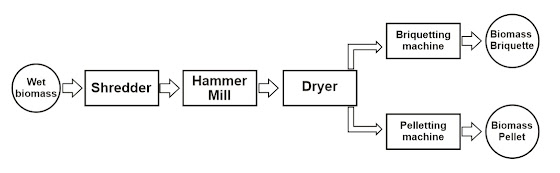
Young coconut waste can be processed into briquettes or pellets. Biomass densification technology is suitable for application as a solution for young coconut waste. The young coconut waste needs to be reduced in size (size reduction), namely with a shredder and hammer mill, then dried with a dryer before being compacted / densified into briquettes with a briquetting machine or into pellets with a pelletiser (pelleting machine). By briquetting or pelletizing the waste, it can be used as fuel or energy source for SMEs or boilers in industry. Many SMEs or processing industries can use this fuel. Apart from being environmentally friendly, it is also easy to use. Simple furnaces can be developed to use these briquettes and pellets.

Indonesia is famous for its seductive land of coconut islands. This is because the extent of coconut plantations in Indonesia reaches around 3.7 million hectares, most of which are smallholder plantations. The extent of these coconut plantations places Indonesia as the owner of the largest coconut plantations in the world. Coconut trees mainly grow along the coast, and indeed Indonesia also has the second longest coastline in the world, after Canada.

Saturday, February 17, 2024

Future Palm Oil Mill: Producer of CPO, Biochar and Hydrogen at the Same Time

Efficiency factors, optimizing potential and improving climate should be implemented simultaneously in the palm oil industry. This can be done by replacing the combustion furnace in the boiler with pyrolysis so that the boiler fuel is mainly biooil, a pyrolysis by-product, with the main product being biochar and building a biogas unit for hydrogen production as the final product. Biochar will be used as a soil amendment together with fertilizer so that it becomes slow release fertilizer, so that fertilizer use efficiency (NUE: nutrient use efficiency) increases. The use of biochar as carbon sequestration, namely by using it together with fertilizer, will also provide additional income from carbon credits. Acid soil or dry soil will have better fertility with the application of biochar.

Furthermore, liquid waste or POME (palm oil mill effluent) is used as raw material for biogas. With the main component of biogas being methane (CH4), with steam reforming the methane will react with steam at a temperature of 700-1100 C with a nickel catalyst to become hydrogen/H2 and carbon monoxide/CO. To maximize hydrogen H2 production, the resulting carbon monoxide / CO is then subjected to a shift reaction, resulting in hydrogen / H2 and carbon dioxide / CO2 products. The reaction runs at a temperature of 400-500 C or at a lower temperature, namely 200-400 C. At higher temperatures the shift reaction usually uses an iron oxide or chromium catalyst, while at lower temperatures the catalysts usually used are copper, zinc oxide and alumina. , which helps reduce CO concentrations to below 1%.

Wednesday, May 26, 2021

The Urgency of Biochar Application on Palm Oil Plantations in Indonesia

The large number of acidic soils in Indonesia that are used for palm oil plantations makes the productivity of palm oil fruit or the resulting FFB (fresh fruit bunch) not optimal. The acid soil covers the largest dryland area in Indonesia. It occupies approximately 55% of the total land area (191.09 million ha) in Indonesia. About 107.36 million ha of all Indonesian acid soils is classified as dryland acid soils and the rest (14.93 million ha) as peat soil. Acid soils in Indonesia are distributed amongst the big islands, such as Kalimantan (39.42%), Sumatera (28.81%), Papua (18.03%), Java (7.77%), and Sulawesi (6.95%). Acidic soils with low pH make nutrient absorption low in plants and so do soil microbial activity, which plays a large role in soil fertility. This condition should not be ignored because besides making the cultivation of palm oil plantations not optimal, there will also be a lot of fertilizer used. This makes the operational costs of  palm oil plantation operation high. Biochar is a biomass pyrolysis product that is effective and efficient in overcoming these problems. With the abundant amount of biomass waste produced by palm oil mills or CPO mills as biochar raw materials, efforts to improve the quality of plantation soil should be easy to do and have even become the operational standard for these plantations. But the fact is not.


Why hasn't biochar been used to improve soil quality and thus increase the production of palm oil fruit or FFB? The lack of information and education about the benefits and uses of biochar are the main factor. This of course makes the application of biochar in palm oil plantations not yet done even though palm oil mills have abundant biomass waste such as empty palm fruit bunches (EFB) and fiber which are generally not used and cause environmental problems. The priority for processing EFB compared to other products such as EFB pellets or compost also needs separate considerations. The best choice, of course, is based on a comprehensive study according to the characteristics of the business or business will be built. Consider not only short-term economic benefits, but also environmental and long-term benefits is an important thing.


Quantitatively, an increase in the production of palm oil fruit or FFB, an increase of at least 20% with the application of biochar is something that is normal. And a 20% increase in fruit production will also result in a big profit. Productivity of a number of other agricultural commodities can be increased by 30%, 40% or even more than 100%. The low productivity of palm oil fruit in Indonesia can be increased by the application of biochar, which is particularly effective in improving the soil quality in the palm oil plantations. Moreover, about 80% of the components of the cost of producing crude palm oil (CPO) come from the plantations, and 20% in the processing sector (palm oil mills). The operational costs of palm oil mill plantations, especially fertilizers, can also be reduced by the use of biochar. The priority of liquid biofuel development will also get better if the volume of biofuel raw materials such as CPO increases. This shows the strategic role of biochar. Apart from that from the aspect of climate change, biochar will also absorb CO2 concentrations in the atmosphere or reduce the concentration of greenhouse gases, as a solution to today's world problems. 

 
Meanwhile, from the side of the palm oil mill, another advantage obtained from biochar production is the use of excess energy from the pyrolysis process or the production of biochar as an energy source for the boiler. Boiler feed water (BFW) will also be preheated twice when it is used for cooling in the pyrolysis condenser and then the economizer on the boiler. In this way, the energy needed by the boiler decreases. When the boiler energy source uses the energy source from pyrolysis, this means that the palm kernel shell (PKS) can be taken and used for other things and can even be sold directly for local and export markets. The main obstacle to business development in the palm oil industry is the availability of energy source namely electricity. If the energy source is available, the development of palm oil-based businesses is very open and varied, such as the production of CPO derivatives, palm kernel shell processing, PKO production, PKO derivative production, biomass power plants and so on.

Sunday, March 14, 2021

Benefits of Palm Oil Company When Produce Biochar

There are at least four things that become motivation for biochar production, namely as in the chart above. There are a number of slices that make the impact of biochar application multi-benefits, which is very much in line with today's world problems, namely climate change and global warming. Biochar has also been accepted as an instrument to reduce the concentration of CO2 in the atmosphere which causes the two big problems above, namely in 2018 biochar was included in the Intergovermental Panel on Climate Change (IPCC) as one of the negative emissions technologies (NETs). Biochar application is a carbon negative scenario because biochar can absorb CO2 from the atmosphere. This is slightly different from the use of biomass fuels such as wood pellets, wood briquette and palm kernel shell (PKS) in industrial boilers or power plants, which are carbon neutral scenarios. Indeed, basically there are 3 big scenarios to reduce the concentration of CO2 in the atmosphere, namely increasing the efficiency of equipment that uses fossil fuels, using carbon neutral fuels and carbon negative scenarios such as biochar.


Palm oil trees are known to require a lot of water and fertilizer to maintain the life sustainability and productivity of their fruit, so practical efforts in the form of increasing fertilizer nutrient efficiency and increasing fruit productivity are important. Besides that, palm oil mills produce a lot of biomass waste, especially empty fruit bunches (EFB ) and mesocarp fiber, which are very potential for biochar raw materials. The biochar is then applied in palm oil plantations which can be used with chemical fertilizers or with compost / organic fertilizers.


Pyrolysis and gasification technologies are commonly used for the production of the biochar. Apart from producing biochar by pyrolysis or gasification, energy is also produced which can be used for the business development of the palm oil industry or for electricity production. Production of PKO (Palm kernel oil) from kernel processing at KCP (kernel crushing plant) or production of torrefied PKS from PKS processing with torrefaction can be done by utilizing excess energy from the production of biochar. Most of the palm oil mills or CPO mills do not have kernel processing or KCP to produce PKO. And by making torrefied PKS, the caloric value of PKS will increase, it is easy to downsizing (increased grindability), for example in the use of cofiring and does not absorb water (hydrophobic property). In general, palm oil mills will have many advantages, both economically / financially and environmentally, with this biochar production.

Apart from being used for business development like the diagram above, excess energy from pyrolysis or gasification can also be used as boiler fuel in the palm oil mill. In this way the energy to heat the boiler, which is usually with palm kernel shell and mesocarp fiber, can be replaced by energy from pyrolysis or gasification. After that, all of the palm kernel shells / PKS can be sold or exported, thus providing additional profits for the palm oil company. The need for biomass fuel, especially palm kernel shell / PKS, is predicted to increase, both in the domestic market and in the export market. Japan is currently the largest consumer or user of palm kernel shells and it is predicted that the demand will also increase. Japan will also impose stricter standards on imports of palm kernel shells to ensure environmental sustainability by applying the GGL (Green Gold Label) certification which will be effective starting April 2023. This is like the wood pellets with FSC certification. If anyone is interested in an economic analysis of the use of biochar in palm oil business, please contact us.

Saturday, September 26, 2020

When Choosing Wood Briquette Production Over Wood Pellet

 Wood pellets are projected to have a bright future because their needs are increasing all the time. The need for environmental programs to overcome climate change and global warming with carbon neutral fuels such as wood pellets is increasing. The use of wood pellets is mainly for power plants, both with cofiring and 100% (fulfiring) using wood pellets. 60% of the power plants in the world are coal power plants which are positive carbon fuels, thus increasing the concentration of greenhouse gases (CO2) in the atmosphere, so that CO2 emissions need to be reduced. The need for wood pellets with a large volume with an average of 10 thousand tons per export shipment and continuous means that not many can play for the production of wood pellets, because of the large raw materials needed, the large plant capacity, big investment and so on.

Screw and mechanical press type briquette


Hydraulic type briquette

Wood briquette is an attractive alternative for the utilization of wood wastes with a limited volume, a smaller plant capacity and so on. Wood briquette users are also different from wood pellets. Wood briquette is used mainly for heating stoves during winter in 4 seasons countries or for fueling industrial boilers. Apart from that, technology and products are also more varied than wood pellets. The briquette machine is simpler and easier to operate. The briquette machine can also handle a wider variety of raw materials, larger particle sizes, higher ash content and lower production costs. Wood Briquette technology can be grouped into 3 as follows:

Mechanical Press Briquette Machine

1. Mechanical Press

The mechanical briquette press is made like an eccentric press, and has a very simple design. The continuously rotating eccentric, connected to the piston, presses the raw material through a conical die system, where the briquettes are being formed. The large flywheel ensures extremely quiet and balanced operation. The press operates at 270 strokes per minute. The briquettes are cooled and hardened in one cooling line, which also functions as a briquette conveyor. The briquetting press is fully automatic, providing smooth operation with minimal maintenance and service. The rugged design ensures long service life and the briquetting press can operate up to 7,000 to 8,000 hours per year (583 - 667 hours per month or  20 - 22 hours per day).

The main advantage of the mechanical briquette machine is that the press can be used both for the production of briquettes for household use (consumer briquette) and also for industrial briquettes for boilers (industrial briquette). Industrial briquettes can be made as short pieces, or at random lengths or cut to a specified length. Other advantages are high capacity, low production cost, and adjustable density.

2. Hydraulic Press

In a hydraulic press, the raw material is pressed into the compression chamber at a certain rate. Inside the chamber, an appropriate amount of material is compressed or pressed with a piston. The main piston transfers the raw material into the mold forming briquettes to the required final condition and density.

The hydraulic press compression process is relatively slow. The compression cycle can be between six and 25 cycles per minute, depending on the amount loaded or the density of the briquettes. Hydraulic briquette machines are usually small in size, with capacities ranging from 50 kg / hr to 200 kg / hr. Round briquettes, with a diameter of 50 mm to 75 mm. However, at present, hydraulic briquettes can be made mainly in rectangular shapes with a capacity of up to 1.5 tons per hour. The traditional size is 150 x 60 mm, but larger briquettes can also be made.

 3. Screw Extruder Press

In the extruder press, the raw material is fed into the chamber with a screw feed. The raw material is screwed into a cone mold and an extension mold. The compression screw is conical. The screw operates at approximately 800 revolutions per minute, and during this process high heat - up to 300 degrees Celsius - is generated in a combination of friction and molding system heating. This briquette output has a hole in the middle and can be carbonized so that it becomes a product known as sawdust charcoal briquette.


For those who are interested in producing the wood briquette, we can help provide the machine and help with the marketing of the briquette products or please send an email to eko.sbs@gmail.com

Biomass Boiler Testing and Selection of Suitable Biomass Fuel

In line with the trends toward decarbonization and sustainability across various sectors of life, particularly in the processing industries ...