Showing posts with label gasification. Show all posts

Sunday, June 15, 2025

Optimization of Palm Oil Mill Operations to Maximize Profits by Utilizing EFB Waste

As a profit-oriented company, palm oil companies will also do various things necessary to maximize their profits, both in the operations of their palm oil mills and on their plantations. The more efficient the operations of the palm oil mill, as well as on its plantations, the higher the profits obtained. Minimizing the environmental impact of waste produced, even zero waste, and becoming part of responsible and sustainable environmental management practices, including part of climate solutions, are important parts of this industry that cannot be abandoned. That is why palm oil mills must innovate to achieve optimal conditions. To achieve these conditions, it can be done by evaluating current practices and finding better solutions.

CPO (crude palm oil production) requires steam for the sterilization process. This is why palm oil mills definitely need boilers for their production process, for more details read here. Steam from the boiler is also used for power generation with steam turbines to drive generators. The operation of the boiler is generally carried out by burning fiber (mesocarp fiber) and some palm kernel shells / PKS, so that some palm kernel shells /PKS can still be sold or even exported. This common practice in palm oil mills has also been running for decades, but it turns out that there is still a lot of biomass waste from palm oil mills that has not been utilized, especially empty fruit bunches or EFB (empty fruit bunches) which account for around 23% of the fresh fruit bunches (FFB) processed. These EFBs are usually only piled up behind the palm oil mill and tend to pollute the environment.

The EFB can be processed into biochar. Biochar production with thermal processes, either pyrolysis or gasification, will produce energy as cogeneration in palm oil mills. Cogeneration is the right solution for biochar production while supplying energy needs for boiler operations. In this way, 100% of palm kernel shells / PKS can be sold or even exported, meaning that palm oil companies' profits are greater. But to maximize biochar production, pyrolysis is the right choice. This is because gasification technology is to maximize gas products while pyrolysis is to maximize solid products (biochar). By-products from pyrolysis are also beneficial for the palm oil industry.

Empty fruit bunches (EFB) are solid waste from palm oil or CPO production which is the largest in number. This is what makes many machine manufacturers make these EFB processing machines. Most of the machines made are equipments for cutting and pressing the EFB so that the water content decreases and the material size becomes smaller. However, both the water content and the size of the EFB as the output of the machine or equipment still do not meet the requirements to be further processed into biochar. The typical output is more than 4 inches and the water content is more than 45%. EFB must have a low water content of 10% and can be less than 1 inch for biochar production or as fuel in the boiler.


To obtain the EFB with a dryness level or water content of 10%, waste heat recovery from palm oil mills can be utilized for the drying process. Other biomass waste from the palm oil industry can be utilized as fuel or a source of heat energy for drying the EFB. By utilizing these biomass wastes, mill operations can be more efficient so that profits are maximized and environmentally friendly with zero waste. 

Friday, June 21, 2024

Why is There No Biochar Production for The Palm Oil Industry Yet?

Even though biomass waste is abundant in the palm oil industry, both in the plantation area and in the palm oil mill area, most of the biomass waste, especially empty fruit bunches or EFB, is still not utilized or is simply piled up or thrown away. In fact, if the palm oil industry has a strong vision about maximizing profits by minimizing the occurrence of waste, especially biomass, and maximizing environmental sustainability as well as being part of the climate solution, then biomass waste, especially empty fruit bunches or EFB, is a big opportunity.  Currently, special department in the palm oil industry that specifically deal with sustainability issues are starting to be created by palm oil companies. Waste management issues including the utilization of EFB, reducing soil and water pollution due to fertilizers and increasing fertilizer efficiency are the concerns of the sustainability department.

The empty fruit bunches or EFB can be used as fuel so that most or all of the palm kernel shells or PKS can be sold directly and even exported. Palm oil mill boiler fuel currently uses fuel in the form of palm fiber (mesocarp fiber) and some palm kernel shells / PKS, which can be replaced using empty fruit bunches (EFB) and palm fiber (mesocarp fiber) and without palm kernel shells / PKS. Palm kernel shells / PKS are a very popular biomass fuel in the global market that competes fiercely with wood pellets. By being able to sell all palm kernel shells / PKS and at the same time utilize empty fruit bunch / EFB waste, the palm oil industry will provide many economic benefits.

The use of empty fruit bunches / EFB and mesocarp fiber as a heat source for the boiler is not burned as usual or as is done by all palm oil mills today but must be gasified or pyrolyzed so that another product is produced in the form of biochar. Although gasification can be used to produce biochar, pyrolysis is more recommended because the quality and quantity of biochar will be better. The biochar can later be used for the palm oil plantation itself. The use of biochar in palm oil plantations will significantly save on fertilizer use as well as reducing water and soil pollution due to inefficient use of fertilizer. The biggest cost in operating a palm oil plantation is fertilizer, so by using biochar these operational costs can automatically be reduced. Biochar will become a slow release agent so that fertilizer use will be more efficient or increase NUE (Nutrients Use Efficiency).

Empty fruit bunches / EFB and mesocarp fiber are solid waste from palm oil mills so the waste is located around the palm oil mill, while biochar is used for palm oil plantations. In palm oil companies, management is generally separated between the plantation and mill departments. The use of biochar in palm oil plantations while the raw material comes from palm oil mills requires special arrangements regarding this matter. This could be, for example, trucks transporting fresh fruit bunch / FFB from the plantation to the palm oil mill, then after the FFB is unloaded at the mill, they then go to the plantation again carrying biochar from the palm oil mill.

Currently, no one is utilizing empty fruit bunches / EFB and palm mesocarp fiber as a source of boiler heat and biochar production. The main factor causing this is the main orientation or vision of the palm oil company itself as described above. This is predicted to change soon as awareness of climate issues increases and reaches all levels, especially in sectors related to energy and sustainibility. Moreover, when biochar is applied to plantation land, it also gets carbon credit as carbon sequestration. The smoke coming out of the boiler furnace will also be cleaner as seen from its opacity. The use of gas and liquid fuels from pyrolysis by-products will produce better combustion quality as well as smoke from the chimney. And even the liquid products from pyrolysis can also be used as biopesticides and organic fertilizers. Boiler efficiency will also increase because it uses boiler feed water (BFW) in the form of hot water from the condenser output of the pyrolysis unit.

Apart from old palm oil mills which really want to upgrade their industrial energy systems and fertilizer efficiency in their plantations including sustaibility according to this vision, new palm oil mills whose status is in the development stage should be able to apply this concept more easily. New palm oil mills can immediately follow developments and demands of the times so that they become trend setters with this vision. Being a pioneer and trend setter is indeed more difficult and even risky than just being a follower, but this will raise the reputation and become a leader in the industry so it should also have a positive impact on the company's business performance. A worthy effort.

Friday, February 9, 2024

Size Reduction: Shredder or Chipper ?

There are many biomass processings that require size reduction. With this size reduction, the biomass raw material has a smaller and more uniform size and shape, making the follow-up process easier. After reducing the size, the surface area or contact area becomes larger so that the drying process will be more efficient, especially in continuous drying. The small and uniform size also makes handling easier. Size reduction is usually used in the initial / pretreatment process before the main / core process of processing a biomass.

Biomass, especially from plants, also has various shapes and sizes. This greatly influences the size reduction equipment used. Fibrous biomass such as coconut fiber or empty oil palm fruit bunches will be more effectively and efficiently reduced in size with a shredder rather than a chipper. This is because the fiber dominant and tenacious structure is easier to tear or shred and crush than to cut into pieces like using a knife.

Meanwhile, woody biomass has hard, brittle characteristics and an elongated shape, so the use of a chipper is more effective and efficient compared to a shredder. The character of the wood is easier to cut with equipment such as a knife for size reduction. The output or product from the shredder and chipper is also different in terms of size and shape. The wood produced from the chipper machine is usually called wood chips and looks like chopped wood, while the output from the shredder is in the form of shreds.

Biomass processing products into energy, namely by compaction (densification) into pellets or briquettes, as well as thermochemical routes such as pyrolysis, gasification and combustion are widely used today. If the size and shape of the biomass from the size reduction equipment is suitable, it can be used immediately. However, if the shape and size are not suitable then it is necessary to continue with the next size reduction stage, namely using a hammer mill so that a biomass product is obtained that can be the size of sawdust. In the production of pellets and briquettes, the biomass particle size needs to be made as small as the sawdust, so that compaction (densification) is optimal. Meanwhile, in the thermochemical process, the size of the biomass becomes small particles such as sawdust, usually for equipment that carries out fluidization, for example fluidized bed combustion.

Wednesday, December 14, 2022

Palm Oil Mill Redesign for IVO Production: Using Pyrolysis, Gasification or Biogas?

The production of biodiesel / green diesel using raw material of RBD PO is too good (overspec) and too expensive, so it needs to be replaced with a cheaper raw material, namely IVO (industrial vegetable oil). For this purpose, it is necessary to redesign the palm oil mill so that a number of FFB extraction production into CPO carried out at the palm oil mill need to modify the process flow. The sterilization process can be eliminated so that there is no need for water for steam production as well as boilers and steam turbines for electricity production. Water treatment units may also be no longer needed or may still be needed but for different processes.

Another important thing is the supply of energy, especially electricity, for this new type of palm oil mill. This is because most of the equipments used in the palm oil mill are mechanical equipments that work by consuming electricity. As the mill that has a lot of biomass waste, it's certainly not a difficult thing to do, even so far, palm oil mills produce their own electricity by burning palm mesocarp fiber and palm kernel shell in the boiler. But in a new type of palm oil mill with a different configuration, the boiler may not be needed or it is still needed but there are differences from before. Basically, of course, how to achieve the highest level of efficiency with the new process.

Another factor is how the new production process also provides greater benefits for the palm oil industry, for example biochar products are also produced. The biochar product will later be used in palm oil plantations to improve soil fertility and also as a carbon sink and absorb N2O gas, which is a greenhouse gas. Carbon credits from the application of biochar as a carbon sink will also provide additional income for the palm oil industry, which is also not a small amount. Currently, many palm oil plantations are located on acid soils or with low pH, which results in low productivity of palm oil yield, so it needs to be increased. Also, in the operation of palm oil plantations, the cost of fertilizer is the highest cost component, and for this reason, biochar is the solution to this problem. With the high productivity of FFB with this treatment, the clearing of palm oil land is no longer needed, so that the focus on palm oil plantations which causes deforestation is also reduced, more info read here.

For electricity production, apart from burning palm nesocarp fiber and palm kernel shell in the boiler, then the resulting steam drives a steam turbine, another way is pyrolysis and gasification of biomass. With pyrolysis (slow pyrolysis) more biochar production or as the main product. Whereas with gasification the product of biochar is less with more main gas product. Biogas from liquid waste (POME) is another energy source that can be used. Basically it depends on the goals and needs, how much electricity is needed, how much biochar is needed and so on. But with the area of palm oil plantations reaching tens of thousands of hectares, the need for biochar will be very large, so pyrolysis will be more suitable to be applied. And if the demand for electricity is large enough, then electricity from biogas can also be used as an addition to electricity from pyrolysis. 

Even with this pyrolysis, other useful products for palm oil plantations will also be produced, such as liquid smoke. This liquid smoke can be used as a biopesticide whose application can use agricultural drones at speeds of 16 hectares/hour or more. Biooil products from pyrolysis can also be used for direct fuel using a burner or further refined to become vehicle fuel. Burning gas or liquid fuels will give cleaner emissions to palm oil mills compared to burning solid fuel that has been done so far.

Digestate from biogas can be used together with biochar so that it can provide maximum results in palm oil plantations. With a porous biochar structure, digestate plus biochar will become a slow release organic fertilizer so that fertilizer use will be more efficient. Apart from that, with the large amount of potential for biomass waste in the palm oil industry, it also allows for a number of business developments, especially if there is an adequate supply of energy. An example is the production of activated carbon from palm kernel shells (PKS) or the processing of kernels into kernel oil (crude palm kernel oil). By optimizing all the potential, especially biomass waste so that it can provide economic and environmental benefits, the palm oil industry will be even more attractive.

Sunday, March 14, 2021

Benefits of Palm Oil Company When Produce Biochar

There are at least four things that become motivation for biochar production, namely as in the chart above. There are a number of slices that make the impact of biochar application multi-benefits, which is very much in line with today's world problems, namely climate change and global warming. Biochar has also been accepted as an instrument to reduce the concentration of CO2 in the atmosphere which causes the two big problems above, namely in 2018 biochar was included in the Intergovermental Panel on Climate Change (IPCC) as one of the negative emissions technologies (NETs). Biochar application is a carbon negative scenario because biochar can absorb CO2 from the atmosphere. This is slightly different from the use of biomass fuels such as wood pellets, wood briquette and palm kernel shell (PKS) in industrial boilers or power plants, which are carbon neutral scenarios. Indeed, basically there are 3 big scenarios to reduce the concentration of CO2 in the atmosphere, namely increasing the efficiency of equipment that uses fossil fuels, using carbon neutral fuels and carbon negative scenarios such as biochar.


Palm oil trees are known to require a lot of water and fertilizer to maintain the life sustainability and productivity of their fruit, so practical efforts in the form of increasing fertilizer nutrient efficiency and increasing fruit productivity are important. Besides that, palm oil mills produce a lot of biomass waste, especially empty fruit bunches (EFB ) and mesocarp fiber, which are very potential for biochar raw materials. The biochar is then applied in palm oil plantations which can be used with chemical fertilizers or with compost / organic fertilizers.


Pyrolysis and gasification technologies are commonly used for the production of the biochar. Apart from producing biochar by pyrolysis or gasification, energy is also produced which can be used for the business development of the palm oil industry or for electricity production. Production of PKO (Palm kernel oil) from kernel processing at KCP (kernel crushing plant) or production of torrefied PKS from PKS processing with torrefaction can be done by utilizing excess energy from the production of biochar. Most of the palm oil mills or CPO mills do not have kernel processing or KCP to produce PKO. And by making torrefied PKS, the caloric value of PKS will increase, it is easy to downsizing (increased grindability), for example in the use of cofiring and does not absorb water (hydrophobic property). In general, palm oil mills will have many advantages, both economically / financially and environmentally, with this biochar production.

Apart from being used for business development like the diagram above, excess energy from pyrolysis or gasification can also be used as boiler fuel in the palm oil mill. In this way the energy to heat the boiler, which is usually with palm kernel shell and mesocarp fiber, can be replaced by energy from pyrolysis or gasification. After that, all of the palm kernel shells / PKS can be sold or exported, thus providing additional profits for the palm oil company. The need for biomass fuel, especially palm kernel shell / PKS, is predicted to increase, both in the domestic market and in the export market. Japan is currently the largest consumer or user of palm kernel shells and it is predicted that the demand will also increase. Japan will also impose stricter standards on imports of palm kernel shells to ensure environmental sustainability by applying the GGL (Green Gold Label) certification which will be effective starting April 2023. This is like the wood pellets with FSC certification. If anyone is interested in an economic analysis of the use of biochar in palm oil business, please contact us.

Wednesday, May 23, 2018

See Modern Charcoal Production Today

More specifically than the use of charcoal in general, the agricultural world, especially organic farming has become one of the current users of charcoal. Charcoal in the agricultural world or commonly known as biochar is widely used because it can withstand nutrients or fertilizers from leaching so that it is widely used for the manufacture of slow release fertilizer, then the pores in the char also become the home of microbes that break down various organic materials become fertilizer to the plant, the pores also improve the physical structure of the soil. In addition, biochar can also keep the soil moisture because water is also easily absorbed in the structure of the pores. Biochar also increases soil pH, is also able to absorb carbon dioxide (CO2) from the atmosphere (carbon negative scenario), and can last up to tens or even hundreds of years in the soil. These are the things that encourage the use of biochar in the agricultural world, which in short can increase agricultural productivity or help improve the world food products.

The role of biochar in some ways can indeed be substituted with other materials, for example for the ability to retain water, cocopeat is better than biochar, for the surface area with the number of pores the activated charcoal is much larger than the biochar, and to raise the pH for the soils acid then dolomite lime better. In an application in the field of planting media engineering to obtain the best agricultural media is very likely use a number of materials mentioned above. Optimal results can be obtained based on soil characteristics and plant species. Economic factors are also an important consideration factor after the above technical aspects.
Modern biochar production currently uses thermochemical processes continuously. There are two thermochemical technologies for biochar production namely pyrolysis and gasification. Pyrolysis technology is more widely used because it produces more biochar and better quality. Why with pyrolysis can get 2 things? This is because basically (slow) pyrolysis is a technology used for the production of charcoal or maximizes its solid product, so the process control is also designed for that purpose. While the gasification is designed to maximize its gas product, so the char is only positioned as a by-product. The operating temperature of gasification is also higher (800 C) than pyrolysis (450 C) so that the char is also mixed with ash.
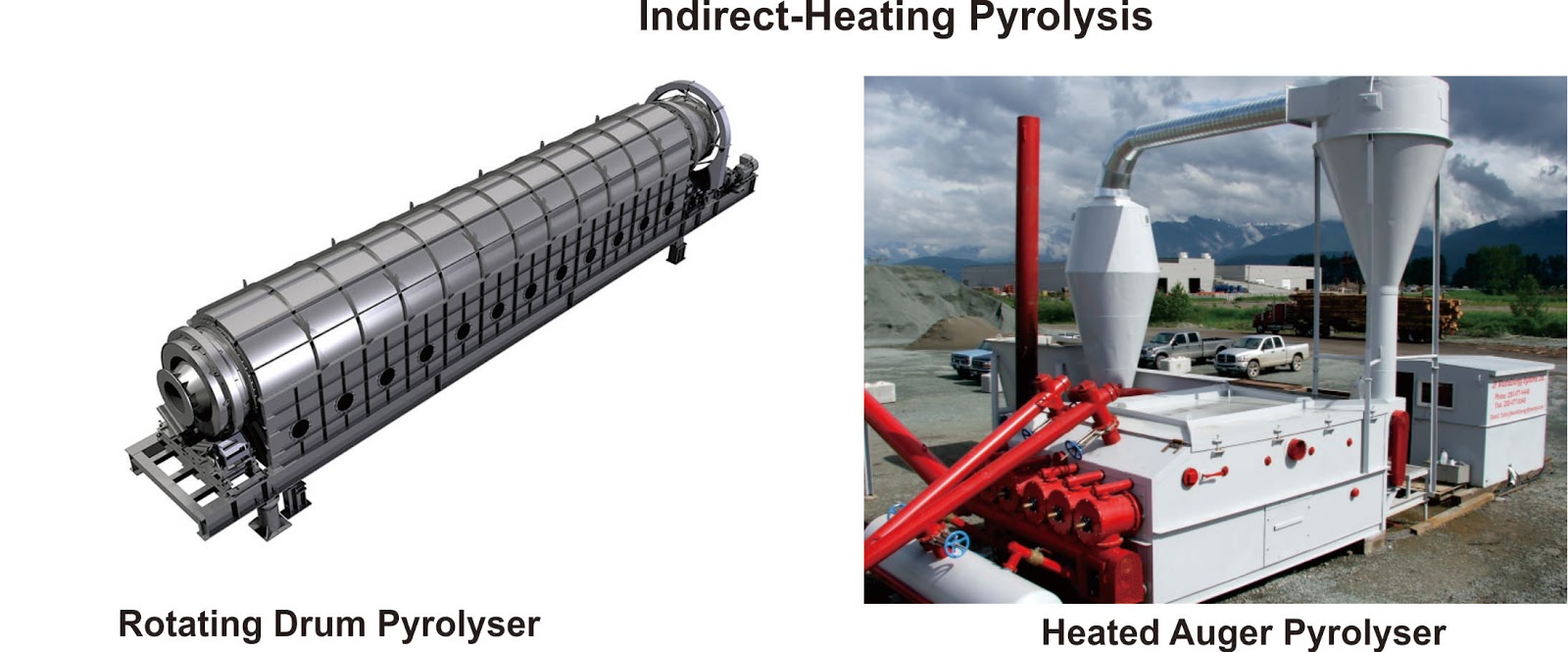
More specifically the indirect heating pyrolysis technology is more widely used for biochar production today. With this technology the pyrolysis process control is easier and the charcoal quality is also better. Application of indirect heating pyrolysis technology for continuous process generally use rotating drum and heated auger type. Biochar production capacity is generally in the range of 2-4 tons / hour. The byproducts of the pyrolysis process are also of high economic value such as bio-oil for fuel, pyroligneous acid (liquid smoke) for fertilizer and biopesticide, as well as syngas for fuel and more specifically for electricity production.

Friday, December 15, 2017

Improving Dryer Efficiency At Wood Pellet And Wood Briquette Factories

Rotary dryer or drum dryer is a common type of dryer used in the biomass industry namely wood pellet and woodbriquette factories. The advantages of rotary dryer due to the construction is simple, easy in operation and the drying capacity is quite large. There are two important points to consider in the use of a rotary dryer dryer: 1. Heat flow pattern, single pass or triple pass drum; 2. Type of equipment for emission control, such as multiple cyclone systems or other types. Both of these will affect the dryer efficiency as well as the environmental aspects. In practice in Indonesia almost all rotary dryers use single pass with a co-current with material to be dried. Multi-cyclone with cyclone also serves as a temporary storage is also widely encountered.

Side of other efficiencies that can be improved that is on the heating media. This is because the fuel consumption for drying is costly. Currently the rotary or drum dryer drying process that operates by direct-contact between the flue gas heat with the dried material such as sawdust. The flue gas usually comes from burning wood waste as well. If the plant site contains bulk materials such as rice husks, peanut shells, palm shells, cashew shells and so on, improve efficiency with gasification technology can be done. The trick is to replace the flue gas burning furnace with gasifier or from the beginning has designed a rotary dryer with a gasifier as a heat generator. An increase of efficiency by 20% can be achieved by using the gasifier.

Heat gasifier type downdraft and work continuously will be suitable for the heat source. This is because the heat gasifier does not require a complicated syngas cleaning unit and with the downdraft type syngas will be cleaner because the resulting tar is much less than the updraft type.

Reject (Non-Standard) Coconut Fruit for Bioavtur / SAF Production

The international civil aviation organization (ICAO) has included non-standard coconuts on the ICAO positive list – ICAO document – ​​CORSIA...