Showing posts with label woody biomass. Show all posts

Monday, October 20, 2025

Green Aluminum and the Role of Biomass-Based Energy

The need for aluminum is predicted to increase, including in the construction, transportation (including aircraft), automotive, household appliances, and electronic equipment sectors. Green aluminum production from bauxite mining, then processed into alumina as an intermediate product from bauxite refining and into the final product in the form of aluminum, is very ideal. Aluminum production, especially from the processing of alumina into aluminum, requires very large electrical energy. For the production of around 300,000 tons/year of aluminum, approximately 1 GW (1,000 MW) of electrical energy is needed. To meet these electrical energy needs, very large power plants need to be built. And if using fossil-based energy sources, especially coal, the need will be very large.

PT Inalum in North Sumatra is an example of green aluminum production in the production of aluminum from alumina. This is because the aluminum production from alumina uses energy from hydroelectric power plants (PLTA) to meet its electricity needs. However, for more than 40 years, the aluminum plant has imported millions of tons of alumina as its raw material. And once the alumina plant from bauxite in Mempawah, West Kalimantan, is operational, the majority of the alumina used as PT Inalum's raw material will be supplied from the alumina plant in Mempawah, West Kalimantan. Approximately 1 million tons of alumina will be produced from the alumina plant in Mempawah, West Kalimantan, or more than 80% of PT Inalum's alumina needs in North Sumatra.

Alumina production from bauxite also requires significant electrical energy, necessitating a power plant capable of meeting the plant's operational needs. Most alumina plants still rely on fossil fuels for electricity production. For decarbonization efforts, renewable energy sources, such as biomass-based wood pellets, are feasible. Wood pellets can be used with a gradual cofiring ratio, ultimately leading to full-firing, or 100% use of wood pellets or other biomass-based energy.


The demand for renewable energy, particularly biomass-based energy, is enormous and sustainable, necessitating biomass sources capable of meeting this demand. These biomass sources can be woody biomass or agricultural waste. Woody biomass sources include forestry waste, wood processing industry waste, and wood produced by energy plantations. Meanwhile, agricultural waste sources include agricultural and plantation waste, as well as agro-industrial waste. Sustainability certification also requires attention, and in the near future, it could become mandatory regarding the origin of biomass-based energy sources. 

Sunday, June 15, 2025

Wood Pellet Production, Solution to Urban Wood Biomass Waste Problems

Sorting is 50% of the solution to the problem of urban waste. The best sorting is at the location where the waste is generated, such as in households in housing or residential areas. With sorting, further waste processing will be much easier. The better the sorting is done, the easier the waste processing can be done. The reluctance of the community to sort waste makes the waste problem more complicated, prone to social conflict and protracted. Although difficult and complicated, cultivating waste sorting must continue to be done because if not handled it will become a serious environmental problem. The paradigm of waste processing also continues to change according to conditions, namely related to environmental impacts, availability of landfills, types and volumes of waste, as below.

If urban waste or MSW (municipal solid waste) can be sorted and processed properly, the environment will be clean and healthy. For example, such sorting is leaf waste made into compost, organic waste from the kitchen and leftover food for maggot feed or farming, wood waste in the form of twigs, pieces of wood and so on for wood pellet production, and plastic waste to be pyrolyzed into fuel or naphtha. And to be processed adequately, the volume of waste must also be sufficient and continuous. This is because the procurement of units for waste processing is also quite expensive. Waste processing should also be decentralized, so that it does not pile up in one place. The production capacity of the village or sub-district scale seems quite good and suitable for the manufacture of such waste processing units.

Among the urban waste is wood waste in the form of twigs, pieces of wood and so on that can be used for the production of wood pellets or wood pellets. The wood waste can come from pruning and felling trees, wood processing industry waste or wood that clogs waters such as rivers. The use of wood pellets or wood pellets can be for household cooking or SME industries. The use of wood pellets in addition to being a fuel or renewable energy that is environmentally friendly, easy to store and use and a solution to overcome biomass waste and reduce LPG imports which are worth around IDR 63.5 trillion each year.

Along with the innovation that continues to be done, wood pellet cooking stoves are becoming easier to use, efficient, clean and safe. For local governments, the production of wood pellets from wood waste also provides many benefits, namely as a solution to handling the waste, creating jobs and socializing the use of environmentally friendly renewable energy for the community. If this is successfully done, in the future the utilization of wood waste can continue to be developed.

Monday, August 12, 2024

Energy Plantations Energy Sources for All Time

 "Allah who makes fire for you from green wood, then you kindle (fire) from it." (QS. Yaasin (36): 80)

The sun was created by Allah SWT as the main source of energy for humans and living things on earth. It takes about 8 minutes for sunlight to reach the earth and is converted by plants into a food source so that it can be consumed by animals and humans. Humans also get food from animal sources. The more sunlight, the more can be converted by plants through the process of photosynthesis. Without the sun, plants die, animals die, humans die so that there will be no life on earth. Fossil fuels are essentially a source of energy from plants and animals in the past. Mining and use of fossil fuels will release a number of greenhouse gases (GHG) which increase the earth's temperature which at a certain level is dangerous for the earth's population itself. Efforts to overcome this are by using non-fossil energy and renewable energy so as not to contribute to increasing the concentration of GHG in the atmosphere which increases the earth's temperature.

From plants or trees can be directly used as a source of energy or fuel, namely firewood. Derivatives or energy products from plants are also very diverse and can meet all human needs, both energy in the form of solid fuels, liquid fuels and gas fuels. The production of firewood, wood chips, wood briquettes, sawdust, torrified biomass to charcoal are a number of solid fuel products. While the production of biooil, bioethanol, biodiesel, renewable diesel / green diesel, and bioavtur / bio jet fuel are a number of liquid fuels. And biogas and bio-syngas are gas fuels that can be produced from the original material in the form of plants.

A number of conversion techniques based on physics, chemistry and biology are needed for the conversion. The use of appropriate plant species is also needed to facilitate the conversion, for example for the production of solid fuels, biomass sources such as wood are needed, while if the target is liquid fuel, then the type of oil-producing plants that need to be pursued. Conversion from solid fuels to liquid or gas fuels can also be done but in general the longer and more complicated the process, the more expensive the production costs will be. But still, energy plantations are the basis for all of that.

Popular and fairly easy biomass processing is to make wood chips with size reduction then wood pellets and wood briquettes through biomass densification. Furthermore, to convert sugary biomass into ethanol with fermentation and azeotropic distillation, convert lignin biomass (lignocellulosic biomass) into ethanol with enzymatic hydrolysis reactions followed by fermentation and azeotropic distillation. Converting woody biomass into fuel with a thermal process can be burned directly or if you want to make charcoal, concentrate the fixed carbon, namely by pyrolysis or carbonization, and if you want to maximize liquid products / bio-oil / pyro-oil, namely by fast pyrolysis and if you want to maximize gas products, namely by gasification. And so that the characteristics of the biomass are like hydrophobic coal, the torrefaction or mild-pyrolysis process can be carried out. Torrefaction and densification are usually carried out together to optimize the biomass fuel product.

With gas to liquid (GTL) namely the gasification process and followed by the Fisher - Tropsch process, bio-ethanol, biodiesel and bioavtur / bio jet fuel can be produced. While from groups of plants that produce oil such as palm oil, biodiesel can be made especially with the transesterification or estran (esterification plus transesterification) process. Even used oil or used cooking oil / used cooking oil and miko (minyak kotor) / dirty oil or PAO (palm acid oil) can also be used for biodiesel / green diesel or further processed into bio-jet fuel / bio-avtur with the HVO / HEFA - SPK (Hydro-processed Esters and Fatty Acids-Synthesized Paraffinic Kerosene) process.

So basically, biomass from trees can be processed into various forms of energy or fuel needed by humans. In addition to being used directly as a heat source, this energy can also be converted into mechanical energy or electrical energy, for example biofuel-fueled vehicles to biomass power plants. So the source of energy throughout the ages stored in plants is this biomass as stated by Allah SWT in the verse above and there is no doubt whatsoever about it. Indonesia as a tropical country is a "heaven" for the production of biomass because of the rays of sunlight throughout the year and adequate rainfall and extensive land. The storage of energy in plants from sunlight is also likened to a battery that can be used anytime and anywhere for more details read here.

Another important thing to note for the creation of energy plantations or biomass plantations is the status of the land used. The land must not be from deforestation or land conversion (land use change) that damages the environment. Industrial plantation forests (HTI) that are in accordance with their designation can be used as energy plantations. In addition, biomass for producing energy can also be cultivated on critical land, or referred to as 'unproductive' land. The Indonesia Ministry of Environment and Forestry (KLHK) estimates that critical land in Indonesia in 2016 was 24.3 million hectares (Times Indonesia, 2017). This is a very large area, and overall Indonesia's territory is large enough to provide biomass for renewable energy production.

Thursday, August 5, 2021

Will Indonesia's Wood Pellet Production Beat Vietnam?

Vietnam's wood pellet production began in 2012 with a very small capacity of around 175 tons/year and now in 2021 or about 9 years later, its production has reached around 4.5 million tons/year, placing Vietnam in second place as the world's wood pellet producer after the United States. The total production of 4.5 million tons/year is supplied from 74 wood pellet factories in Vietnam. In 2020 exporting wood pellets of 3.2 million tons to Japan and Korea for power plants with an export value of close to USD 351 million. In addition to Korea and Japan, Vietnam's wood pellets are also exported to Europe.

Initially, Vietnam's wood pellet production used waste from the furniture industry. Furniture waste in the form of sawdust from the industry has dried and the particle size is suitable for wood pellet production, so equipments such as hammer mill and dryer are not needed. Many Vietnamese wood pellet factories at that time did not have the hammer mill or dryer. With raw materials that are ready to be pelleted, the cost of producing wood pellets is very cheap, plus labor costs are also cheap. But as the demand for furniture industry waste for wood pellet production is getting higher, the availability of these raw materials is getting scarcer, so that new wood pellet factories can no longer use these wastes. Other wood processing industry wastes such as sawmills and veneer factories also become raw materials. Furthermore, with the increase in wood pellet production, forest wood wastes and other logs become the next source of raw materials. This also makes production costs increase because they need equipments such as hammer mills and dryers so that the raw materials are ready to be pelletized.

Vietnam is the largest exporter of wood furniture to the United States, surpassing China. In 2020, Vietnam's wooden furniture exports to the United States reached more than USD 7.4 billion, an increase of 31% compared to 2019. Meanwhile, China exported wooden furniture worth USD 7.33 billion in 2020. Although the difference is only small, it proves about growth of Vietnam's growing wood furniture industry. Meanwhile, the export of Indonesian furniture and handicrafts according to HIMKI (Indonesian Furniture and Handicraft Industry Association) is estimated to reach USD 2.75 to 3 billion this year. According to Abdul Sobur, president of HIMKI, the furniture and handicraft industry is an important industrial sector and has become a pillar in the current pandemic era. With Indonesia's land area reaching 1.9 million square km or more than 5 times that of Vietnam, Indonesia's potency to develop the wood pellet industry is very potential for Indonesia. In addition to utilizing biomass waste from the furniture and handicraft industries, the wood processing industry, and forest wastes, energy plantations are also very potential to be developed in Indonesia. One of the advantages of Vietnam compared to Indonesia is its position which is closer to Korea and Japan so that the cost of transporting wood pellets to buyers or users is cheaper.

With this land area, Indonesia has the potential to develop energy plantations for massive wood pellet production. Even the energy plantation can be made from ex-coal mining land which covers an area of about 8 million hectares, for more details read here. Although currently Indonesia's wood pellet production is still around 100-200 thousand tons / year or like Vietnam’s wood pellet production in 2012 but with this huge potential, Indonesia's potential to become the world's main producer of wood pellets is also large, even becoming a leading country in energy use of biomass. The cofiring program at a number of coal powerplants in Indonesia also encourages the use of biomass energy, especially wood pellets. There are 114 coal powerplants units owned by PLN (Indonesia state owned electricity company) that have the potential for cofiring spread across 52 locations with a total capacity of 18,154 megawatts (MW) with a target for completion in 2024. Energy plantations in addition to supporting business & energy security, should also support the livestock sector, especially ruminants for more details read here, so that food security to achieve self-sufficiency in meat can be done. So can Indonesia surpass Vietnam's wood pellet production? Of course it can, but it takes a lot of extra efforts, and it takes a long time. But at least if Indonesia promotes its wood pellet production, there will be many benefits, including economic, social and environmental.

Tuesday, April 7, 2020

Debarking from Energy Plantation Wood, Is It Necessary?

Debarking machine
Wood pellet target market is an important thing that needs attention. If the power plant is the main market for wood pellets, the quality standard of wood pellet products follows the technology used by the power plant. Meanwhile, if wood pellets for households who want premium quality, wood pellets that are produced also follow these quality standards. The wood pellet market for electricity generation needs large, different from the wood pellet market for households that are sold in small packages or the retail market. Electricity generation technology also needs to be monitored so that all wood pellets produced can be absorbed. Pulverized and fluidized bed combustion technology is the technology most widely used for electricity generation. In pulverized combustion technology generally wood pellets cannot be used 100% (except with a number of modifications), while fluidized bed technology can use wood pellets or biomass pellets from various raw materials.
What is debarking? Why do need debarking? Debarking is the separation of bark from log, with the aim of reducing ash content. That means that if the ash content of the log with the bark can be accepted by the user, of course debarking is not necessary. For power plants usually can accept wood pellets up to 2% ash content for standard pellets and 6% for utility pellets. Meanwhile, if the user wants a wood pellet product with very low ash content, premium pellet (less than 1%), then debarking must be done. The wood species used also affects the ash content. Almost all energy plantations use fast rotation plants and coppice such as gliricidia with ash content of more than 1% so that it is more suitable for electricity generation and do not need debarking.

CFB Powerplant in Japan
Another thing to note is ash chemistry. The potassium and chlorine content in the ash is a critical point that needs attention. Fast rotation plants in general have a high potassium content than wood biomass in general. This makes the use of power plants in particular pulverized combustion increasingly limited to cofiring applications. Whereas in fluidized bed combustion because the operating temperature is lower then it can be tolerated and is considered not to cause problems. This means that wood pellets from energy plantation wood are compatible with biomass power plants with fluidized bed technology and can be used for cofiring with a certain percentage of pulverized combustion.

Sunday, June 2, 2019

Wood Waste of Replanting For Sawdust Charcoal Briquette Production

Palm Oil Trunk
Rubber Wood
At a certain age the trees on large plantations are no longer productive so they need to be replanted to maintain the sustainability of the plantation business. Two large plantation groups in Indonesia, which cover millions of hectares, are palm oil plantations and rubber plantations. Wood waste from the trunks of these trees can reach thousands or even millions of tons, and is generally not utilized. Indeed, there are uses of replanting wood waste for furniture, buildings and household appliances industries, but the portion is still very small so it cannot absorb the huge volume of wood. For example rubber wood can also be used for industrial furniture, wood and building wood, as well as palm oil logs. Even rubber wood is also used for making particle boards such as MDF (Medium Density Fibreboard) or HDF (High Density Fibreboard).

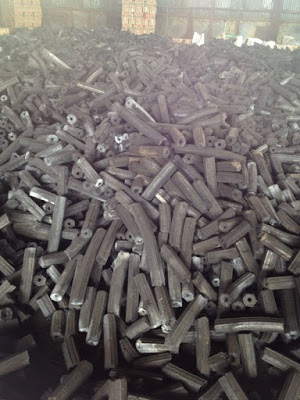
Sawdust Charcoal Briquette
Sawdust Briquette Charcoal in Carton Box
The utilization or processing of replanting wood waste for the production of wood charcoal briquette (sawdust charcoal briquette) is the right solution for this problem. Large market potential factors and product specification requirements that are not too difficult make this business attractive. In contrast to wood pellet products which are usually for power plants that require large volumes of supply and very strict specifications, so sawdust charcoal briquette products in addition to the volume of supply also do not have to be large and the specifications are more loose. This is because the use of sawdust charcoal briquette is for barbecue or more specifically mostly for roasting lamb meat in Saudi Arabia, the Middle East and Turkey. In wood pellets for electricity generation specifications are often difficult to fulfill, especially in the chemical aspects of ash such as chlorine, potassium and even sulfur, to be more clearly read here. Whereas in the production of sawdust charcoal briquette for chemical ash, the level of which is only ppm is not a problem at all.
Charcoal Briquette Production Route
Many people think that the production of sawdust briquette charcoal requires additional adhesives such as starch (tapioca), this is understandable because many people still do not know about the production process of the sawdust charcoal briquette. To produce charcoal briquettes in general, using charcoal raw material is then crushed into powder and added adhesive (such as starch) and then briquetted. The briquette product is then dried and packaged to be marketed. The production process of charcoal briquettes in this way is less good and less acceptable to the market. While the production process by means of the wood is crushed about the size of sawdust and then dried and then briquetted. The briquetting does not require adhesive because in wood there is always a lignin compound, which is useful as the adhesive. Furthermore, the briquettes are carbonized to increase fixed carbon and reduce volatile matter. Charcoal briquette products in this way, commonly called sawdust charcoal briquette, have better quality and are in demand by the market. The above scheme is enough to explain 2 routes of the production process of two types of charcoal briquettes.
Wood waste of replanting in time will also run out and be replaced by new plants. How can the sawdust charcoal briquette production business continue? A production unit certainly requires a supply of raw materials. To be able to continue to supply raw materials for production, one alternative is to make energy plantations. The energy plantations can be with fast rotation plants such as calliandra or gliricidae. To optimize woody biomass productivity and business, the energy plantation should be integrated with sheep, cattle and honey bee farms. And for more details can be read here.

Sunday, July 29, 2018

Set Up Wood Charcoal Briquette Production in ASEAN Countries

ASEAN countries have large forests and various forest resources. However, there is a decrease in some countries due to irregular logging in some countries. This is why sustainable forest management is needed to maintain the biomass of forest resources. Indonesia has the largest forest area, but has declined since 1990 primarily due to illegal logging and forest fires. Malaysia has the highest number of biomass and forest growth in area ratio, while Thailand is the lowest. This could also be due to higher rainfall in Malaysia compared to other ASEAN countries, which is 2,875 mm / year, with an world average of 900 mm / year and Indonesia 2700 mm / year. For more details can be seen in table below. Indonesia and Malaysia mainly produce sawn wood and plywood, while Thailand is wood chip and particle board. Vietnam produces many sawn wood, while Cambodia and Laos consume lots of logs as fuel.
Wood charcoal briquette or sawdust charcoal briquette have a very high market especially in Middle East, Saudi Arabia and Turkey. These countries use sawdust briquette charcoal to bake the meat, especially the lamb which is a favorite food there. The production of sawdust briquette charcoal uses logging residues and industrial wood residues. This should be the extent of forest and wood processing industries comparable to the sawdust briquette charcoal industry. The abundant logging wastes are usually the tops of small diameter trees and branches. The logging waste is about 100% average for the production of the logs themselves, so that the amount is huge. Sabah, Malaysia and Kalimantan, Indonesia produces many of these logging wastes at very cheap prices.
As for waste wood processing industry is usually in the form of sawdust, and wood pieces both board and round wood. It is estimated there are 1600 sawmills and 120 plywood factories in Indonesia. The raw materials of the plywood industry are originally from natural forest, but as demand continues to increase the supply of natural forest timber decrease so that it shifts with wood from the planted trees. When using wood from natural forest, the diameter of wood can be more than 70 cm and when using wood the trees planted wood diameter is only about 30 cm. Samarinda, East Kalimantan, Indonesia at first many plywood factories were operating but due to the declining timber supply of many of these factories which shut down production. The yield of plywood from raw materials is 50%, while the remainder becomes waste. Part of the waste is used for block board and packing material, but only about 10%, so 40% is still waste. 
While in Malaysia, the total volume of wood industry waste estimated 7.5 million cubic meters per year. The highest sawmill waste in Sabah, while plywood waste in Sarawak. Sawmill produces sawn wood products ranging from 40-65% and the remaining 35-60% are sawdust. While yield for ply wood ranged 50-60%, while 40-50% as waste. For the molding plant its yield is higher ie 70-74%, means waste 26-30%. Percentage of wood waste from 75% ply wood industry and 25% from saw mill industry. Utilization of wood industry waste is still not optimal, even just stockpiled and then burned because it is considered polluting the environment.

In Laos, there are about 200 wood processing factories (furniture, packing materials, flooring and doors) located mostly around Vientiane, the capital of Laos and only one plywood factory. Charcoal producers are scattered everywhere in the country due to high demand for households. The yield of the wood processing industry is about 60%, so that 40% is waste. Utilization of waste is also not optimal, such as sawdust just dumped just behind the saw mill.
Production of sawdust briquette charcoal (wood briquette charcoal) will be the solution for the utilization of such waste. Sawdust is the best raw material because it does not need size reduction and can be shorter production process. Whereas if the waste is still in the form of pieces of wood then it needs for size reduction first to the size of the particle like sawdust. After that if the wood powder is still wet (moisture content more than 10%) it is necessary for drying with a rotary dryer or drum dryer. Furthermore, after dry powder material is followed by briquetting and carbonisation process into sawdust briquette charcoal as the product. 

Tuesday, September 22, 2015

Potential Mapping the Wood Biomass To Energy


When the need for renewable energy from wood biomass greater, then at a certain level of wood biomass derived from wastes sawmills, or industries wood processing and so be insufficient so that it is necessary other sources are able to fulfill this purpose. Energy plantation or forest by type of short rotation coppice or SRC is the best scenario for the purpose. While this is still very much forest in Indonesia is available when used for the manufacture of energy forests or plantations, such as in the schematic below.


Detailed mapping to identify a variety of things that needed to be urgently needed because it will be linked to the size of the investment for the manufacture of energy forests or plantations. Remote sensing via satellite, aircraft, hot air balloons and the like is one of the stages to get the detailed mapping. The location of the energy forest or plantations had previously been determined, and the remote sensing of the various more detailed information will be sought, such as boundaries, topography, plant species that are already on location, age of the plant, plant height, and the type of soil. Imagery or aerial photography from remote sensing are usually seen only difference in color and form will then be translated to be processed, analyzed and obtained information as desired.


 Further field surveys in the region also needs to be done to improve the accuracy of the information of the previous stages. Field surveys are usually conducted by several teams to make the plot area-an area in a specific area which used as a sample and analyzed to find the information needed. Particular method is also used to determine the location of the plot and the amount, so the more the plot as the samples taken in the area it will be more accurate mapping information.


Furthermore, after the whole information has been obtained then the decision will be made soon. Wood pellets are a form of biomass energy that is very popular for the international market either for electricity or heat generation sector. Increasingly needs wood pellets are expected to be increased, or 2024 global production of wood pellets will be 50 million tons. Old plants in the energy forests or plantations location can also be used for the production of wood pellets if the quality and quantity according to the raw material of wood pellets is approprit before eventually using wood biomass from the energy plantations or the forests.

Tuesday, July 1, 2014

In Madura, Pioneering an Eco-Friendly Firewood

Bangkalan, East Java. Irham Rofii stands out from your run-of-the-mill Muslim preacher, even here on the island of Madura, off the coast of Surabaya, which is home to a bevy of high-profile clerics and their Islamic boarding schools.

Irham also runs a school, but with a difference: He is known as a “green pioneer” in his community and, most recently, a biomass energy champion.

“It used to be overheated here in Madura. Now you’re arriving here drenched in sweat, but in the past we were scorched [by the sun],” the 48-year-old says, recalling how dry and barren the subdistrict of Geger in Bangkalan — one of four districts in Madura — was just a few years ago.

Irham took to planting trees in the area, which was a challenge given how nutrient-poor the soil was. Soon after he took charge of Darul Ittihad, the Islamic boarding school his father had founded, Irham began using his influence as a local religious and community leader to encourage residents to follow suit in planting trees.

The Islamic clergy holds strong sway over local communities in Madura, more so than in most other parts of predominantly Muslim-populated Indonesia, and the Madurese are said to trust their clerics more than government officials.

“So when I set the example, people came to believe that planting trees was good. So they began to do it too,” Irham says, adding that reforestation is now considered by local residents as an activity that has religious merit.


 Geger has since been transformed from a once barren area. Houses sit along a road that cuts through the subdistrict, into Kombangan village where Irham lives, looking almost like intruders in an old-growth forest — when in fact it is the various trees and shrubs now growing densely in the area that were introduced more recently and now provide shelter from the searing heat of the day.
“It used to be impossible to grow rambutan trees here,” says Irham, whose tree-planting campaign has earned him the nickname Kyai Hutan (Forest Cleric).

“If you’d been here two months ago, you could have easily picked the rambutan off the trees around here,” he adds, pointing to a tree not far from where we sit, as he addresses guests — local and foreign — who have come to see his latest project.

Having essentially created a forest where before there was none, Irham is now involved in another green project, one that has been going on for the past two years, this time on renewable biomass energy — more specifically, wood pellets.

The project was proposed by Yetti Rusli, an adviser with the Forestry Ministry, and approved for funding in 2012 by the Indonesia Climate Change Trust Fund (ICCTF). The ICCTF is a body under the National Development Planning Agency (Bappenas) tasked with managing funds from international donors to support climate change mitigation activities in Indonesia.

Near-zero emissions
Upon a request from South Korea, which is set to boost its biomass energy use in order to cut carbon emissions, the Bogor Institute of Agriculture (IPB) conducted a study in 2011 to examine potential of four plants for development as energy wood pellets, an environmentally friendly alternative to carbon-heavy coal.

Yanto Santosa, a professor of ecology at IPB and an adviser to the ICCTF, says the four plants were red calliandra, Gliricidia, white leadtree and ear tree. The study found that pellets produced from each plant released near-zero carbon emissions and heat of around 4,600 to 4,700 calories per kilogram — nearly as much as coal at 4,800 to 5,500 calories per kilogram. Calliandra (Calliandra callothyrsus) came out the winner due to its high productivity.


“In its first year, calliandra may be harvested after nine months, and then after that every six months,” Yanto says. “Every time a calliandra tree is cut down, seven to nine buds will appear. [Farmers] probably only need to replant the trees after 15 years.”
The other plants tested, meanwhile, took longer to grow, which meant lower productivity.

“Higher productivity means faster absorption of carbon dioxide,” Yanto adds.
He says calliandra also has the highest density, which explains its less than 1 percent ash content, meaning the wood is highly combustible with near-zero emissions — a good indication of a clean fuel.

Noer Yanto, former official with the local forestry agency who is also heavily involved in the wood pellet project in Geger, says calliandra has another advantage in that it can grow in nutrient-poor soil and degraded land. It does not require fertile soil to grow in, and in fact its nitrogen-fixing ability allows for other plants to grow more easily — making it perfectly suited for Madura, a large part of which remains dry and barren.

Those are the reasons why calliandra, native to Panama and Mexico and introduced in Indonesia in 1936, was chosen as the raw material for wood pellets in the ICCTF pilot site, he says.
A total of 214 hectares in three villages in Geger have been dedicated to growing the plant — some interspersed with other plants — after Irham, Noer and Ghozali Anshori, another local public figure, encouraged members of the local farmer’s cooperative, Gerbang Lestari, to participate in the project. Gerbang Lestari was founded by Irham.

The cleric has even allowed a plot of his land to be used to house the factory that will process the wood. He got his students and residents to help build the factory together, with funds from the ICCTF.

“We want our students to be good not just in religion, but also in science and technology,” Irham says.

A total of Rp 2.5 billion ($207,000) has been allotted for the project, including Rp 1.2 billion for the wood pellet mill, most of whose parts were shipped from China.

The machine, half-assembled in Indonesia, was ready for use a month ago and has been on a test run since then, processing narrow calliandra trunks and branches into wood pellets.


Business interests and beyond
Daru Asycarya, a Forestry Ministry official supervising the project, says it has drawn the interest of several prospective buyers, including one from South Korea who wants to buy 300 tons of calliandra wood pellets per month.

No deal has been inked, though, Daru says, as the mill is still in the testing stage and only has a production capacity of a ton per hour or around 220 tons per month.

“We want to first make sure that we can produce prime-quality products that will be more widely accepted,” he says.

As for local customers, Daru says, some tea growers in West and Central Java as well as cement maker Holcim have expressed interest in the wood pellets for use in their operations.

“Many industries have now begun using biomass energy,” he says. “Semen Indonesia [a cement maker], for example, wants biomass to comprise between 30 and 40 percent of their energy source. They’ve begun looking at us.”

Syamsidar Thamrin, the ICCTF secretary, has other uses in mind.
She says calliandra wood pellets can be an ideal solution for the electricity needs of many of the remote villages across Indonesia, especially on the smaller islands that remain beyond the reach of the national power grid run by state-owned electricity firm PLN.

“Wind power is not always economical. Solar cells remain expensive. Kerosene is cheap only because it’s subsidized. And don’t forget the cost of fuel shipment,” Syamsidar says.
“Calliandra, though, is cheap. I hope this project will be replicated, and later on scaled up for the whole of Madura. And in 10 or 20 years from now, I hope [calliandra wood pellets] will be used to support ‘power the villages’ programs,” she adds.

With as many as 24 million hectares of land across Indonesia categorized as degraded or barren, Yanto says there is a large potential for industrial-scale calliandra cultivation and a massive wood pellet industry that will benefit not only local farmers and communities with additional incomes, but also Indonesia with a new potential power source, and eventually the world, with reduced carbon emissions.


Indonesia is currently facing an energy crisis, with domestic oil reserves expected to be depleted by 2025 if no new reserves are found. Gas reserves are expected to last only for another 30 years, while only highly-polluting coal is expected to stay around for longer — for the next 60 years, according to the Agency for the Assessment and Application of Technology (BPPT).

But despite the situation, and the amounts of carbon the fossil fuels emit into the air, the development of sustainable and renewable alternative energy sources in Indonesia has been going at a snail’s pace.
Fossil fuels still dominate Indonesia’s energy mix, with less than 5 percent coming from renewable sources, namely hydro-electricity and geothermal power, according to 2010 data from the Energy and Mineral Resources Ministry.


 Syamsidar dismisses concerns that a wood pellet industry will turn out like the palm oil industry, which has led to the wholesale destruction of huge swaths of pristine forest to clear land for oil palm plantations. If that were to happen with the calliandra industry, experts say, it would go against the whole point of producing clean energy for lower emissions.


“Oil palm requires productive land. But with calliandra, we’re focusing on barren and degraded lands,” Syamsidar says. “Rather than letting those lands stay abandoned, why not put them to use?”

Source : http://www.thejakartaglobe.com/news/madura-pioneering-eco-friendly-firewood/ 

Reject (Non-Standard) Coconut Fruit for Bioavtur / SAF Production

The international civil aviation organization (ICAO) has included non-standard coconuts on the ICAO positive list – ICAO document – ​​CORSIA...