Showing posts with label export wood pellets. Show all posts

Friday, October 24, 2025

Export of PKS and Wood Pellets for Biomass Power Plants and BECCS in Japan

In Japan, with approximately 290 biomass power plants, the transition to BECCS should be faster, but it's just a matter of policy and regulation. Installing CCS (Carbon Capture and Storage) units at biomass power plants makes the plant's operation carbon-negative, or carbon dioxide removal (CDR) mode. The amount of carbon captured and stored, separating it from the atmosphere, can earn carbon credits that can be used for CCS operations at biomass power plants. Decarbonization to achieve the 2050 Net Zero Emissions (NZE) climate targets and the Paris Agreement are the driving force.

And because biomass power plants always require biomass fuel for their operations, this presents an opportunity for Indonesia to supply wood pellets and palm kernel shells (PKS). Power plants in Japan, most or the majority of biomass fuel comes from imports, such as the Kanda Biomass Power Plant (Kanda Biomass Energy) in Kanda City, northeast of Chiyoda, Tokyo. Kanda Biomass Energy uses three types of biomass: wood pellets (60 percent), palm kernel shells (PKS) (30 percent), and wood chips (10 percent). Wood pellets are imported from British Columbia, Canada and Vietnam, palm kernel shells (PKS) from Indonesia, and wood chips are imported locally from northern Kyushu. This facility consumes approximately 170,000 tons of wood pellets, then 120,000 tons of palm kernel shells (PKS), and 60,000 tons of wood chips per year.

Biomass power plants in Japan generally use fluidized bed combustion (FBC) technology in their boilers. The reasons for using this technology are higher fuel flexibility, high efficiency due to good mixing, relatively low combustion temperatures, which minimize the problem of ash deposits due to melting and the use of excess air. It also further increases efficiency and reduces flue gas production. FBC technology is suitable for large capacities above 20 MW. Over time, this technology has been divided into two types: bubbling fluidized bed (BFB) and circulating fluidized bed (CFB). Generally, the differences between the two are not significant, such as fuel size, unit construction, and air-fuel ratio. Palm kernel shells (PKS) are more suitable for CFB power plants because they are less than 4 cm in size. Power plants in Japan, in particular, that use PKS or palm kernel shells as fuel because they use CFB technology.

With relatively low operating temperatures of 650-900°C, ash problems can be minimized. Certain biomass fuels sometimes have high ash content and ash chemistry that can potentially damage the generating unit. Furthermore, fuel cleanliness is also very important, this is because technically certain impurities such as metals can block the air pores in the perforated plate of the FBC unit, even though air, especially oxygen, is absolutely necessary for the combustion process and also maintains the fluidized fuel bed condition. These fuel cleanliness requirements must be met by the supplier or seller of the biomass fuel. Therefore, the buyer requires the amount of impurities (impurities/contaminants) that can be accepted is very small, namely around less than 1%. PKS cleaning is done by sieving either manually or mechanically. For more details on biomass fuel cleanliness issues can be read here.

The demand for biomass fuel is predicted to continue to increase. And biomass power plants continue to expand, with an estimated 6 GW of additional power plants projected to be installed in Japan by 2030, with an installed capacity of 7.3 GW by 2024. In fact, 11 new power plants are scheduled to come online by 2025, increasing annual biomass fuel demand by approximately 1.1 million tons. If Indonesia could also supply wood pellets to Japan by maximizing forest residue, sawmill waste, or other wood processing industry waste, that would be extraordinary.

As an estimate of forest waste utilization, for example, a production forest with an area of ​​200,000 hectares (approximately 2,000 km2) and because it is located in a tropical area with an average woody biomass growth rate of 20 tons/hectare/year, then the forest will produce 4,000,000 tons/year of wood every year from new growth. An area of ​​200,000 hectares may seem very large, but with Indonesia having almost 70 million hectares of production forest, an area of ​​200,000 hectares is only 0.29%.

For example, we set the default setting for wood utilization from production forests: 35% for building materials, furniture, flooring, etc., 30% for paper, tissue, and packaging, with 5% of the harvested wood remaining in the forest. Furthermore, 15% of sawmill waste (sawdust, chips, etc.) is used for wood pellet production, and the remaining sawmill waste is sent to pulp and paper mills and engineered wood industries.

And it is estimated that 35.3% of the 3.8 million tons/year of wood waste annually goes to wood pellet factories (approximately 1.34 million tons annually). In some locations the actual percentage is much lower because paper mills and engineered wood industries use more raw materials with the same raw materials as wood pellet factories. Therefore, in general, wood pellet factories are not located in locations that already have demand or existing use for pulp and paper and engineered wood industries. With the high water content, drying is necessary for wood pellet production, so the estimated wood pellet production is 650,000 tons/year. With the size of a handymax vessel that can carry 25,000 tons/shipment, this means 26 shipments are needed to Japan each year, or with a panamax vessel that can carry 50,000 tons/shipment, this means 13 shipments to Japan each year. 

Monday, March 10, 2025

Biochar for Energy Plantations

The low productivity of wood from energy plantations is one of the obstacles to the development of energy plantations. Although energy plantation plants such as calliandra can grow on marginal or critical lands, the quality of the soil affects the productivity of the wood produced. This makes it important to improve the quality of the soil of these energy plantations so that they can produce optimal plant productivity. Biochar can be an effective solution for this. Biomass waste that pollutes the environment can be used for biochar production or wood products from these energy plantations can be partly used for biochar production.

Biochar and energy plantations are two positive things for climate solutions. Energy plantations for the production of carbon neutral biomass fuels such as wood pellets, while biochar is to improve soil quality, save fertilizer use and so on and as carbon sequestration / carbon sinks that are carbon negative. The biochar solution for energy plantations will maximize CO2 reduction and sustainability efforts. The vastness of energy plantations is because they are pursuing the target of producing biomass fuel quantities which are comparable to land use and also comparable to the use of biochar. This is so that industrial-scale biochar production is needed to support this, read more details here. The more damaged the land or critical lands are, the greater the need for biochar. And the production of large-capacity biochar has the opportunity to get carbon credit or BCR (Biochar Carbon Removal) credit which can be a driving force for the growth of biochar industries.

Critical and marginal lands should be prioritized as energy plantation lands. This will not only restore land quality but will also provide added value to land use and efforts to prevent disasters. Land legality is also an important concern. Land must be clear and clean, meaning free from disputes so that it does not cause problems in the future. Furthermore, industrial forest plantation land (HTI) which is indeed in accordance with its designation as a production forest can also be used for energy plantation land. How damaged or degraded the land is will determine how much biochar is used. Meanwhile, the creation of energy plantations from land conversion from protected forests / conservation forests to production forests should be prohibited, because instead of saving the environment, it will actually have a greater negative impact on the environment. So opening forest land (deforestation) for energy plantations is not recommended at all.

Tuesday, September 24, 2024

Learning from the Success of Wood Pellet Industry in Asia (Vietnam) and Europe (Latvia)

The trend of using wood pellets globally has not been long, it only started around the early 2010s and a number of countries responded quickly so that their wood pellet industry grew rapidly as part of their economic engine in line with the global trend for decarbonization and green economy or bioeconomy. The readiness of a number of countries to respond to this opportunity is also not without reason but indeed their insight and knowledge have supported them to do so. Indonesia as a tropical country with vast land and abundant human resources should also be able to boost the opportunities of this wood pellet industry so that it becomes one of the world's main players.

Vietnam and Latvia are two countries in the world that are currently leading the wood pellet industry, there is even the largest wood pellet factory in the world there, for more details read here. Initially, both countries also started this industry from a small capacity. For Vietnam, Vietnam's wood pellet production began in 2012 with a very small capacity of around 175 tons/year and currently in 2021 or around 9 years later, production has reached around 4.5 million tons/year, placing Vietnam in second place as a world wood pellet producer, after the United States. The total production of 4.5 million tons/year is supplied from 74 wood pellet factories in Vietnam. In 2020, 3.2 million tons of wood pellets were exported to Japan and Korea for power plants with an export value of nearly USD 351 million. In addition to Korea and Japan, Vietnam's wood pellet production is also exported to Europe.

Initially, Vietnam's wood pellet production used waste from the furniture industry. Furniture waste in the form of sawdust from the industry was dry and its particle size was suitable for wood pellet production, so equipments such as hammer mills and dryers were not needed. Many Vietnamese wood pellet factories at that time did not have hammer mills or dryers. With raw materials ready to be pelletized, the cost of producing wood pellets was very cheap, plus the cost of labor was also cheap. However, as the demand for furniture industry waste for wood pellet production increased, the availability of these raw materials became increasingly scarce, so that new wood pellet factories could no longer use these wastes. Waste from other wood processing industries such as sawmills and veneer factories also became raw materials. Furthermore, with the increasing production of wood pellets, forest wood waste and other round wood became the next source of raw materials. This also increased production costs because tools such as hammer mills and dryers were needed so that the raw materials were ready to be pelletized.

Meanwhile, Latvia, as a small country in northern Europe, saw an opportunity to lead in this growing industry. With almost half of its territory covered by forest, Latvia had the natural resources to produce wood pellets. In the early 2000s, with government support for responsible forest management, sustainable wood production was introduced, including support for entrepreneurs who wanted to start producing wood pellets. It wasn’t long before the world caught on. Countries across Europe, including the UK, Denmark and Italy, began relying on Latvian wood pellets for their heating and power plants.

Despite being a small country, Latvia has become a major player in the wood pellet industry, competing with larger countries such as Germany and Sweden. Latvia is now one of the largest exporters of wood pellets in the world. Latvia's success story teaches us that even a small country with strong will, focus on quality, innovation and sustainability, natural resources can lead to global success. Latvia's success shows that when there is government support, technology investment and dedicated people, even a small country can lead in a competitive global market. And as the world increasingly looks for clean and sustainable energy solutions, the success of Latvia's wood pellet industry is an inspiring example of what can be achieved with vision, hard work and a commitment to sustainability.

Tropical countries like Indonesia are a "heaven" for biomass energy, this biomass energy is like a green battery that must be developed, for more details read here. When small countries like Vietnam and Latvia can boost their wood pellet industry, then Indonesia should not want to be left behind. When great potential is wasted, then besides being an ungrateful attitude that will have an impact on poverty and environmental damage, it is also stupidity. The large amount of land available, even millions of hectares becoming critical land and multi-benefit from energy plantations should motivate the wood pellet industry. When Vietnam and Latvia can do it, Indonesia should do the same.

Tuesday, August 27, 2024

Large Capacity and Sustainable Wood Pellet Production in Java Island

Biomass for energy production can be cultivated on critical land, or so-called 'unproductive' land. The Ministry of Environment and Forestry estimates that critical land in Indonesia in 2016 was 24.3 million hectares (Times Indonesia, 2017). This is a very large area, and overall Indonesia's territory is large enough to provide biomass for renewable energy production.  

Globally, the need for wood pellets is predicted to continue to increase. This is because in the current power generation industry, more than a third of global electricity production still uses coal. This portion must drop to 4% by 2030 and 0% by 2040 if the world wants to limit global warming to 1.5 degrees Celsius (2.7 degrees Fahrenheit) and prevent the severe impact of the climate crisis. The world has 6 years from now to reduce the use of coal in power plants to less than 4% by 2030, this is also what makes a number of coal companies develop renewable energy, especially wood pellets from energy plantations.

However, in Java Island, the availability of land for energy crop development is limited because it conflicts with the need for agricultural land. The greatest opportunity for energy plantation forest development is on land owned by Perhutani which is categorized as 'unproductive land'. In some cases, through social considerations, land can be directed to programs that are in line with the objectives of social forestry in accordance with the Decree of the Minister of Environment and Forestry number P.39 / 2017 and P.38 / 2016. However, as an effort to develop the business, Perhutani can utilize its land to specifically produce biomass for energy.

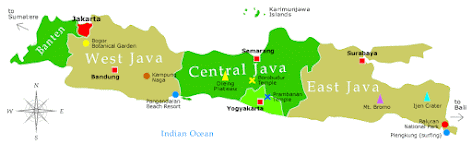
In accordance with Perhutani's long-term plan, and in line with the company's business development plan, Perhutani has allocated a forest area of ​​116,372 ha or around 4.7% of Perhutani's total area in Java (2,445,000 ha) as a potential area for biomass plant development spread across 13 KPH (Forest Management Units) in Central Java, East Java, West Java and Banten provinces.

Throughout the Perhutani area, there are potential areas that have unproductive forest stands (open land or reduce forest potential, or tend to be unproductive in the long term) covering an area of ​​308,000 hectares, spread across 57 KPHs. This area is divided into 15% in Central Java, 34% in East Java and, 51% in West Java and Banten. Based on the unproductive area, approximately in 27 KPHs it is calculated to be around 229,286 ha or 74% of the total potential area for Biomass Energy Plantations.

Hundreds of thousands of sawdust are currently used for PLN's cofiring program in Java, disrupting the supply of raw materials for wood pellet factories. This is why the production of wood pellets from sawdust taken from the sawmill industry or wood industry waste in Java for large-capacity wood pellet production will be at great risk of disrupting the supply of raw materials. So that the wood pellet factory in Java can run well if the availability of raw materials can be maintained and this can only be realized in two ways, namely first using its own raw materials, this can be done by sawmills and wood processing industries that utilize their own waste for wood pellet production, and second with raw material sources from energy plantations. The area of ​​land that can be used for energy plantations as described above is very potential for a source of raw material supply for large-capacity wood pellet production on Java Island and the availability of supporting facilities on Java Island which are more complete and better is an additional driving force.

Sunday, July 7, 2024

Large Capacity Wood Pellet Production Cannot Be Done on Java Island?

Raw materials are a vital aspect of a production activity. No raw materials means no production. Likewise in the wood pellet industry. The availability of raw materials is absolutely necessary for the continuity of the wood pellet business. To maintain the supply of raw materials, wood pellet factories must have reliable sources of raw materials. Currently, most or even all wood pellet factories on the island of Java rely on sources of raw materials for wood pellet production from wood waste, especially sawdust from sawmills and wood processing industries. 

Currently, coal-fired power plants in Java are running a coal cofiring program with biomass to reduce carbon dioxide emissions or decarbonization. The use of coal in these power plants will be reduced while the use of renewable energy, especially biomass, is increased. The biomass currently used for cofiring is sawdust with a volume of up to hundreds of thousands of tons per year. A very large amount. Wood pellet factories that use sawdust as raw material must compete with the cofiring program in these power plants. This competition increases the price of sawdust because the supply remains the same but demand increases. Disruptions in the supply of raw materials in these wood pellet factories result in disruptions in production and automatically their business aspects.

With these conditions, large-capacity wood pellet production in Java Island becomes less attractive. In fact, the portion of biomass use, especially sawdust, will continue to increase along with the decarbonization program to achieve net zero emissions by 2060. This is increasingly burdensome for wood pellet factories that rely on raw materials from buying sawdust. Wood pellet factories in Java can run well if the availability of raw materials can be maintained and this can only be realized in two ways, namely first using their own raw materials, this can be done by sawmills and wood processing industries that utilize their own waste for wood pellet production, and secondly with raw material sources from energy plantations. Energy plantations that are specifically dedicated to wood pellet production will be able to maintain the stability of the supply of raw materials for wood pellet factories. Wood pellet factories can partner with Perhutani for the second point above.

Sunday, March 10, 2024

Turning on Indonesia's “Green Battery”

With its position on the equator so it has a tropical climate, it will receive sunlight all year round. Energy from sunlight should be utilized optimally in the current era of decarbonization. So that solar energy can be used at any time, this energy must be stored. This is like a battery mechanism for storing energy, so that the energy does not just pass through and disappear. Storing and converting solar energy has been done naturally since life existed, namely in plant biomass. With photosynthesis in plants, solar energy with water and CO2 is converted into biomass in the form of wood, fruit, leaves and various parts of these plants as well as O2 for us to breathe. Solar energy does not just pass and disappear but is stored in the plant as an energy source or "battery" that can be used at any time.

With this paradigm, of course efforts to maximize energy storage in "green batteries" must be maximized as an effort towards low or carbon neutral fuel. With the largest land area in Southeast Asia, of course efforts to maximize "green batteries" become more important and strategic. The use of fast growing species and short rotation coppice will be very suitable for converting and storing solar energy. Moreover, in tropical climates the wood harvest is also faster than in sub-tropical countries or cold areas, due to the abundance of solar energy.

The potential land area for making "green batteries" is very large, reaching tens of millions of hectares. In addition, reclaimed land reaches millions of hectares, more details can be read here. The "green battery" is in the form of an energy plantation whose wood is used for the production of wood pellets. In the form of wood pellet products, biomass energy becomes easier to store and use at any time. Unlike intermittent solar or wind or water power plants, biomass fuel in the form of wood pellets is not like that. It can be used according to your request and desired target, making it more practical and reliable. The reasons why the "green battery" in the form of energy plantations has not been developed can be read here.

Apart from "green batteries" from energy plantations, "green batteries" can also come from production forests in general. In these production forests, the main product is wood which can be used for various purposes such as building wood, furniture, plywood, flooring and so on. The wood industry waste is then used for the production of wood pellets. Wood pellet production basically has to use wood waste or wood that worth as wood waste such as wood from energy plantations, so that the wood pellet industry is economical and profitable. It is estimated that there is 25 million tons/year of wood waste that can be used for the production of wood pellets In Indonesia. And specifically from the plywood industry alone, wood waste is estimated to reach 5 million tons every year.

It is estimated that the Indonesian wood industry can actually be optimized until its production capacity reaches 91 million cubic meters per year, but in reality in 2022 the forest products industry will only be able to produce 42.19 million cubic meters per year or around 48.7% of its optimum capacity. There are 3 factors that cause the low realization of the wood industry, namely, efficiency of the wood industry, problems related to raw materials and market availability.

Research on batteries continues along with the global decarbonization trend and the energy transition is a necessity to achieve the decarbonization target. Large capacity batteries so that electrical energy produced from renewable energy plants such as wind and solar can be stored is the target of this research. This research costs a lot of money and takes a long time, it is estimated that in the next 20 or 30 years, these large capacity batteries will be available. Meanwhile, currently most power plants use fossil fuels, especially coal. Energy transition efforts at power plants can be carried out by substituting coal for wood pellets. Moreover, as a tropical area, biomass energy can remain as the main energy in the future non-carbon era.

Indonesia's "green battery" must be activated and developed, because apart from its function as an energy source, the "green battery" is also a CO2 storage or carbon sink. As long as the amount of wood harvested is smaller or the maximum is equal to the growth of the energy plantation or "green battery", the amount of CO2 absorbed by the plants does not decrease or the CO2 released into the atmosphere does not increase, and the same goes for production forests in general. When at a certain age the growth becomes saturated and begins to decline in CO2 absorption, meaning that the forest cannot permanently store CO2 in a fixed volume, so it needs regeneration/replanting. Meanwhile, in energy plantations, due to the characteristics of the plant species, regeneration/replanting is not necessary every time it is harvested, but can be done decades later. And furthermore, the use of carbon capture and storage (CCS) technology in power plants that use 100% of their fuel from wood pellets means that the CO2 produced is not released into the atmosphere or is carbon negative, which reduces the concentration of CO2 in the atmosphere.

Tuesday, March 5, 2024

Why Has Large Capacity Wood Pellet Production from the Calliandra Energy Plantation Not Been Realized?


As a tropical country that has the largest land area in Southeast Asia, the potential for fuel or renewable energy from biomass, especially wood pellets, is very potential and promising. To maintain the stability of large capacity production volumes and their continuity, wood pellet production must use raw materials from energy plantations or biomass plantations. Energy plantations from short rotation coppice & fast growing species from legume groups such as red calliandra (Calliandra calothyrsus) have been a concern for quite a long time, but why has this large capacity wood pellet production not yet been realized or has no industry realized it? Below could be two main factors causing this:

1. Quality of calliandra wood pellets

The characteristics of rotational crops and fast growth of the legume group are that they contain quite high levels of potassium and sodium (K+Na) in their wood. Potassium has the property of having a low melting point so it will be problematic for heat exchangers in power plant boilers in general. The high potassium content makes its use unsuitable for power plants in general, namely those that use pulverized combustion (PC). Red calliandra (Calliandra calothyrsus)  in particular is the same, so with a large production capacity, the quality of export-oriented wood pellet products needs to be improved by reducing the content, especially potassium and sodium (K+Na). 

The process of reducing K + Na, which is part of the ash content, is carried out using a leaching / washing process. This unit needs to be added to the wood pellet production process from red calliandra. Apart from making calliandra wood, the raw material for wood pellets, this process becomes wetter, it also produces waste water. This will increase the production costs of red calliandra wood pellets.

Although it is possible that the leaching/washing process was not carried out so that the resulting wood pellets still have a fairly high K + Na content, they still have the potential to be used for certain types of power plants, such as those with fluidized bed and stoker technology. However, this type of power generation technology is not as common as the use of pulverized combustion (PC) technology. So that market acceptance for the production of calliandra wood pellets is large or can be used in all types of power plants, the leaching/washing process should be carried out.

2. Utilization of only certain parts (partial) of the plant, and not comprehensive (whole tree utilization)

When it only use wood for wood pellet production, it means that only part of the plant is used (partial) or there are other parts of the plant that are not used, namely the leaves and flowers. In fact, these two parts of the plant will be able to maximize income or profits which will provide the impetus to accelerate the realization of large capacity wood pellet production from the energy plantation. The additional costs incurred for the leaching/washing process will be compensated by the income/profits from leaf processing and flower utilization.

Calliandra leaves which have a high protein content are processed into animal feed, especially into flour or also pelleted into feed pellets. Meanwhile, the nectar from flowers is used as food for honey bees in beekeeping to produce calliandra honey. By maximizing the potential of all parts of the plant (whole tree utilization) of calliandra, various products (multiple products) are produced so that the driving force to accelerate the realization of large capacity wood pellet production from energy plantations becomes stronger.

One form of gratitude for Allah SWT's blessing in the form of a country with a tropical climate with vast land is to use it in an environmentally sound and sustainable manner. Tropical areas like Indonesia are a "paradise" for biomass production, especially for biomass energy (bioenergy) in the form of wood pellets. Optimizing this potential, especially with large capacity production of wood pellets and additional products, could be a boon and a blessing for prosperity as well as a solution to global climate problems (carbon neutral fuel). And basically business judgment is also needed from the entrepreneur's side so that the entrepreneur has the courage to decide to execute this business opportunity.

Monday, October 23, 2023

Export-Oriented Large Capacity Wood Pellet Production

Availability of raw materials and market control are the two absolute main things that must be fulfilled so that the wood pellet production business can be sustainable. Investing in expensive equipment will be useless if the two things mentioned above are not met. In large capacity wood pellet production, the quality of the production equipment used is very important. The production goal of achieving large capacity will be achieved if it is carried out with an efficient and safe production process so that production costs are low. Production equipment that is capable of working non-stop 24 hours, easy operation and maintenance with good performance is vital. Regarding raw materials, apart from continuous availability, there are 2 important things that need to be considered, namely the consistency of raw materials and cheap logistics to the location of the wood pellet factory.

Mapping the potential of raw materials needs to be done well, as well as the wood pellet market. Wood pellet raw materials from one type of wood (single material) are certainly easier than mixed raw materials from several types of wood. This is related to the composition of the mixture, which of course is not a problem if the raw material is from one type of wood (single material) which is homogeneous. To strive for homogeneous raw materials, this can be done by creating energy plantations, while mixed raw materials can be taken from several wood processing sources such as sawmills and so on. Energy plantations that can be multifunctional so that they provide many benefits. This can be done by maintaining a balance between wood productivity for wood pellet production, environmental functions in the form of maintaining erosion and groundwater, and the volume of wood harvested must not exceed the growth rate or be at least the same (carbon balance) and the use of by-products for additional revenue such as utilization leaves for animal feed and honey from beekeeping.


Meanwhile, from a market aspect, a number of requirements also need to be met so that sustainable transactions occur. Apart from technical factors in the form of wood pellet specifications and production volume, non-technical factors such as sources of raw materials related to environmental sustainability are also often required nowadays. Users of wood pellets abroad, especially power plants, are in decarbonization efforts through cofiring programs with coal. Sustainable decarbonization efforts usually require environmental certificates such as FSC regarding the source of the raw materials used. This is to prove that the renewable fuel chain, especially wood pellets, indeed complies with mutually acceptable environmental sustainability standards. There are certain countries that impose long contracts for the purchase or procurement of their wood pellets, but there are also those that choose short-term contracts. The typical buyer or market for wood pellets also needs to be given special attention.

Thursday, August 10, 2023

Post-Mining Reclamation with Energy Plantation Revegetation for Wood Pellet Production

Revegetation is one option for post-mining reclamation. The choice of revegetation options also has certain considerations apart from environmental, social and of course economic or business aspects. The vision for the future in the form of sustainability is an important factor for post-mining reclamation, especially the revegetation.

Revegetation with palm oil plantations is one of the most popular revegetation options. This is because palm oil product (CPO) and their derivatives sell well in the market. However, the land requirements and operational costs for palm oil plantations themselves are not easy and cheap. The choice of revegetation with other plants should also be considered.

Creating an energy plantation from short rotation crops (short rotation coppices) can be considered. This is because land and operational requirements are much easier and cheaper. Even in the long term the use of the land will also improve the quality of the land. Products from energy plantations will also become a world trend and the current global climate solution, namely wood pellets. Meanwhile, by-products in the form of animal feed (feed pellets or hay) and honey from beekeeping are no less interesting by-products.

The extent of post-mining land, which reaches millions of hectares, is of course a very attractive potential for the development of these energy plantations. The need for bioenergy, especially wood pellets, is also getting bigger along with the global decarbonization program. Likewise the need for animal feed which is a link in the chain of human food needs, especially meat or protein. Efforts to increase land use value, prevent natural disasters, absorb employment and economic benefits are the thrust for revegetation reclamation with the energy plantations.


Tuesday, January 10, 2023

Wood Pellet Production: With a Rotary Dryer or Belt Dryer?

Air quality is an important factor in environmental health. The better the air quality, the better the environmental quality. Maintaining clean air quality is sometimes not something that is easy and cheap, especially for industry players. The higher the air quality standard used, the greater the effort and cost incurred.

In the wood pellet industry as an example, especially in the use of dryer. Almost all wood pellet industries in Asia use rotary dryer and almost none use belt dryer. Meanwhile, in Europe belt dryers are widely used because of lower emission than rotary dryers. In addition, belt dryers also have higher efficiency and can work at lower temperatures than rotary dryers. With a number of these advantages, however, belt dryer are also more expensive compared with rotary dryer.

Basically, rotary dryer can also have good performance, especially in terms of emissions if they are designed and operated properly. The use of high-efficiency dust collectors such as cyclones and bag filters can achieve high emission quality standards. However, the higher the efficiency of the dust collector, the higher the power required.

So the choice used actually depends on the expected air emission target. Europe and US/Canada generally have higher air quality standards than countries in Asia. This makes the emission aspect an important concern for them. Meanwhile, in terms of wood pellet production, the priority aspect is efficiency, so that with good performance the dryer can produce dry wood powder product that are suitable for feeding into pelletiser. The quality of the wood pellets as the final result is also very dependent on the quality of the dry powder product from the dryer. Meanwhile, in terms of safety, the high concentration of dust particles so that they can accumulate in a number of places in the wood pellet factory also has a greater potential for fires to occur.

Wood Pellet Export Opportunities
The lack of supply of wood pellets in Europe due to the Russia-Ukraine war caused wood pellet producers from Southeast Asia and North America to try to seize this opportunity. Production of wood pellets from Russia is estimated at around 3 million tonnes/year which previously filled the European market is now banned, so as a result of this ban the stocks of wood pellets in Europe have decreased drastically. The large demand and lack of supply will naturally push up prices, especially when coupled with increases in other energy commodities, so that the price of wood pellets continues to increase. In fact, because of the high price of wood pellets in Europe, wood pellets from Vietnam, which previously planned to be exported to Japan, were diverted to Europe.

It is also predicted that this uncertain condition will not recover in a short time. In 2021 Europe leads the production of wood pellets with production reaching nearly 20 million tons or around 48% of global production, while consumption of wood pellets reaches 24.5 million tons. Meanwhile, according to Hawkin Wright's data for 2020-2021, the growth in global demand for wood pellets has reached 18.4%, while supply or production growth is only 8.4%. Indonesia should have a great opportunity to become a major wood pellet player with its potential. The wood pellet production can be exported to Europe to cover the shortage of supply and in general to meet global demand.

Biomass Boiler Testing and Selection of Suitable Biomass Fuel

In line with the trends toward decarbonization and sustainability across various sectors of life, particularly in the processing industries ...