Tuesday, August 21, 2018

Satay and Processed Lamb Meat anytime!

Eating satay and processed lamb meat products is delicious, so how delicious if you can eat it often. Some of our people can enjoy these dishes only during Eid al-Adha. Of course this must continue to be improved because the average meat consumption of the Indonesian population is still low. Even though protein is one of the essential nutrients we really need. And for that lamb meat is the best meat despite many myths that oppose it. In Al Qur'an Surah 6: 143-144, eight pairs of animals (4 pairs) are two (a pair) of sheep, a pair of goats, a pair of camels and a pair of cows. Of the series of livestock mentioned in the verses above, sheep are first mentioned, then goats, camels and cattle.
The rules in the Qur'an, the first one has virtue over afterwards. Now, this is where sheep have superiority compared to other livestock mentioned in the verses, although all these animals are halal meat eaten. Other indications of the virtue of sheep can also be found in the Qurban event, namely when Prophet Ibrahim was ordered by Allah SWT to slaughter his son Ismail, then by Allah SWT saved Ismail and replaced him with a large sheep. Then we commemorate this event every year and become the Shari'a of Qurban on the Eid al-Adha feast every year in 10 Dzulhijah. Besides that, all Prophets are sheep shepherd, is another indication that lamb is the best meat and the sheep that are grazed are the best treasures

The next question that can arise is is there another guide more specific about diet, especially protein? The Qur'an also indicates the source of protein from large livestock occupies the largest portion of poultry and fish. The source of animal protein that is from large livestock is revealed in at least 7 verses or 64%, from fish revealed in 3 verses or 27% and from poultry revealed in 1 verse or 9%. So that the fulfillment of protein needs is the priority of large livestock, especially those that are grazed, because in addition to producing cheap protein, it also fertilizes the land for various human needs.
So that satay and processed lamb meat can be eaten anytime and anywhere, food innovation is needed. We are certainly familiar with various canned foods so that they can last longer such as gudeg, rendang and so on. Of course this is also very possible for lamb. It is also to further promote the best meat, so that when it is called meat, the community will later associate it to lamb instead of beef or chicken as happened today. If the conditions are like that, then the sheep farming industry will grow rapidly. Sheep farming can be integrated with various large plantations and for more details can be read here.

Large Plantations and Large Farms

Fertilizer problems or soil fertility have always been the main topic or discussion for a large plantation business. This is very reasonable because maintaining productivity of crops can only be done by maintaining soil fertility or providing adequate fertilizer. For this reason, the budget for the supply of fertilizer is always a large portion of the plantation business. Then the condition leads to the question of how to make efficiency or save the fertilizer budget? Of course many techniques can be used for this purpose, but basically the selection or use of fertilizer that is appropriate and the effectiveness or absorption of fertilizer for plants is a key success factor in maintaining soil fertility. Let's try to answer the main question above.

When chemical fertilizers are increasingly abandoned because of their effects which damage the environment, there is no other choice but to use organic fertilizer. In large plantations such as oil palm plantations, basically there are also many biomass wastes from palm oil mills that can be used as fertilizer, such as fronds and palm oil trunks. But when these ingredients are also processed to become a particular product, and also the composting process of fibrous wood species takes a long time, the best choice is with organic manure. The question is where do you get livestock manure compost for the oil palm plantation? Actually there are more sources of organic fertilizer or compost that can be produced from palm oil mill effluent, namely from liquid waste. If the palm oil mill has an anaerobic digester, the biogas residue from the sludge can be used as organic fertilizer. At present there are not many palm oil mills that process liquid waste with the biogas unit, with the reason that the unit is considered expensive.

The history and experience of our predecessors before the use of chemical fertilizers can be used as a reference for this. At that time they were able to meet the fertilizer needs of their agricultural businesses, namely by sheep, goats, cattle and buffalo farming. The livestock manure is used for agricultural fertilizer and agricultural waste is used for animal feed. The basic pattern can also be developed for large plantations with several adjustment techniques to improve efficiency. Technical applications in the field that can be done, namely large plantations must cooperate with large farms or even ideally have a large farm to meet the needs of fertilizer for its plantations. For example, an oil palm plantation that has 2000 hectares of plantation area, 100-200 (10-20%) hectares are used for sheep farming. The sheep breeding, not by just being caged, but grazing in the fields of pasture.
Why is sheep farming done in the pasture fields? This is because by grazing the cost of feed can be suppressed very large or the business becomes very economical. The biggest cost component of livestock business is feed. If the availability and supply of feed can be overcome then the other components become easier. The pasture is in the form of grass and shade trees. Making grass always available is the essence of the business, even it can be said that the pasture is grass farming itself. Rotational grazing is the best grazing technique at the moment. When the grass is fertilized with sheep dung during the grazing, the dirt produced when in the cage can be used for fertilizer on large plantations such as the oil palm. The biogas unit can be used to optimize the utilization of dirt from the cage.
Basically, sheep farming can also stand alone and also be profitable. Therefore, sheep farming can be done separately. In the case when an energy plantation is used for the production of wood pellets, it is still constrained by various things such as the presence and supply of electricity, so the farm business can still be run properly. The production of large-scale wood pellets in various regions in Indonesia is currently still constrained due to the electricity supply. This will certainly hamper the growth of the wood pellet industry so there needs to be another way to overcome this, which insha Allah will be discussed later.
With this concept, not only increases plantation and meat production, but also a complete closed cycle business that is environmentally friendly and sustainable. Honey bee farming can also be added for optimization because obviously the bees besides helping the pollination process will also produce honey, a superior product of high economic value. Various food problems, insha Allah, can be overcome with this concept. This is because from the production side it can be made very efficient with the 2 biggest cost components being reduced significantly by fertilizer and animal feed with the integration of large plantations and large farms.
Although it has used compost from livestock manure, there are still more techniques that can be applied to improve fertilizer efficiency by using biochar. With biochar, the fertilizer will be retained in the biochar pores so that slow release makes it effective for fertilization. In addition, biochar will also hold the fertilizer from leaching due to high rainfall, so that the use of fertilizer can also be saved significantly. Biochar will also be the home of microbes to decompose organic matter into nutrients needed for plants. So, in short, with biochar, the productivity of plantations is high, but the use of fertilizer is minimal because it is efficient, especially when fertilizer is produced from the farm itself. This biochar can be produced by processing the plantation biomass wastes by pyrolysis. For more details about pyrolysis can be read here.

Saturday, August 4, 2018

Activated Carbon For Gold and Silver Industries

Initially wood charcoal with a surface area around 200 m2 /gram was used to extract gold and silver from the solution. As the development of the activated carbon having a surface area of  1,000 m2 / gram is used for that, of course, also with the increasing efficiency of the extraction. It encourages the production of activated carbon throughout the world. Coconut shell is the favorite material for active charcoal production today, and palm kernel shell is likely to be the next priority.
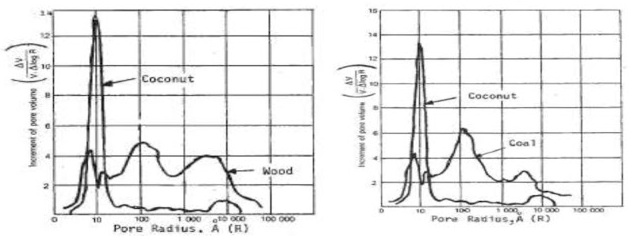
Activated carbon has a large surface area because of the large number of pores from its surface. The pores are intentionally made to improve the efficiency of adsorption. The more pores are formed the more activated carbon surface area. Based on the size of these pores are divided into macropore, mesopore and micropore. Macropore is the largest pore size located on the outer side or surface of activated carbon and as the entrance material will be adsorbed then through mesopore medium to last to the micropore. Micropore is the last terminal of material that is adsorbed. Micropore pore size ranges from 10 angstrom, mesopore 100-1000 angstrom and macropore larger 1000 angstrom (1 angstrom = 1e-10 meter). The raw material or activated carbon material, the choice of activation process used and the operating conditions that will determine the surface area of activated carbon consisting of macropore, mesopore and micropore. Hardness and density of materials are also often important considerations given the use of activated carbon itself, for example a number of extractions are carried out by stirring and there are also column operations.
The specific use of activated carbon for the application of certain materials or industries usually also requires certain specifications. Activated carbon used in fluid fluids will be optimal when specially designed under these conditions, as well as those used in gas fluids. The size of the target material and its extraction methods will determine the technical specifications of the activated carbon. Likewise in gold and silver, which extraction with stirring and column operations. So the raw material of coconut shell is generally still the main choice because it has a high level of hardness and density so that abrasion resistance. And so too the palm kernel shells can also be used given the high level of its hardness. So the activated carbon used must meet the criteria of quite hard, active enough and appropriate particle size. In the gold extraction activated carbon gold produced by the activation of physics (steam activation) is used. Rotary kiln is an activation equipment with raw materials such as coconut shell, while fluidized bed appliance and multi hearth kiln are commonly used for activated carbon from coal.
Activated carbon basically can be made from various materials that contain carbon (carbonaceous material) such as coal, coconut shell, palm kernel shell, wood, bamboo, heavy oil and even bone. Each material, type of activation and operating conditions of the process determines the quality or characteristics of activated carbon. Activated carbon from coconut shell has many micropore, while activated carbon from wood is dominated mesopore and macropore (micropore only has small portion) because wooden structure also more open. For activated carbon from coal micropore distribution, mesopore and macropore are almost evenly distributed. Based on the above characteristics, activated carbon coconut shell is widely used to adsorb small molecules of gas and liquid. Its uses such as gas masks, solvent recovery and gold recovery. While activated carbon from wood for the application of large molecules such as adsorbing organic dyes in the industry. While activated carbon from coal for the adsorption of organic molecules with varying sizes and their use is generally for drinking (potable) water treatment and wastewater treatment.

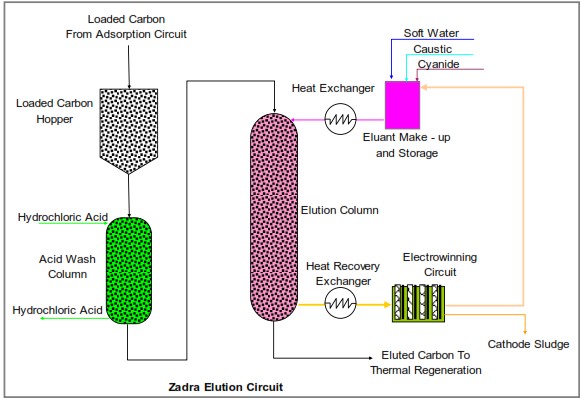
After gold or silver is adsorbed into the pores of activated carbon, the next step is to pick or remove (delution) from activated carbon. There are 2 technologies commonly used for this stage namely AARL elution process and Zadra elution process. The difference between electrowinning is an integral part of the Zadra circuit but a separate part of the AARL circuit. Zadra dominates in North America while AARL dominates in Southern Hemisphere, where the technology was originally developed. Which is the best? Operators factor and device performance more decisive. The 10 largest gold producers today include China, Australia, the United States, Russia, South Africa, Peru, Canada, Ghana, Indonesia and Uzbekistan.

Monday, July 30, 2018

Production of Biophenol, Bioformaldehyde and Wood Adhesive from Pyrolysis Liquid Products

The byproducts of biomass (slow) pyrolysis are liquid and gas products. The liquid products consist of biooil and biomass vinegar (pyroligneous acid). Biooils can be directly used as fuel with a particular burner, or can also be upgraded to the vehicle fuel. Meanwhile, if used for non-energy products, can be used for the production of green chemical or renewable chemicals such as BioFormaldehyde and wood adhesive. While the aqueous phase of pyrolysis liquid product that is biomass vinegar (pyroligneous acid) can be used for feedstock biophenol production. Previously biomass vinegar has been known for various uses such as latex coagulant, anti-termite and fertilizer. While the biophenol production process scheme of biomass vinegar as follows.

Global consumption for phenol currently reaches 20 million tons or worth 20 billion US dollars (280 trillion rupiah). Renewable phenol or biophenol can substitute phenol which has been produced based on petroleum. Excess heat and excess syngas from the pyrolysis process can be used for the production process of the biophenol as energy sources. An integrated and efficient production unit will produce highly competitive products, such as the pyrolysis process which is primarily charcoal, and from its by-products made derivative products that are desperately needed today.

Set Up Wood Pellets Production in Southeast Asia

Korea and Japan are the main destinations of the wood pellet market especially for producers in Southeast Asia. Korea with Renewable Portolio Standard (RPS) policy, while Japan with feed in tarrif. So the estimated needs of wood pellet of both countries reached 10 million tons in 2020 and so on. Currently most of the supply of wood pellets in Japan from Canada and for Korea in supply mainly from Vietnam. In 2019 and beyond in Japan will be importing wood pellets in large quantities because a number of power plant facilities began to operate.

Based on a number of analyzes, one of them can be read here, there was a decline in the production of woody biomass in Southeast Asia from 815.9 million tons (16.3 EJ) in 1990 to 359.3 million tons in 2020 predictions. This condition occurs due to deforestation and excessive logging (including illegal logging). The destruction of the forest is certainly a cause of concern for the disaster also needs to be solved solution as soon as possible. Reforestation can be done as a solution to forest destruction. There are two types of tree groups for the solution of fast growing species and slow growing species. Determination of both types of trees in accordance with the vision and mission of the forest area concerned. In addition, there is also a production forest area that can be used for wood production for energy or especially wood pellet production. Rapid rotation trees such as calliandra are suitable for production forest areas or industrial plantations.
The production of wood pellets from the above energy forest or energy plantation in an industrial timber estate is an ideal concept. With such energy plantation even the supply and continuity of raw materials will be more secure and sustainable because of the wood harvested from the planted plantation itself. Production capacity can also be large in proportion to the size of the plantation. Countries in Southeast Asia have generally still have a large land and are in a zone of tropical climate so that its development potential is very strategic. The tropical climate plus high rainfall makes the growth of trees in the energy plantation to be optimal. Subtropical climates, although they can produce wood from energy plantations but will take longer, and even less rainfall. 1 year time in eg Indonesia will be equivalent to 4 years in subtropical countries for the production of woody biomass from the energy plantations.
Southeast Asian countries have a strategic position to supply wood pellets to Japan and Korea. There are at least two things underlying, namely: first, the position or location of Southeast Asia adjacent to Japan and Korea as its market destination. Second, the availability of raw materials in the form of abundant biomass in the area, even with the location close to the equator so that the tropical climate with high rainfall that supports the growth of plants as a source of biomass. In general, more than 50% of Southeast Asia is overgrown with forests (except Singapore and Brunei Darussalam). Forests produce various types of wood. Forests in Southeast Asia consist of several species, including tropical rain forests (equatorial), tropical monsoon forest, forest, mountain forests, coastal forests, and swamp forests. Most of the forests that grow are tropical rain forests. Then how the characteristics of the tropical forest? Here are the characteristics of the tropical forest:
1) The leaves are green all year round.
2) The distance between trees tight and the thick leaf cover.
3) There are layers of plant species.
4) Underage is rarely encountered.
5) Many parasitic and creeping plants
And here's a description of the potential for biomass in Southeast Asian countries:

-Indonesia
Indonesia has the largest forest among the countries in Southeast Asia, but it also has the largest area. Forest area reaches about 60% with mostly outside Java. Java Island is the most populous island with 60% of Indonesia's population live there, seen the most luminous island of Java when photographed with satellite at night. There are 80 million hectares of production forest that can be used for various industrial tree crops, especially energy forests or plantations for wood pellet production.

-Malaysia
Currently, it is estimated that 59% of Malaysia's land is still in the form of forest. Efforts to repair forest destruction due to erosion continue to be done Malaysia state. Various high value added crops continue to be pursued, including how to generate faster profits such as rattan for intermediate harvest before the main harvest takes longer. Energy forests or plantations that can be harvested with fast time, without replanting up to tens of years will be an attractive option.

-Thailand
In 1961 an area of ​​56% of Thailand is a forest area. But in the 1980s the forest area had been reduced to less than 30% or vanished as much as 130,000 km2 (26%). Hardwoods such as teak have dominated the forest timber products. Efforts to restore the forest area, while reducing the pressure of forests for deforestation are urgently needed. Making  energy forests or an plantationsfor wood pellet production will provide a solution to the problem, as it will drive a forest-based and sustainable economic sector.

-Vietnam
The topography consists of hills and dense wooded mountains, with lowlands covering no more than 20%. Mountains account for 40% of Vietnam's total area, with small hills contributing 40% and tropical forests 42%. Energy plantations or forests will also be an attractive option for sustaining forests and driving the economic sector.

-The Philippines
The Philippines is an archipelago country that has many volcanoes as a series of Pacific Sirkum Mountains. The fertile soil conditions strongly support agrarian activities covering agriculture (in the form of rice, corn, and abaca or manila fiber), fisheries and forestry (almost half or 40% of land area is forest). In addition, the river is short-flow with a heavy flow can be used as a source of energy. Energy plantations or forests for wood pellet production will also be attractively developed even with the supply of electricity from hydroelectric power, thereby completely free of fossil fuels.

-Cambodia
Cambodia actually has great forestry potential. Recorded in 1969 forest area in Cambodia more than 70%, but in 2007 to less than 5%. The country is considered one of the world's highest deforesting countries. More than 25,000 square kilometers of forest disappeared during that time. Reforestation efforts continue to be pursued. Energy plantations or forests can be one solution to reforestation while suppressing deforestation.

-Laos
The forest in Laos is also very wide which covers about half the country. The forests enter tropical rainforest, bamboo forest, and mixed forest. About 70% of the Laos region is mountainous and there is Mount Bia as high as 2,819 meters which is the highest mountain in the country. However, these forests are in danger because of excessive logging in areas such as the South and Southeast. In early 1993, the Lao government proclaimed 21% of the country's territory as the National Biodiversity Conservation Area (NBCA), which may be developed into a national park. Once completed, it is expected to be the best and largest national park in Southeast Asia. Energy plantations or energy forests can be an ongoing solution to reforesting bare forests while creating jobs with wood pellet production.

-Myanmar
Myanmar has a varied landscape from the lowlands to the mountains. The number of large rivers and volcanoes cause the soil conditions are very fertile. It is very supportive for agrarian activities such as agriculture, plantation, and forestry. Almost 52% of the area is still in the form of forests that produce a lot of timber. Teak is primarily the main product of forest wood in Myanmar. Energy plantations or forests with rapid rotation for wood pellet production will be an attractive option. This is because to produce teak takes decades, while wood from the energy plantation for wood pellet production only takes one year and can be harvested continuously throughout the year.
The processing of biomass into wood pellets is essentially compaction (densification). After the particle size and dryness level are appropriate then the biomass can then be pelleed. If the biomass does not have the appropriate size and level of dryness then it needs to be prepared with a certain pretreatment so that it can reach the condition. A sizing and drying equiment is commonly used to achieve the condition. Sizing equiments are usually chipper and hammer mill. The two stages are reduced in size to ensure the desired particle size. An appropriate particle size makes the pellet density to be of the expected standard.

Rotary dryer or drum dryer is a drying equipment commonly used to achieve the expected dryness level, which is about 10%. Too dry or too wet will result in the quality of resulting pellets. When the raw material is too dry the pellet is not formed but if the raw material is too wet the pellet surface will crack and break easily when cooled. The shape and size of die on the pelletiser also vary according to the type of wood used. To get optimal result that almost all raw materials can be converted into pellet and only very little still remain in the form of powder (fine), then the size and shape of the die must be in accordance with the characteristics of wood powder or raw material.

Once out of pelletiser, wood pellet then cooled so that it becomes hard and has a smooth and shiny surface. Cooling is also done gradually so that the pellet is not cracked and broken because of a drastic reduction in temperature. Counter current type of cooling is commonly used for cooling. With the counter current mechanism the cooling process can run gradually so that the quality of pellet is maintained. After cooling, wood pellets are then sieved to separate with the dust and last stored or in packing for subsequent ready for sale especially export market.
Sunday, July 29, 2018

Set Up Wood Charcoal Briquette Production in ASEAN Countries

ASEAN countries have large forests and various forest resources. However, there is a decrease in some countries due to irregular logging in some countries. This is why sustainable forest management is needed to maintain the biomass of forest resources. Indonesia has the largest forest area, but has declined since 1990 primarily due to illegal logging and forest fires. Malaysia has the highest number of biomass and forest growth in area ratio, while Thailand is the lowest. This could also be due to higher rainfall in Malaysia compared to other ASEAN countries, which is 2,875 mm / year, with an world average of 900 mm / year and Indonesia 2700 mm / year. For more details can be seen in table below. Indonesia and Malaysia mainly produce sawn wood and plywood, while Thailand is wood chip and particle board. Vietnam produces many sawn wood, while Cambodia and Laos consume lots of logs as fuel.
Wood charcoal briquette or sawdust charcoal briquette have a very high market especially in Middle East, Saudi Arabia and Turkey. These countries use sawdust briquette charcoal to bake the meat, especially the lamb which is a favorite food there. The production of sawdust briquette charcoal uses logging residues and industrial wood residues. This should be the extent of forest and wood processing industries comparable to the sawdust briquette charcoal industry. The abundant logging wastes are usually the tops of small diameter trees and branches. The logging waste is about 100% average for the production of the logs themselves, so that the amount is huge. Sabah, Malaysia and Kalimantan, Indonesia produces many of these logging wastes at very cheap prices.
As for waste wood processing industry is usually in the form of sawdust, and wood pieces both board and round wood. It is estimated there are 1600 sawmills and 120 plywood factories in Indonesia. The raw materials of the plywood industry are originally from natural forest, but as demand continues to increase the supply of natural forest timber decrease so that it shifts with wood from the planted trees. When using wood from natural forest, the diameter of wood can be more than 70 cm and when using wood the trees planted wood diameter is only about 30 cm. Samarinda, East Kalimantan, Indonesia at first many plywood factories were operating but due to the declining timber supply of many of these factories which shut down production. The yield of plywood from raw materials is 50%, while the remainder becomes waste. Part of the waste is used for block board and packing material, but only about 10%, so 40% is still waste. 
While in Malaysia, the total volume of wood industry waste estimated 7.5 million cubic meters per year. The highest sawmill waste in Sabah, while plywood waste in Sarawak. Sawmill produces sawn wood products ranging from 40-65% and the remaining 35-60% are sawdust. While yield for ply wood ranged 50-60%, while 40-50% as waste. For the molding plant its yield is higher ie 70-74%, means waste 26-30%. Percentage of wood waste from 75% ply wood industry and 25% from saw mill industry. Utilization of wood industry waste is still not optimal, even just stockpiled and then burned because it is considered polluting the environment.

In Laos, there are about 200 wood processing factories (furniture, packing materials, flooring and doors) located mostly around Vientiane, the capital of Laos and only one plywood factory. Charcoal producers are scattered everywhere in the country due to high demand for households. The yield of the wood processing industry is about 60%, so that 40% is waste. Utilization of waste is also not optimal, such as sawdust just dumped just behind the saw mill.
Production of sawdust briquette charcoal (wood briquette charcoal) will be the solution for the utilization of such waste. Sawdust is the best raw material because it does not need size reduction and can be shorter production process. Whereas if the waste is still in the form of pieces of wood then it needs for size reduction first to the size of the particle like sawdust. After that if the wood powder is still wet (moisture content more than 10%) it is necessary for drying with a rotary dryer or drum dryer. Furthermore, after dry powder material is followed by briquetting and carbonisation process into sawdust briquette charcoal as the product. 

Heat Gasifier and Stirling Engine For Remote Villages Electric Solutions

Remote villages far from PLN's electricity network will find it hard to get electricity, especially those on small islands with limited populations. These remote villages are also generally left behind villages and still need special attention. Currently such villages are still very much found in Indonesia, ie 60% or about 50,000 villages, as a more real picture in Java with an average ratio of 3 out of 10 while in Sumatra the ratio is 7 out of 10 and Irian 9 of 10 villages enter left behind villages. One effort to give attention and develop the villages is by providing electricity for their various needs including access to information with the outside world. The availability of energy, especially electricity, also encourages them to be independent with various kinds of production.
Based on the above conditions so it takes small generators that can be operated in the remote villages. The concept of decentralization will be able to reach these areas. To run the plants easily also requires energy resources that abundant available in the villages and especially woody biomass in general is abundant in the rural areas. Even to get the supply of wood energy sources can also be done specifically for example by making energy plantations. Energy plantations with leguminoceae crops such as calliandra will be very effective and efficient to continue to maintain woody biomass supply at these powerplants. In addition, energy plantations is also very possible to be integrated with farms such as sheep and so on.

Gasification is a widely used technology for generating electricity from biomass or into a power gasifier group. Operational problems in gasification are usually on gas purification. Tar is the main impurity gasification unit so it needs frequent maintenance to keep the gas clean. The better the gas cleaning unit then the maintenance period is less frequent and vice versa. The better the unit will usually also be more complicated and more expensive. Internal combustion engines always need a clean fuel supply to be able to operate stably. Dirty fuel will disrupt the operation of the powerplant, such as crust and blockage in the combustion chamber and so on.
Stirling Engine Mechanism
Another alternative to the biomass power plant is with the stirling engine. Stirling engines have in common with the internal combustion engine that is an equipment or converter that produces mechanical energy which is then converted into electricity with a generator. The difference is stirling engine heat engine that converts heat into mechanical energy. While the heat production is done outside the engine, so the stirling engine can also be external combustion engine if the heat source comes from burning outside the unit. In this case so that gasification can also be used, but positioned as heat producer or heat generator used for by stirling engine. Gasifiers that use biomass to generate heat enter the heat gasifier group. The configuration of the heat gasifier is simpler than the power gasifier, this is because the heat gasifier does not need a complex cleaning and conditioning equipment such as gas power gasifier. Moreover, used is a type of downdraft gasifier that the amount of impurity is minimal.
Power Gasifier Diagram
Heat Gasifier Diagram
Stirling engines just like gasification is a not new thing. Both technologies are widely used when there is an energy crisis a few decades ago. At that time both technologies are widely used to move various transportation facilities and also power plants. When current conditions of fossil fuel use awareness increasingly have to be reduced or even should not use fossil fuels or due to environmental aspect pressure then renewable energy becomes an option and technologies such as gasification and stirling engines reappear. Specific factors for the condition of Indonesia are also a driving force namely a large area and still many are in remote areas while the supply of fuel especially petroleum based fuel is difficult to obtain while abundant woody biomass and very easy to obtain. Simple, easy-to-operate, efficient and low maintenance biomass power plant solutions will be Indonesia's electrical solutions as well as environmental solutions.

Reject (Non-Standard) Coconut Fruit for Bioavtur / SAF Production

The international civil aviation organization (ICAO) has included non-standard coconuts on the ICAO positive list – ICAO document – ​​CORSIA...